Investing: Greece is the word

Greece is the Word

The world’s markets and media financial pages have been consumed by a single issue in recent weeks—the stand-off between debt-laden Greece and its international lenders over the conditions of any further bailout. For investors everywhere, both of the large institutional kind and individual participants, the story has been fast-paced and difficult to keep up with. More importantly, the speculation about possible outcomes has been intense.

Of course, no-one knows the eventual outcome or whether there will even be a definitive conclusion. After all, this is a story that has been percolating now for six years, since Greece’s credit rating was downgraded by three leading agencies amid fears the government would default on its debt.

Since then, the Greek situation has faded in and out of public attention as rescue packages came and went and as widespread social and political unrest gripped a nation known as the birthplace of democracy.

But there are a few points to keep in mind. Despite the blanket media coverage of Greece, this is a tiny economy, ranking 51st in the world by GDP in purchasing power parity terms (which takes into account the relative cost of local goods).

On this measure, Greece is a smaller economy than Qatar, Peru or Kazakhstan, none of which currently feature prominently in world news pages. Its economy is about half the size of Ohio in the USA or New South Wales in Australia and about a tenth of the size of the UK. Even within Europe, it is tiny, representing only about 2% of the GDP of the 19-nation Euro Zone.

Size is everything

As a proportion of global share markets, Greece is also a minnow. As of early July 2015, it represented about 0.32% of the MSCI Emerging Markets index and just 0.03% of the MSCI All Country World Index.

And while its total debt is large in nominal terms and relative to its GDP at about 180%, this still represents only about a quarter of 1% of world debt markets.

Of course, what worries investors is not so much Greece itself but the wider ramifications of the debt crisis for its European bank lenders, for the future of the single European currency and for the global financial system.

Yet, many of these concerns are already reflected in market prices, such as in Greek government bonds, the spreads of peripheral Euro Zone bonds, regional equity markets and the single European currency itself.

While no-one knows what will happen next, we can look at measures of market volatility as a rough guide to collective expectations. A commonly cited measure is the Chicago Board Options Exchange’s volatility index, sometimes known as the ‘fear’ index. This has recently spiked to around 18 from 12 in mid-June. But keep in mind the index was up around 80 during the peak of the financial crisis in 2008.

Of course, the human misery and dislocation suffered by the Greek people through this crisis should not be downplayed, neither should the financial risks. But from an investment perspective, there is still little individual investors can do beyond the usual prescription.

Perpective

That prescription is to remain disciplined and broadly diversified across countries and asset classes and to be mindful that markets accommodate new information instantaneously. So the risk in changing one’s portfolio in response to fast-breaking news is that you end up acting on events that are already built into security prices.

In summary, the events in Greece are clearly worrisome, but Greece is a very small economy and a tiny proportion of the global markets. Events are moving quickly and prices are adjusting as news breaks and investor expectations adjust.

For the individual investor, the best approach remains diversifying across many countries and asset classes, remaining focused on your own goals and, most of all, listening to your chosen advisor, who understands your situation best.

Jim Parker

Vice President, Dimensional

You can read more articles about Pensions, Wealth Management, Retirement, Investments, Financial Planning and Estate Planning on my blog which gets updated every week. If you would like to talk to me about your personal wealth planning and how we can make you stay wealthier for longer then please get in touch by calling 08000 736 273 or email [email protected]

Investing: Greece is the word2023-12-01T12:20:12+00:00

Investing: Q2 2015

Q2 – 2015

The second quarter (Q2) saw the domestic equity market fall 2.8% while the market for government bonds fell 2.6% in value. A portfolio composed of 60% equities and 40% bonds finished the quarter 2.6% lower.

Index 1 year 3 years 10 years Low Point Greatest Loss
FTSE100 0.2% 9.2% 6.3% Feb 2009 -39.8%
FTSE Gilts (5-15years) 7.4% 2.1% 5.6% Dec 2013 -6.7%
60-40 Portfolio 3.2% 6.5% 6.3% Feb 2009 -20.4%
LIBOR (3 months) 0.6% 0.6% 2.3%
Consumer Price Index 0.3% 1.5% 2.5%

Taking a longer term view, and given a minimum of 7 years for investment, we look for returns from the FTSE 100 Index to lie somewhere between 6.9% and 10.1% per annum. The most recent decade (from 30 June 2005 to 30 June 2015) is characterised by a return of 6.3%, outside of the lower end of our range. That makes good sense when one considers that the starting and ending points in that period coincide with a maturing bull market in 2005 and some volatility today.

Our hypothetical 60-40 portfolio, comprising 60% in the FTSE 100 Index and 40% in the FTSE Gilts (5-15 years) Index, has gained 3.2% over the last 12 months, 6.5% p.a. in the last 3 years and 6.3% p.a. over the 10 year period. Adjusting those figures for inflation gives us a healthy set of real returns of 2.9%., 4.9% p.a., and 3.7% p.a. respectively.

Those positive inflation-adjusted returns are particularly pleasing when we consider that cash investments have, somewhat unusually, lost ground relative to inflation – a result of 6 years of unprecedented monetary easing.

The last year is characterised by a mixed set of results with the US and Japan performing strongly. Meanwhile relatively low returns have been provided by markets in Asia, Europe and developing world.

Steve Williams

You can read more articles about Pensions, Wealth Management, Retirement, Investments, Financial Planning and Estate Planning on my blog which gets updated every week. If you would like to talk to me about your personal wealth planning and how we can make you stay wealthier for longer then please get in touch by calling 08000 736 273 or email [email protected]

Investing: Q2 20152025-01-21T15:53:27+00:00

Investing: Ecclesiastical name change

Ecclesiastical name change

Today is a new day for Ecclesiastical, who have changed their name to EdenTree. Those of you that have a requirement for ethical investment will appreciate that we have used some of the Ecclesiastical funds. This remains their speciality as they manage about £2.4bn. They say of themselves:

“EdenTree is an investment management firm with a strong heritage of delivering profit with principles. We provide an award-winning fund range managed responsibly by some of the UK’s most highly rated Fund Managers. Our investment team has some of the longest continuous track records of any in the City. We believe that consistent, long-term returns are more likely to be achieved by investing responsibly in sustainable businesses. That’s why we adhere to our profit with principles approach. We firmly believe that the companies still returning results tomorrow will be the ones acting responsibly today, both internally and within their communities.”

Sustainable, SRI and ethical investment

Many of our clients have a requirement for ethically screened investments. There are all sorts of issues with ethical investing, but it has been a growing aspect of mainstream investment for many years. A key difficulty is the depth of any screening or any inclusion in the list of companies that can be held within a fund. This requires some careful thought and discussion about what is really important to you.

Dominic Thomas
Solomons IFA

You can read more articles about Pensions, Wealth Management, Retirement, Investments, Financial Planning and Estate Planning on my blog which gets updated every week. If you would like to talk to me about your personal wealth planning and how we can make you stay wealthier for longer then please get in touch by calling 08000 736 273 or email [email protected]

Investing: Ecclesiastical name change2023-12-01T12:20:15+00:00

Investing: ETF Statistics from LSE

ETF statistics from the LSE

Further to my recent post “What are ETFs” it is perhaps worth outlining the size and growing popularity of ETFs. The LSE (London Stock Exchange) publishes monthly data about various investments that it provides a trading function for.

The latest data (in the July 2015 LSE report) to the end of May 2015 shows that the UK is now the largest market for ETFs in Europe, with 32.7% market share. This beats the Germany (25.5%), France (13.4%), Italy (11.4%), Switzerland (8.5%) and Holland at 4.9% with the other European markets making up the rest. £22billion of trades were placed in June, representing around 302,000 individual trades (buy/sell). These sums are not insignificant and increasing each year, increasing 61% over the last 12 months.

We can explain the pro’s and con’s of ETFs for your portfolio and arrange your investments to suit your requirements and ability to cope with investment risk

Dominic Thomas
Solomons IFA

You can read more articles about Pensions, Wealth Management, Retirement, Investments, Financial Planning and Estate Planning on my blog which gets updated every week. If you would like to talk to me about your personal wealth planning and how we can make you stay wealthier for longer then please get in touch by calling 08000 736 273 or email [email protected]

Investing: ETF Statistics from LSE2025-01-21T15:54:47+00:00

Your FSCS protection is reducing

FSCS compensation is reducing

Today the Government announced that from 1st January 2016 the FSCS compensation limit will be reduced from £85,000 to £75,000. This will achieve two things, firstly it will make some people panic that the reason must be due to some impending crash, the other will be that some people will need to shuffle £10,000 from various bank accounts into a different one.

In practice, the limit is reviewed every 5 years and was last reviewed in 2010. This is all based on European directives (yes another one), ingeniously entitled the Deposit Guarantee Schemes Directive, which is priced in Euros and is for the sum of €100,000 which is worth a bit less than it was in 2010, the pound and UK economy are stronger – hence revalued to £75,000. It is a little odd to make the announcement mid-Greek Euro crisis and of course we have the prospect of our own UK referendum on Europe.

Long story short, your protection is in place until the end of the year, but you will need to take action before then to move funds and open alternative deposit accounts.

Banking License Caveat

Please be aware that the FSCS protection is per person per bank, not per bank account and a significant issue is that several banks (and Building Societies) share the same banking license, so having accounts with them will make no difference to the total compensation that you would receive. You can find information about shared licenses here.

That said, and I really don’t want to alarm anyone, but if several major Banks collapsed at the same time, frankly there is little real prospect of the compensation having much relevance. This is for unusual one-off events where a single Bank fails. I very much doubt a major systemic failure would see £85,000 or the new £75,000 returned to you for each account held.

Dominic Thomas
Solomons IFA

You can read more articles about Pensions, Wealth Management, Retirement, Investments, Financial Planning and Estate Planning on my blog which gets updated every week. If you would like to talk to me about your personal wealth planning and how we can make you stay wealthier for longer then please get in touch by calling 08000 736 273 or email [email protected]

Your FSCS protection is reducing2025-01-27T16:52:58+00:00

Investing: What are ETFs?

Investing: What are ETFs?

An ETF (Exchange Traded Fund) is one of a number of financial products or “instruments” which are better described as ETPs – Exchange Traded Products. In very simple terms, it is an investment that can be traded in pretty much the same way on any world stock market. They are relatively new (beginning life in 1993) but are growing in popularity.

Low cost and transparent

The main advantage of an ETP is that they are often very low-cost and transparent, particularly as the total cost of ownership is very clear. As we know, there are very few things that we can control in the investment world – but cost is one that we can exercise some degree of control over. We cannot control markets (at least not legally!) and whilst use strategies to take account of what is going on in the world, I believe that attempting to time investments to produce superior returns is pretty much beyond everyone. Admittedly it looks very easy in hindsight, but the truth is rather different and knowing when to get out is easier than knowing when to get back in…. and both decisions need to be made. Low cost is not the same as “cheap and nasty” and more than high cost is the same as quality. Cost of ownership is one of many aspects that we consider for our clients.

Focus which enables diversity

So an ETP offers a low-cost approach to accessing markets. In addition they can also provide tremendous focus. If you really want to invest in something specific an ETP will invariably have a solution. Arguably an ETP “democratizes” investing, making is just as cost-effective to invest £100 as £1m. However there are some snags.

Evolving market – teething troubles

Firstly, an ETP doesn’t have the advantage of the FSCS  (compensation scheme) behind it. Frankly that may not bother you as one can make the argument that the such protection is paper-thin in the event of a serious global meltdown. Secondly as a “security” an ETP is traded, often via a stockbroker, which means dealing costs. If the amount is large enough, then this can be an insignificant sum, but clearly it’s not for those that invest modest amounts each month or trade frequently with small sums. Many ETPs are priced in non-sterling currencies, such as the dollar, thus exposing you to increased currency risk. Finally accessibility is still limited, of course I can find the best way for you to access ETFs and resolve these snags, but the choice of providers that genuinely offer trading facilities and best execution practice is fairly small – this is an evolving market. Once these costs are included, often an ETP can be more expensive than a good low-cost Unit Trust or OEIC – which have more “protection”. So I would argue that for all but a few, the main appeal at present remains the ability to use highly specific investment strategies to add value to your portfolio. Essentially this comes down to your investment experience and requirements – which ought to serve your goals, not simply a different investment experience.

However, I want to make it very clear that ETPs can make a lot of sense for the right investor and something that we are able and willing to use appropriately, after all this is part of being independent and being able to access the entire market for solutions.

Dominic Thomas
Solomons IFA

You can read more articles about Pensions, Wealth Management, Retirement, Investments, Financial Planning and Estate Planning on my blog which gets updated every week. If you would like to talk to me about your personal wealth planning and how we can make you stay wealthier for longer then please get in touch by calling 08000 736 273 or email [email protected]

Investing: What are ETFs?2025-01-21T15:54:47+00:00

Investing: Greece

The Greferendum

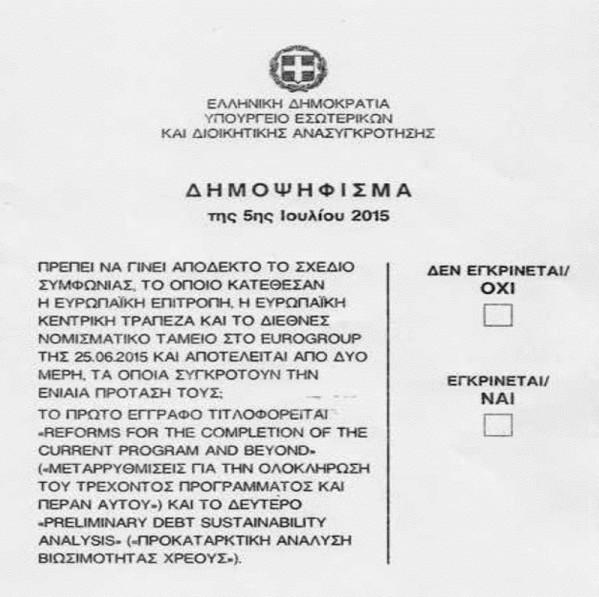
We’ll know more early next week when the result of this weekend’s Greferendum is known (assuming that is, that the referendum is carried through successfully; nothing is certain). Actually, the wording of the referendum is a little, erm, tame…

‘Should the plan of the agreement be accepted, which was submitted by the European Commission, the European Central Bank, the International Monetary Fund, in the Eurogroup of 25.6.2015, and comprises two parts which constitute their unified proposal? The first document is entitled Reforms For The Completion Of The Current Program And Beyond and the second Preliminary Debt Sustainability Analysis’.

I had expected a more direct question about euro membership. I don’t doubt that that particular question will be addressed soon but, for now, the choice is simply ‘yes’ the deal that has been offered by the troika should be accepted or ‘no’ it should not be accepted.

If a ‘yes’ vote is forthcoming I see three possibilities…

  1. A fourth election in four years is set in motion. The current government is campaigning for a ‘no’, so a ‘yes’ vote probably undermines their legitimacy
  2. the current government leads new negotiations and, with further concessions, secures an interim agreement as a stepping stone to the next bailout proper
  3. the current government leads new negotiations which fail to secure an agreement; sparking another referendum (addressing euro membership much more directly) or, perhaps more likely, another general election

If, on the other hand, a ‘no’ vote wins I see two possibilities…

  1. The current government leads new negotiations and, with no further concessions, secures an interim agreement as a stepping stone to the next bailout proper
  2. The current government leads new negotiations which fail to secure an agreement; sparking another referendum (addressing euro membership much more directly) or, perhaps more likely, another general election.

Ultimately there’s the possibility of a Grexit either way. Clearly though, a Grexit is likely to happen much more quickly if the ‘no’ vote wins.  For what it’s worth, I still think a voluntary Grexit is unlikely until the issue of euro-membership is directly addressed with the electorate. An involuntary Grexit – an expulsion from the euro-group – is the more likely scenario.

Super Mario (Draghi)

I’m not dismissive of the ‘contagion’ hypothesis. There is a real risk that discontent spreads from Greece to Portugal, Spain and Italy. And, if a crisis in the Greek mould makes it as far as Spain, it would almost certainly spell disaster. But before that happens I think we will see the European Central Bank (ECB) flex its muscles.

Remember, in July 2012, when Mario Draghi, president of the ECB, said ‘within our mandate, the ECB is ready to do whatever it takes to preserve the euro… [and] believe me, it will be enough’. His statement had an incredible effect on bond yields in the euro-zone. Indeed, that statement alone was enough to limit the euro crisis and it prepared the ground for the nascent recovery we are seeing today.

Back then, the ECB was a central bank heavily constrained by an uncertain mandate. Now, senior court rulings on the legality of some of the ECB’s proposed measures (which had been subject to heavy legal scrutiny in the last three years or so) have defined and broadened the ECB’s mandate. In short, the ECB has considerably more power today than it did in 2012.

I am convinced that the ECB will indeed preserve the euro. I’m certainly not betting against it.

Implications for the stock market

Just to be clear, I’m still in accord with JP Morgan’s Stephanie Flanders on this one…

‘The key takeaway for investors is that the Greek crisis does not pose an existential threat to either the euro system or to Europe’s financial system. Ultimately we do not believe that Greece alone will be enough to put the European recovery into reverse, or that it will prevent a gradual improvement in European corporate earnings. But there is still plenty of scope for nasty surprises and renewed volatility if the Greek situation continues to deteriorate.’ (Source: JPM Market Insights, 19 June 2015).

And at the risk of repeating myself…

Back in 2011, when the euro crisis was at its peak, a Greek default would have been a catastrophe for the euro-zone. It would have spelt disaster for Europe’s banking system and various stock markets around the world would have plummeted. The same is probably not true today; a Greek default would not be a disaster either for the EU, the Eurozone or the stock market (in the long-run at least).

Of course, there is a great deal of complacency. Far too many managers and commentators are dismissive of a potential default; its eventuality would come as a shock to some and the stock market would react sharply while that complacency is washed away.

But does a Greek exit fundamentally alter the long-term potential for listed companies on the continent? How would such a happenstance irreversibly damage the likes of Daimler, Siemens, Louis Vuitton, Total, Airbus, Unilever or Heineken?

In conclusion

Investors should hold risky assets only in the proportions that they are willing and able to hold for the duration of a significant downturn. I know that is easier said than done when interest rates are as low as they are. Investors have a seemingly irresistible urge to ‘reach for yield’. But there is one thing that destroys wealth much more effectively than choosing the wrong fund here or there; investors that blindly carry risk almost always sell out at the first sign of trouble (effectively they ‘buy high and sell low’).

Steve Williams

You can read more articles about Pensions, Wealth Management, Retirement, Investments, Financial Planning and Estate Planning on my blog which gets updated every week. If you would like to talk to me about your personal wealth planning and how we can make you stay wealthier for longer then please get in touch by calling 08000 736 273 or email [email protected]

Investing: Greece2023-12-01T12:40:13+00:00

Investing and the unfolding Greek tragedy

Investing and the unfolding Greek tragedy

It is undeniable that the Greeks are facing an enormous decision of whether to stick or twist. The size of the Greek economy is not terribly significant on a global scale, but it is certainly signficant to those working within it – and of course it is smaller this week than it was last week, however the markets are reacting, arguably over-reacting in typical fashion when uncertainty is rife. The real concern is not really Greece, but other EU States that may be minded to opt for a similar take it or leave it approach to their economic obligations.

I think it has been well documented that the Greek tax system has been painfully inadequate over the years and the recent austerity measures have been punitive. There is a degree to which we might say that bad planning has resulted in bad results, or more colloquially – the free ride is over. However, before we get too sanctimonious, the UK also spends more than it earns and of course this isn’t sustainable in the longer-term.

Financial Planning building block – a budget

To budget seems to be a term last used as a verb rather than an idea “post-war”. The Government here has some difficult decisions and of course they are contentious, earn more (raise taxes) or spend less (cut services) seems to be the only thought processes that politicians are capable of. I am left to wonder if this binary approach to life that is taken by most Governments is really the only viable option. At its heart, people get forgotten. On the one hand more money (lower taxes) is very much like a Trojan horse – at least until we can afford to have tax cuts, equally a State that spends without apparent regard for the future, can lull us into feeling that everything is “ok”…. but ultimately the merry-go-round comes to a stop. I know this isn’t easy, who likes paying more tax?

Paying the Price…or the ferryman

I’m reminded of a Volkswagen advert that is currently around – “You Pay For What You Get”. Perhaps you know it – the guy that buys a cheaper parachute, or climbing rope, or shark cage holiday experience. Some decisions have possible life threatening consequences. We all need to make good decisions, the best we can with what we can afford. It’s unfortunate that this is invariably true in life, even love has a cost. Paris and the Trojans ultimately paid for kidnapping Helen, princess of Sparta (life lesson – don’t mess with the Spartans).

I looked back on a piece I wrote nearly 3 years ago (17 August 2012) called summer holidays come to an end. In which I warned of the problems of continued funding of nations that cannot afford the debt. We need to find alternatives.

Don’t kill the messenger (Tigranes)

Sadly, your investment will be worth less this week than it was last, due to the market valuations at present. Whilst these are unusual times, market uncertainty is decidedly usual (normal) and the key thing to remember is that investments are established for a life-long approach not the next week. Yes there is bad news (when isn’t there?) but recovery will occur…. it’s just a case of when, which is of course no small matter and something that I am keeping under review. I feel very sorry for the Greeks who are experiencing a pain that we would do well to avoid.

Here’s a VW advert that I hadn’t seen.

Dominic Thomas
Solomons IFA

You can read more articles about Pensions, Wealth Management, Retirement, Investments, Financial Planning and Estate Planning on my blog which gets updated every week. If you would like to talk to me about your personal wealth planning and how we can make you stay wealthier for longer then please get in touch by calling 08000 736 273 or email [email protected]

Investing and the unfolding Greek tragedy2025-01-21T15:33:47+00:00

Howzat?

Solomons-financial-advisor-wimbledon-bloggerHowzat?

James Anderson recently became England’s most successful bowler as he took his as he took his 384th wicket, that belonging to Denesh Ramdin and overtaking Ian Botham in the process. This is of course an incredible achievement in International cricket – congratulations Mr Anderson. So I was surprised to see an item on the BBC sports website that attempted to work out who really was/is the best bowler England have ever had.

Sport as you will know has become increasingly dominated by statistics – attempts on target, completed passes, distance run, speed of delivery the list is very long and naturally varies from sport to sport. When winning any sport tournament, many rather dull teams/individuals have argued that its not the manner of the victory, just that there was a victory. I cannot help but think of the time Greece won the 2004 European Football championship (sorry Greece)… or for that matter many Champions League finals, where one team essentially set up camp in their own penalty area hoping to counter attack and steal a victory. Wisden

Cricket is not new to adopting statisitical analysis – arguably starting the statistical obsession with John Wisden’s annual almanac started in 1864. So anyone wishing to pour over cricket statistics has had plenty of opportunity to do so. Anyway the BBC asked its pundits to assess England’s top 10 bowlers and ascribe a value to the wicket taken. In short a batsman that averages 50 runs is worth more than one that averages 5. Recompiling the data provides a different twist with Matthew Hoggard topping the list (248 wickets). Whilst this is “all very interesting” sport, like life cannot be metered into a nice, neat formula. There is always a context, which even with a lengthy span of statistical data is flawed. For example – the quality of the opposition is a key ingredient, the prevailing rules, TV replays and so on, let alone the context of the pressure of the moment. Statistics are cold, unrepentent and have no context other than a time period.

Investment returns and the charts that you see plastered on advertising boards or in any media are similarly misleading. Most investors probably know that this is the case, but few behave as if it is. Most investors are tempted to invest once returns are good, most sell when they have been poor, on average chasing returns, receiving below-average market returns at above market cost. Sadly the equivalent best investment “gongs” or awards also measure historic data (there is no other) and the context of this is against peers. Who is the best fund manager? well it rather depends on which sector, what timeframe, what measure of risk is used, and what luck was involved. In short, its an impossible task, yet many play the game and attempt to quantify who is “best”.

In practice, the only investment returns that matter are the ones that you actually get. Cricket, motor racing, football, tennis, golf…are all enjoyable escapes, but again the only best that any sportsman/woman can be is their own best, in the context of their sport, time, team and luck. I have nothing against awards for best this or that, (they can be a lot of fun – especially if you win one or two) but as ever, context is everything. I can only be the best financial planner that I can be, constantly striving to improve and be better than I was last year, last month, last week… and of course our service (like most) is not for everyone, but for those that want and need it… well we try to make it the best possible.

Dominic Thomas

Howzat?2025-01-27T16:13:04+00:00

Living on the Edge

Solomons-financial-advisor-guest-blogger-Jim-Parker

Living on the Edge

Digital innovation has democratised access to financial information to the point where anyone with a smartphone, a few apps and real-time news and data feeds can be like a pro trader. But who wants to do that? And do you need to? In the world of information flows, speed is barely an issue anymore. And the old hierarchies, where professionals with state of the art systems had priority access to breaking news, have been progressively dismantled.

For instance, a $500 smartphone with a 1.3 gigahertz processor is more than a thousand times faster than the Apollo guidance computer that sent astronauts to the moon nearly half a century ago. Its internal memory is 250,000 times bigger.

Time and Moneyedge_of_tomorrow

The upshot is that financial and other information comes at us faster and in greater volumes than ever. We no longer have to wait for the six o’clock TV news to know what happened in markets today. Our apps notify us in real time. But amid this era of always-on news flow, the big question for most of us is not about our access to real-time information; it’s about whether we actually need to be so plugged in to have a successful investment experience. Dealing with that question starts with reflecting how much of an investment “edge” you get by having access to information that is so freely available.

Returning to the problem

On that score, there’s an old concept in economics called the law of diminishing returns. It essentially says that adding more and more of one input, while keeping everything else constant, gives you progressively less bang for your buck.

At the industrial end of this technology arms race, you have the high frequency traders who spend a fortune on advanced communications infrastructure to try to take advantage of split second changes in millions of prices. On the evolutionary scale, these computer programs make smart phones look like ploughshares. So against that background it’s not clear that adding the latest market-minder app to your iPhone is necessarily the path to investment success.

The second question to ask is what you are trying to achieve. Are you trying to “beat” the market by finding mistakes in prices and timing your entry and exit points? If so, and given the competition above, you might want to review your information budget.

The truth for most of us is that investment is not an end in itself, but a means to an end. We want to save for a house or put our children through school or look after aging parents or give ourselves a good chance of a comfortable retirement.

In this context, the most relevant information is about our own lives and circumstances. How much do we spend? How much can we save? What’s our risk appetite? What are our future needs? And how much of a cash buffer do we need?

Independent Advice

This is the value an independent financial advisor can bring—not in trying to second-guess the market or using forecasts to gamble with your money—but in understanding the life situation of each person and what each of them needs.

Ultimately, markets are so competitive that we really are wasting our own precious resources by trying to game them. What most of us need is to secure the long-term capital market rates of return as efficiently as possible. So our limited resource is not speed or access to information, but our own time. We only have a short window to live the lives we want. And that means we should start any investment plan with understanding ourselves.

That’s where the edge is.

Living on the Edge2025-01-27T16:13:05+00:00
Go to Top