
DIY Investing

Solomons-financial-advisor-wimbledon-bloggerDIY Investing

To my mind, one of the great ironies of financial planning is that a litigious culture, historic mis-selling, poor regulation, fearful professional indemnity insurers, better qualified advisers and RDR has meant that the cost of advising anyone has increased. Already this year our regulatory costs have increased by more than 10% (yet inflation is 0%). This will result in the continued rise of DIY investing (do-it-yourself).

I have tended to take the view that most people need to have a budget, a target, a savings habit and only when they have £50,000+ do decisions get complicated enough for me to get involved. Its not always the case, but largely. So it is alarming how poor most people are at investing – and by poor I mean really bad.

Just Unlucky?lucky sleven

An academic study from 2012 “Just Unlucky?” by Meyer, Stammsschulte, Kaesler, Loos and Hackethal at Goethe University in Frankfurt, into the success or otherwise of online investors (who generally think of themselves as well-informed) concluded that 89% of them lost an average of 7.5% a year. Let me repeat that 89% achieved -7.5% a year! Those that performed better were basically no better, exhibiting the same performance metric as luck. The research is based on German investors.. a nation that is historically characterised as shrewed, efficient, conservative and risk averse.

91% of DIY investors fail – big time.

Why? It would seem a significant element is holding the wrong asset classes and not well diversified globally. There is also a high degree of fear and greed at play, selling at the bottom and buying at the top. I can only imagine that some were following the tips from journalists and media commentators “best buys”. If dealing costs are factored in (and this was DIY investors using online dealing accounts, which presumably they thought were low cost) returns were 1% worse at -8.5% and achieved by 91% of investors.

Part of my job is helping people reduce their mistakes. We cannot be perfect, but we do apply sensible disciplines to remove a lot of errors. We call this advisers alpha – adding returns by good advice. Other research (of American investors) by Dalbar suggests that most investors underperform the market by 4-6% a year. But this latest research suggests it is far worse than that. Yet from next week, the new pension freedoms will mean that more people will take it upon themselves to go DIY with their pension. I don’t imagine that it will be a favourable outcome. This does not bode well for those using “discount” online investments, who eventually become so disenchanted with markets that they try less mainstream investments – which invariably blow up in their face and due to a peculiar twist, advisers such as myself pick up the bill… which to makes the cost of advice higher… and so the cycle repeats.

Dominic Thomas

DIY Investing2025-01-27T16:13:05+00:00

Should I Buy A House?

Solomons-financial-advisor-wimbledon-blogger

Should I Buy A House?

I recently asked for questions and so I’m going to tackle those that I get. So I’m starting with someone at the very beginning of their financial life asking if they should buy a house.

A house is an asset, it is also a home, but frankly whether you rent or buy, a home is something you create. In Britain, we laud home ownership as a goal to strive for, most of the world doesn’t and most of Europe rent.

Why Buy?welcome-home

The short answer is that you have control over where you live. If I may make the wild assumption that by the time you retire any mortgage is repaid, this means that you aren’t still paying rent or facing the regular prospect of renewing your rental agreement or moving. You can, within local bureacrat (sorry… I mean Authority) rules do what you like to your own home. You cannot knock through walls, convert a loft if you don’t own the property.

The Upside of Renting

You aren’t tied to a building, you don’t have to pay for upkeep or repairs. You have no mortgage, so no liability.

The Upside of Buying

You are “tied” but could sell – the issue is timing (no buyers?). Having an asset means other finances are easier – Banks think you are a lower risk, because you are a homeowner. Credit (which means debt) is easier to obtain.

Property prices rise and fall, but generally rise over the long term. It is as the TV pundits suggest, all about location, location, location.. which means where do people want to live? If you own the property you could rent (let) it, if you need to live away from it. However, this needs approval if you have a mortgage and you should never misrepresent the truth to a lender, that is asking for trouble.

Buying a home is a long-term commitment right?

Well yes it is… but one could argue that renting is a longer-term committment. Do you intend to rent for life? the cost of renting will also rise over time (with inflation). Renting is generally about afforability, in retirement, this means having a good pension or source of income to pay the rent… for the rest of your life.

Fear Factor

Property prices have risen enormously. The real issue is “are properties overpriced?” the honest answer is – of course they are. The entire system is built on vested interests. Lenders need to lend, (Governments need lenders to lend), Estate Agents need to sell, Surveyors need to survey and so on… the prices have been pushed up because homeowners want to make a profit on their home when they sell and move on – to larger or smaller valued homes. The system isn’t particularly good or fair, but it is the one we have today and I dont see much likelihood of it changing.

Buying and Mortgages

Most people have to borrow money to buy. That means a long-term loan and one that you need to be able to afford. There are different ways to repay, but you have to repay the loan at some point. However inflation does help. Let me explain.. a property is £250,000, you have a £50,000 deposit and so need to borrow £200,000, which for the sake of example, will be reapid over 25 years. After 5 years how much is the property worth? the same? more? less?… and after 10,15 or 20 years? Well generally proprty will rise, let’s say by an average of 3% a year. Without doing anything to increase the value of the house, after 25 years the property is worth £523,444… the mortgage is repaid (because you agreed to repay it over 25 years). Your equity (what you really own) has increased from 20% to 100% over 25 years…. but if you rent, well you still own “nothing”.

Keep it Real

As an exmaple, if you can borrow £200,000 over 25 years at 4% interest, your repayments will be £1,067 a month. Making the huge assumption that rates don’t change (they can rise or fall, or you could fix) then your repayments will be falling in real terms due to inflation. Rent costs will almost certainly be rising, every year… let’s look at a possibility.

Mr Holmes

Mr Holmes earns £57,500 buys a property for £250,000 in 2015. He has to borrow £200,000 and begins paying £1,067 a month (£12,804 a year – about 22% of his income. His salary rises by 3% a year (lucky him! today… but not unreasonable looking back and I haven’t assumed promotions etc). After 10 years His income is £72,275 and he’s still paying £1,067 a month (now 18% of his income). His house is now worth more at £335,979… so he’s gained £85,979 since buying it. His mortgage is gradually reducing, it takes a while by £200,000 has reduced to about £142,000 – he’s cleared about £58,000 in 10 years. At the end of 20 years his mortgage is now only £56,500, his income is now £103,850 and his monthly payments are still £1,067 and about 12% of his income. Another 5 years and the mortgage is gone… no more payments. He’s done, but his home is still rising in value.

Mr Rentit

Mr Rentit earns the same amount and found a similar property to rent but it only cost him £700 a month to rent. He has the same job and earns £57,500 a year. Mr Rentit isn’t a fool, and he decides to save the £367 a month that his friend Mr Holmes is shelling out each month. He puts this into a tax free ISA which grows at 7% a year (he’s fairly adventurous). At the end of 10 years Mr Rentit’s rent has increased each year… but only by 3% the same as the price houses are rising by. So after 10 years he is paying £1434 a month – double what he started paying. But he has no mortgage, and his ISA is worth £64,259… ten years later he’s paying rent of £1,927 a month (still 22% of his income). His ISA is now worth £192,662 and he has no mortgage. However he’s now a little concerned that rent keeps going up and thinks that his ISA could probably buy a house – just like the one Mr Holme’s has. But that is now worth £451,000 and he only has £192,662. So if he wanted to buy he’d need a mortgage of £258,338.As it is he is facing a lifetime of rising rental costs…. so let’s hope his pension can cope.

To be fair, he had the same £50,000 deposit 20 years ago and it had been in his ISA it would be worth £393,117 and he would still need a mortgage of £57,883 and pretty much level-pegging. He might argue that Mr Holmes had 20 years of upkeep costs and home insurance – that boiler that was replaced.. twice! and so on. Yet Mr Rentit may also be forgetting those letting agent fees, the moving costs and the hassle that he spent trying to register with the local GP/dentist etc eaxh time he moved.

Now, my example is obviously flawed and full of linear assumptions about inflation and the largest being a 4% difference in ISA outperformance of inflation/property prices. None of this will become reality. We could make the numbers prove one case or another (with the wrong assumptions). The issue is one of having an asset or not.

My experience is that most would not be like Mr Rentit – they wouldn’t save the £367 a month and those that did probably were tempted to raid the pot, so would have less. Most investors panic in market crisis, so probably wouldn’t get a market return unless they had a decent adviser… Most homeowners do improve their home, making it more valuable – but there are certainly upkeep costs.

The short answer is really – few people are “better off” by renting. In 40 years time (perhaps at or in retirement) Mr Holmes would still be having to pay rent of £3,480 a month…which means his pension would need to be able to provide this, Mr Holmes would not. So part of the answer is about discipline… and Mr Holmes, being a client, would have saved more of his income despite his mortgage costs, we would have advised him to high-speed repay his mortgage, freeing up income later to squirrel away… but that’s another story.

Dominic Thomas

Should I Buy A House?2025-01-28T14:36:29+00:00

What about China?

Solomons-financial-advisor-guest-blogger-SW

What about China?

For some time now, I’ve been complaining about the oversized contribution from investment in China’s recent expansion

[1]. Actually, I’m not the only one. Policymakers are busily crafting the conditions that might bring about a rebalanced economy – one less reliant on exports & investment and more reliant on domestic demand & consumer spending.

The IMF might be right Chinese Puzzle

‘Investment growth in China declined in the third quarter of 2014, and leading indicators point to a further slowdown. The authorities are now expected to put greater weight on reducing vulnerabilities from recent rapid credit and investment growth and hence the forecast assumes less of a policy response to the underlying moderation. Slower growth in China will also have important regional effects, which partly explains the downward revisions to growth in much of emerging Asia.’ WEO January 2015.

Building more and more factories to house more and more machinery manned by more and more workers will get you a long way; China’s economy is not far off 40 times larger than it was in 1978 when Deng Xiaoping succeeded Mao Zedong. But while ultra-high levels of investment are associated with rapid expansion they’re not generally associated with sustained growth. The returns that are associated with an over-reliance on debt-fuelled investment diminish with time (thanks in part to an inevitable inefficient use of capital) while the risks are amplified (owing to overleverage and rising volumes of non-performing loans).

China, I suggest, has a debt problem – today’s Financial Times reports that ‘Chinese corporations are now among the most indebted in the world’ – but with everything else that is going on in the world[2] investors are not yet fully alive to the possibility of a much slower pace of growth. Indeed the huge premium that the market for Chinese A shares (dominated by domestic investors, it has risen in value by over 60% in the last 6 months) has over the market for B shares (dominated by international investors, it has risen in value by a much less thrilling 19% over the same period) suggests that Chinese investors are most hopeful of sustained high growth rates.

So far as I can see, two paths are apparent; China’s rate of growth can slow in orderly form or disorderly form, but it will slow nevertheless.

Steve Williams


[1] Post 2008 in particular, where gross fixed capital formation has accounted for around half of the Chinese economy[2] It’s all so exciting; an extraordinary oil price decline, huge gulfs in monetary policy between those in the US and Europe, Syriza’s rise to power in Greece, another full-blown Russian crisis and Japanese policymakers throwing everything, including the kitchen sink, in a spectacular attempt to kick-start their economy

What about China?2023-12-01T12:39:57+00:00

Is this the end of With-Profits?

Solomons-financial-advisor-wimbledon-blogger

Is this the end of With-Profits?

On Friday Legal & General, one of the UK largest insurance companies announced that they would be closing their with-profits fund (worth over £12 billion) to new investment. To be honest, I’m delighted.Captain Future

With-profits funds sound quite good in principle – in essence they are an old-style way of investing, whereby the insurance company provided modest returns from the market, adding bonuses each year (which couldn’t be taken away once added) and then adding a final or terminal bonus at the end of the investment period. It was designed to provide a more predictable return for investors and a “smoother” investment journey. Unfortunately, you never really know where you are. You don’t get all of the market returns (and equally don’t suffer all of the market loss). However returns and bonuses have been falling over the years and the ability to actually have any meaningful indication of what an investment is actually worth is “difficult” with calculation made for market value adjustments and advanced payment of final bonuses. To be frank, the science of with-profit investing feels all rather like smoke and mirrors, though I don’t believe that this was the original intention.

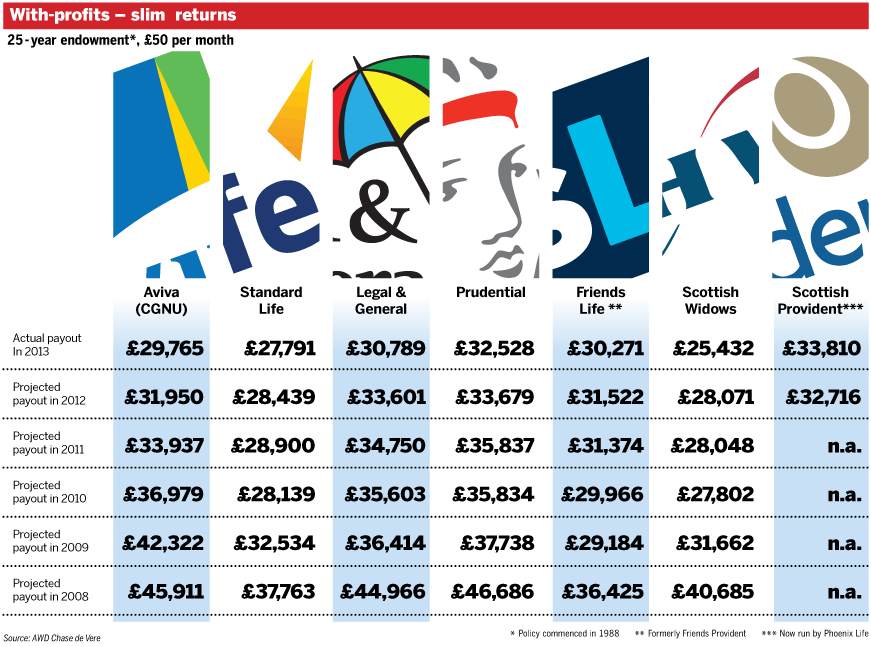
Changes to market conditions and the requirement for with-profit funds to hold some very “low risk” assets has meant further depressing returns. I have never advised anyone to buy a with-profit fund, for little reason other than it is pretty difficult to figure out the real value of an investment. In a unit-linked type of investment, the value is the value – unless there are any penalties levied by old style charging structures. These days, in more “transparent” times, with-profits simply aren’t up to the task. Of course some of 0ur clients will have old policies that have with-profits so I have to give them consideration, but in an ideal world to my mind you should be able to see the real value of your investment each day. Here is an image I found, put together by Chase De Vere and in an item in the FT by Josephine Cumbo in March 2013… the article and graphic highlight the rise in declining final payouts from with-profit funds… and there are around 20m people with such holdings, which tended to be sold in the 1980’s and 1990’s.

withprofits.img

Legal & General have confirmed that there will be no changes to their with-profit funds and it will be “actively managed”. The main reason for the closure is a reduction in business as a result of the adviser charging regime, the implication being that charges on funds have had to reduce and many advisers, have finally realised that they need to do rather more work than simply select a fund based on where they last had lunch…or saw “with-profits” as a default investment choice for the uninformed (on a massive scale if you are a Bank). I’m expecting other UK insurance companies to follow suit – at least those that are actively trying to keep up with the market.

Dominic Thomas

Is this the end of With-Profits?2025-01-27T16:13:05+00:00
Go to Top