
The Deep End

The Deep End

Have you ever seen a child standing tentatively at the edge of a swimming pool? She’s torn between her desire to join the gang in the water and her fear of diving in. In committing to the market, investors can be like that.

You can always find a reason for not investing. “Perhaps I should wait till after interest rates rise?” goes one line of the thinking. “Or maybe I should delay till there’s more clarity on China? Or hold back until after earnings season?”

Emotions and assumptions usually underlay this indecision. The emotion can be anxiety about “making a mistake” or fear of committing at “the wrong time” and suffering regret. The assumption is that there is a perfect time to invest.

Obviously, the ideal solution would be to enter the market just as it bottoms and exit the market right at the top.

But the reality is that precisely timing your exit and entry is close to impossible. If it were easy, millions would be doing it and getting very rich in the process. Instead, the only ones who tend to consistently make money out of market timing are those who write books about it.

The financial media certainly love market timing stories. For one thing, there is always some event or variable they can peg it to—like a decision on interest rates or upcoming earnings or a chart indicator. For another, the idea of timing the market is a powerful one and tends to get readers’ attention.

For example, one high-profile US forecaster in early 2012 predicted a 50-70% equity market decline over the following two-to-three years. It was to be a replay of the 2008-09 crisis, he said, but with an even deeper recession.1

Timing the market… or time in the market?

That turned out to be a bad call. Global equity markets, as measured by the MSCI World Index, delivered a total positive return in Australian dollars of 93% from the end of 2011 to the end of 2014.2 In USD, it was 53%.

Others advocate more elaborate timing strategies. For instance, one recent academic paper suggested the stock market delivers better returns relative to Treasury bills in the second, fourth and sixth week after each of the US Federal Reserve’s policy-setting meetings in a given year.3

The idea here is that the Fed leaks information about its interest rate intentions in such a predictable way that, even without the information, savvy investors can make money by just buying stocks in certain periods.

While these theories can be fascinating, it is arguable how many of us have either the time or inclination to try them out. And even if we did, this does not take account of the costs of all the required trades or the possibility that as soon as we implemented the idea it would be arbitraged away.

So ahead of a central bank meeting, some would-be investors fret about whether they should hold off until they see how the market reacts. Others already invested worry whether they should take their money out.

What really matters

The truth is that for long-term investors, these issues should be irrelevant. What matters is how their portfolios are structured and how they are tracking relative to their chosen goals. Markets will go up and down, security prices will change on news and it makes little sense to second guess them.

But while no one yet has come up with a consistently successful strategy for timing the market to perfection, there are some things that everyone can do to help ease the anxiety they feel about investing.

One is to realise that it does not have to be a choice between being 100% in the market and 100% outside. Ideally, an investor should stick to their strategic asset allocation—be it 70/30 or 60/40 or 50/50 equity/bonds.

Another is that this strategic allocation can be combined with periodic, disciplined rebalancing, in which the investor shifts assets from well performing asset classes to those less favoured. This is a good way of controlling risk without necessarily trying to time the market.

A third option is that there is nothing wrong with investors taking into account the returns they have already enjoyed and adjusting their asset allocations if they are on course to meet their goals. So, for example, for some investors it might make perfect sense to lock in returns after a good period and put the money into short-term fixed income if that meets their needs.

Yet another option is dollar-cost averaging. This is a method where an individual invests small amounts of an available pool of cash into the market over a period, rather than investing a lump sum in one go.

A useful contribution on this subject comes from Ken French, Professor of Finance at the Tuck School of Business at Dartmouth College. In his role as an academic, Professor French says the optimal decision is to invest it all at once. But while this might give an individual the best investment outcome, he says it might not be the best investment experience.4

This is because people tend to feel regret more strongly when it results from things they did do than from things they did not. So, for instance, it feels much more painful to buy stocks now and see the price go down than it is to neglect to buy stocks and the price goes up.

Professor French says that by dollar cost averaging, people can diversify their “acts of commission” (the stuff they did do) as opposed to their “acts of omission” (the stuff they didn’t do).

“The nice thing is that even if I put my finance professor hat back on, it’s really not that damaging to your long-term portfolio to just spread it out over three or four months,” he says. “So if you as an investor find that’s much more tolerable for you, you’re not really doing much harm.”

So, in summary, it’s always difficult to choose exactly the right time to get into or out of the market. For instance, it would have been nice to get out in late 2007 and back in around early March 2009.

But most mortals are unable to finesse it to that degree. The good news is that there are other options than just staying out of the market altogether and plunging back in.

These include maintaining a long-term strategic asset allocation in the first place, periodically rebalancing, taking money off the table if retirement goals are on track and dollar-cost averaging if that provides comfort.

The underlying philosophy in all these options is that individual investors are making decisions based on their own needs and risk appetites, not according to someone else’s opinion as to what the market does next.

Uncertainty will always be an integral part of investment (and life). But there are many things we can control. And this is where a good adviser comes in.

1. “Get Set for a Crash, Forecaster Says”, Globe and Mail, 10 January 2012

2. MSCI World Index (net div, AUD), Returns Program

3. “Want to Play the Market? Count the Fed Leak Weeks: Study”, Reuters 21 November, 2015

4. Fama/French Forum, “Dollar Cost Averaging”, 23 June, 2009

Jim Parker

Vice President, Dimensional

You can read more articles about Pensions, Wealth Management, Retirement, Investments, Financial Planning and Estate Planning on my blog which gets updated every week. If you would like to talk to me about your personal wealth planning and how we can make you stay wealthier for longer then please get in touch by calling 08000 736 273 or email [email protected]
The Deep End2023-12-01T12:19:39+00:00

What is the truth about SIPPs?

What is the truth about SIPPs?

If you didn’t read yesterday’s post, can I suggest that you do so. Click here to see it. The quickest route to a financial scam is to fail to read information. The Radio 4 programme suggested that the scam concerned meant that some people had pretty much lost their entire pension. So can I encourage you to simply give me 5 minutes of your time so that you have a few more facts about financial scams? This article assumes that you have heard the radio programme concerned.

SIPPs

Firstly, a SIPP (Self Invested Personal Pension) is not simply for the rich (as implied by the programme). There is nothing wrong with a SIPP they can be just as cheap as a standard personal pension. The main difference is that they can include unregulated investments. You may recall that this was supposedly what the public was clamouring for at one point – remember Gordon Brown back-tracking on being able to put residential property into a pension? Well that would have to be into a SIPP. A residential property is an unregulated investment too! We arrange SIPPs because they have a far greater range of funds – our main reason for using them is to access low cost funds (very low cost).

Risk Profiling and Risk Questionnaires

Any decent adviser will attempt to explain and assess your attitude to risk. This isn’t an easy concept. The best tool I know is the one I use for clients. The world-leading software from FinaMetrica, it’s a psychometric test and naturally rather more than “on a scale of 1 to 10..” Risk is relative and requires thought. Crossing the road is “risky” but rather more so if you don’t look or listen. Box-ticking is never going to do justice to a proper, contextualised conversation…. but worst of all is assuming that your attitude to risk is the same as your advisers…. almost certainly not.

Transferring Your Pension

Again, there is nothing wrong with this, but there needs to be a good reason to do so (or several). Moving an investment based pension to another investment based pension is pretty straight-forward, but there issues to consider carefully. In any event moving this sort of pension is called a pension switch (like for like), although often called a “pension transfer” in layman’s terms it isn’t. It doesn’t help that all the forms to do this are called pension transfer forms, or transfer packs and so to be consistent, advisers, myself included use the same term, but it is not what the regulator means by “pension transfer”.

A Real Pension Transfer

Moving a final salary or “Defined Benefit” pension is invariably unwise, but there are exceptions. We do not (and never have) moved these sort of pensions, these are called pension transfers, and these are the type that causes the regulator concern – for good reason – you would be giving up guarantees! In essence a pension transfer involves moving from a guaranteed arrangement into an investment (which fluctuates in value, so not guaranteed). On occasion, there can be good reasons to move though – if the original scheme is in difficulty or your own circumstances are a little unusual. This requires specialist advice, which we can refer. However, I would argue that historically pension transfers were done to generate commission for the adviser rather than benefit for the investor. However at times, a transfer might be suitable.

Valuing Pensions

Invariably we arrange investments of all descriptions and provide valuations. My own view is that the investor ought to be able to view the investment online and the data should confirm what we say. I also do not like lock-in’s. Any investment that is a little bit out of the ordinary will need an exit method. Many more complex, high risk and unregulated investments all have problems with exit. Normal, regulated funds do not, with the exception of property funds, which can have similar problems and are far from ideal for anyone seeking or requiring liquidity.

Fraud

There will always be people wanting to take advantage of you. These psychopaths (I cannot think of a more suitable term) have little remorse (if any) for the fact that this is your hard-earned money. People are always behind investments, never forget that, on both sides.

Celebrity Endorsements

Similarly, taking advice from anyone not qualified to provide it is a mistake that you really do not need to make in 2015 and beyond. Just because he or she writes about cars, finance, cooking or music or performs in films, does not make the product “good”. They are being paid to read a script. Most people would willingly accept a cheque for reading and smiling, my advice would be to never endorse anything that you have no genuine knowledge of. It is of course a very old “trick” of confidence.

Why does this happen?

Lots of reasons, here are 4.

  1. Because people become fed up with their investments and don’t like the alternative of cash which is currently paying peanuts. There are a plethora of alternatives now, some are ok, but most are simply taking advantage of the generally poor opinions about Bankers and will just as easily take advantage of you (by which I mean deprive you of as much of your money as you are willing to hand over).
  2. Because they are short of cash and being desperate will raid the future to pay for today
  3. Because they have been duped by people implying trustworthiness, but actually have no accountability or relationship
  4. Because financial stuff is pretty dull and full of jargon and its a lot of effort to read and not many people want to pay for advice, particularly if that advice doesn’t deliver the news that they want to hear.

The good news is that your investment experience does not have to be like this, however you do need to remove emotion from your investment strategy (easy to say) and also retain discipline. Investing is life-long, certainly not just for Christmas.

Want more? I suggest you get my free downloadable report about pensions.

Dominic Thomas
Solomons IFA

You can read more articles about Pensions, Wealth Management, Retirement, Investments, Financial Planning and Estate Planning on my blog which gets updated every week. If you would like to talk to me about your personal wealth planning and how we can make you stay wealthier for longer then please get in touch by calling 08000 736 273 or email [email protected]

What is the truth about SIPPs?2025-01-27T16:38:37+00:00

Pension Scams – The Empty Box

Pension Scams – The Empty Box

Yesterday I outlined that 2015 has been a poor year for investors. I also pointed to not making a bad situation worse by making further mistakes. Invariably and sadly, many are tempted by high returns elsewhere in an effort to recoup losses and/or an unwillingness to accept the reality of life.

Unfortunately, there is always a willing con-man to part you from your money with promises that tempt some to make some dreadful decisions. The BBC radio 4 programme “You and Yours” which can be found on the iplayer which aired 2 weeks ago (3rd December) is worth listening to. It’s a 45 minute show, so put it on whilst you are wrapping gifts for Christmas. You can find it here. (click)

This story has been around for a while, the regulator warned about it some time ago. In a nutshell, this is the story of pension liberation, though I don’t think the term is used anywhere (it ought to be). The brief version is that investors were encouraged to move their pensions into a SIPP (Self Invested Personal Pension) and once there, the money was invested into a “fund” which is unregulated. The fund was actually a “dead cert” of an investment, which was actually storage units or “storage pods” with Store First. One might hope that most people would think at least twice before making such an “off the page” investment, but it doesn’t help when a well-known person from the media appears in the commercial suggesting the implausible is possible… in fact guaranteed.

The Empty Box

Recap: the investment actually went buying a storage unit, then hoping that it will be rented and that the pod will appreciate in value. The price of the pod does not appear to be a market rate and attempting to sell the pod at anything like the purchase price is… well something about snowballs and hell freezing over. Note there are many similar “opportunities” arriving to your spam mailbox.

Let me be clear, there is nothing wrong with anyone renting or offering to rent or run a business that rents storage space. However as a direct investment, you are essentially becoming a business that rents storage space, so do you have all the facts to hand? and even if that is the case, of all the business opportunities “out there” do you really want to rent a box to others for profit? How much of such a business strategy is actually within your control?

There are lots of problems with what happened, for starters the advisers were not authorised (qualified, vetted, approved and regulated) advisers and they breached all sorts of regulatory standards. The processes involved were corrupted and frankly anyone doing even a modicum of research would probably conclude that this is not typical investing.

Unfortunately as the “fund” is unregulated, there is no compensation, despite appearing within a pension.

Tomorrow I will conclude by outlining some of the facts and part-truths from the Radio 4 programme, so that you don’t fall victim to something similar.

Dominic Thomas
Solomons IFA

You can read more articles about Pensions, Wealth Management, Retirement, Investments, Financial Planning and Estate Planning on my blog which gets updated every week. If you would like to talk to me about your personal wealth planning and how we can make you stay wealthier for longer then please get in touch by calling 08000 736 273 or email [email protected]

Pension Scams – The Empty Box2025-01-27T16:38:38+00:00

2015 has been a bad year…. for investors too

2015 has been a bad year… for investors too

It has not been a good year for investors, frankly it has not been a good year for lots of people – we are all aware of the disasters and atrocities that have occurred around the world. So as you review your investments which have not performed as anyone would have hoped, a sense of perspective is probably wise.

The problem with stock market or traditional investing is that we see good years a bad years. 2015 has been a bad year, with the FTSE100 opening the year at 6,556 rising to a high in April of 7,103 (up 8.3%) but currently lagging at around 6,050 (down 7.7% over the year to date).

It is natural to feel annoyed and fed up, particularly as it is easy to get the impression that somewhere, somehow others are doing better. The truth is perhaps rather different. A fall of 7.7% is what the market provided via the FTSE100 (the UKs 100 largest companies). To have a smaller fall (or even a gain) you would have had to take more investment risk (essentially attempting to beat the market return based on belief, information or frankly luck). The market return is literally the market average return. This assumes that you were invested at the start of the year. If you invested towards the end of April your “loss” would be worse.

Realisation about Loss

However what is a loss? In essence a loss is only realised when you sell your investment for less than the price you paid for it, which might happen due to changing circumstances, but should not happen within a financial plan.

Part of my role is to help clients minimise their mistakes. One would be to sell at the bottom – to panic and “get out” once markets have fallen (this would be called “realising a loss” – ie making it real). It is tempting to do so, but unwise unless your circumstances have genuinely changed.

Risk and Diversification

However all portfolios are diversified across a range of assets, so you aren’t purely in the FTSE100. Portfolios have a global nature and hold cash, commodities and Bonds. The mix (asset allocation) is the important tool we use to devise a suitable portfolio for you, given your ability to cope with investment risk and also have a context (your financial plan) for your money. This is what we call diversification of risk, but might be better understood as “not holding all your eggs in one basket”.

Yes, the year has been poor for investors, but do not be tempted to seek higher returns, and yes even cash with its dreadful returns was a better option in hindsight. The returns will “feel” and appear worse as statements at 5th April would have exposed the comparative high point in the year. However in the long-term investing rewards those that stick with the plan. There is ample and readily available evidence for this.

Noisy “genuises”

Be mindful that most people will never (or very rarely) talk about their investment losses, but invariably shout from the rooftops about their investment successes. The truth is rather different and much better hidden. This applies to private investors and professionals alike.

Tomorrow I will highlight another mistake that you can avoid and frankly, one that you need to encourage anyone you know to read the piece.

Dominic Thomas
Solomons IFA

You can read more articles about Pensions, Wealth Management, Retirement, Investments, Financial Planning and Estate Planning on my blog which gets updated every week. If you would like to talk to me about your personal wealth planning and how we can make you stay wealthier for longer then please get in touch by calling 08000 736 273 or email [email protected]

2015 has been a bad year…. for investors too2025-01-27T16:38:38+00:00

Credit Crunched – 99 Homes

Credit Crunched – 99 Homes

The Credit Crunch may well be one of the defining moments of a generation, it has certainly altered the way many view investment and retail banks. The institute of which I have been a member for a number of years (The Institute of Financial Planning) merged this month with CISI – the Chartered Institute for Securities and Investment having been agreed in September.

One of the many good things about the IFP, who I regard(ed) as the best of the best, was the willingness of other members (in theory competitors) to share best practice. Indeed many have become valuable sources of wisdom for me (in what I hope is a two-way street) and have become professional friends. Understandably, many of us were surprised and perhaps concerned about the changes that the merger may bring about. After all, investment bankers were part of the problem that caused the credit crunch and haven’t we now just “got into bed with them”?

Ethics

In order to migrate my membership over to CISI I had to pass an ethics test. Being candid, it has always been something of a struggle to find and complete any CPD type stuff for the IFP on the topic of ethics – for which there is a required minimum of 2 hours a year (no that doesn’t mean being ethical for 2 hours a year, but demonstrating learning and application of the broad topic of ethical dilemmas).

I followed the online resource and was presented with a series of case studies, which I am pleased to say were interesting and based in the world of real life rather than a purely theoretical one. The overwhelming perspective being that if others follow the same path, I have had my faith and optimism significantly increased in the investment world, which if I’m being honest, I didn’t have before.

99 Homes

I have been greatly deflated and frustrated by the greed and bullying exhibited by large corporations and the relentless pursuit of gain without any thought of others. My opinion of the investment world, is almost certainly not that much different from yours. A recent film that captured this is called “99 Homes”. It stars Andrew Garfield, who you may have seen as Spiderman (perhaps not) or as Eduardo Saverin in The Social Network (the film about Facebook). Anyway, Garfield plays a character that has his home repossessed and, well… shall we say something of the gamekeeper turned poacher occurs. I found the film compelling and perfectly exposing the moral maze and ethical dilemma that people find themselves in. Here is the trailer…. seriously a good watch.

You can get the film on DVD here..

Dominic Thomas
Solomons IFA

You can read more articles about Pensions, Wealth Management, Retirement, Investments, Financial Planning and Estate Planning on my blog which gets updated every week. If you would like to talk to me about your personal wealth planning and how we can make you stay wealthier for longer then please get in touch by calling 08000 736 273 or email [email protected]

Credit Crunched – 99 Homes2025-01-27T16:38:38+00:00

The Patience Principle

The Patience Principle

Global markets are providing investors a rough ride at the moment, as the focus turns to China’s economic outlook. But while falling markets can be worrisome, maintaining a longer-term perspective makes the volatility easier to handle.

A typical response to unsettling markets is an emotional one. We quit risky assets when prices are down and wait for more “certainty”.

These timing strategies can take a few forms. One is to use forecasting to get out when the market is judged as “over-bought” and then to buy back in when the signals tell you it is “over-sold”.

A second strategy might be to undertake a comprehensive macro-economic analysis of the Chinese economy, its monetary policy, global trade and investment linkages and how the various scenarios around these issues might play out in global markets.

In the first instance, there is very little evidence that these forecast-based timing decisions work with any consistency. And even if people manage to luck their way out of the market at the right time, they still have to decide when to get back in.

In the second instance, you can be the world’s best economist and make an accurate assessment of the growth trajectory of China, together with the policy response. But that still doesn’t mean the markets will react as you assume.

A third way is to reflect on how markets price risk. Over the long term, we know there is a return on capital. But those returns are rarely delivered in an even pattern. There are periods when markets fall precipitously and others where they rise inexorably.

The only way of getting that “average” return is to go with the flow. Think about it this way. A sign at the river’s edge reads: “Average depth: three feet”. Reading the sign, the hiker thinks: “OK, I can wade across”. But he soon discovers the “average” masks a range of everything from 6 inches to 15 feet.

Likewise, financial products are frequently advertised as offering “average” returns of, say, 8%, without the promoters acknowledging in a prominent way that individual year returns can be many multiples of that average in either direction.

Now there may be nothing wrong with that sort of volatility if the individual can stomach it. But others can feel uncomfortable. And that’s OK too. The important point is being prepared about possible outcomes from your investment choices.

Markets rarely move in one direction for long. If they did, there would be little risk in investing. And in the absence of risk, there would be no return. One element of risk, although not the whole story, is the volatility of an investment.

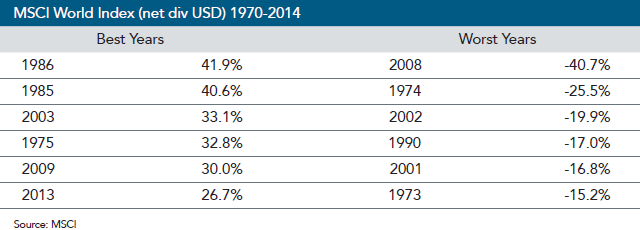
Look at a world share market benchmark such as the MSCI World Index, in US dollars. In the 45 years from 1970 to 2014, the index has registered annual gains of as high as 41.9% (in 1986) and losses of as much as 40.7% (2008).

But over that full period, the index delivered an annualised rate of return of 8.9%. To earn that return, you had to remain fully invested, taking the unsettling down periods with the heartening up markets, but also rebalancing each year to return your desired asset allocation back to where you want it to be.

Timing your exit and entry successfully is a tough ask. Look at 2008, the year of the global financial crisis and the worst single year in our sample. Yet, the MSCI World index in the following year registered one of its best-ever gains.

Best and worst

Now, none of this is to imply that the market is due for a rebound anytime soon. It might. It might not. The fact is no-one can be sure. But we do know that whenever there is a great deal of uncertainty, there will be a great deal of volatility.

Second-guessing markets means second-guessing news. What has happened is already priced in. What happens next is what we don’t know, so we diversify and spread our risk to match our own appetite and expectations.

Spreading risk can mean diversifying within equities across different stocks, sectors, industries and countries. It also means diversifying across asset classes. For instance, while shares have been performing poorly, bonds have been doing well.

Markets are constantly adjusting to news. A fall in prices means investors are collectively demanding an additional return for the risk of owning equities. But for the individual investor, the price decline only matters if they need the money today.

If your horizon is five, 10, 15 or 20 years, the uncertainty will soon fade and the markets will go onto worrying about something else. Ultimately what drives your return is how you allocate your capital across different assets, how much you invest over time and the power of compounding.

But in the short-term, the greatest contribution you can make to your long-term wealth is exercising patience. And that’s where your adviser comes in.

Jim Parker

Vice President, Dimensional

You can read more articles about Pensions, Wealth Management, Retirement, Investments, Financial Planning and Estate Planning on my blog which gets updated every week. If you would like to talk to me about your personal wealth planning and how we can make you stay wealthier for longer then please get in touch by calling 08000 736 273 or email [email protected]

The Patience Principle2023-12-01T12:19:59+00:00

China – 8000 miles

China – 8,000 miles

I’m sat in the shadow of Beinn Resipol, a remote and moody monument in mountain form, close to Moidart in the Highlands of Scotland. Shanghai is around 8,000 miles away. Still, I can hear the sound of investor panic.

The following extracts from Bloomberg’s daily Economic Brief sum up what’s happening over there…

‘In the second quarter, China’s markets and economy were in a virtuous circle upward. In the third quarter, they are in a vicious spiral down. The Shanghai Composite Index fell 8.5 percent to 3,209.9 at the close on Monday. The index is now down 37 percent from its mid-June high and below the 3,500 mark that many investors expected the government to defend.’

Furthermore…

‘All of the forces that accelerated market momentum on the way up are now working in reverse on the way down. The balance of outstanding margin loans has fallen to 1.4 trillion yuan, down from a peak of close to 2.3 trillion yuan in mid-June. The number of new trading accounts has slumped as the “greater fools” to whom speculators had hoped to offload stocks have wised up.’

I don’t doubt that some investors expected the Chinese government to defend stock prices but, for the life of me, I can’t figure out how the government could possibly succeed in so doing; I know of neither mechanism nor precedent. Of course, the government will do something. It will engage more easing – most likely in the form of reduced reserve requirements for banks – and that might go some way to settling investors. But it won’t sustain asset prices for long. And besides, the Chinese government has far larger fish to fry.

China’s economy is slowing. That’s not necessarily a bad thing. In fact, it’s something of a necessity if policymakers are to be successful in re-balancing the Dragon economy toward a more sustainable model – away from debt-fuelled investment on the one hand, toward higher household spending driven by rising incomes on the other. The alternative is worse – economies with over-sized investment tend to slow too, ultimately, but in a much more dramatic fashion. And that would be a disaster for the one party, in a one-party system, whose legitimacy is founded on lifting living-standards. So, the period of transition that China faces is a very difficult one indeed. Success, if it is successful, will be hard won.

In the meantime, China’s slowdown comes at a bad time for the global economy. Brazil and Russia are in decline, so too is Japan and the euro-zone is struggling to escape the doldrums. It seems a great many investors were counting on China – which, according to the Wall St Journal, ‘accounts for 15% of global output but has contributed up to half of global growth in recent years’ – to maintain some momentum.

That was always a dangerous assumption.

Steve Williams


You can read more articles about Pensions, Wealth Management, Retirement, Investments, Financial Planning and Estate Planning on my blog which gets updated every week. If you would like to talk to me about your personal wealth planning and how we can make you stay wealthier for longer then please get in touch by calling 08000 736 273 or email [email protected]

China – 8000 miles2023-12-01T12:20:00+00:00

The China Syndrome

The China Syndrome

The recent severe volatility in China’s share markets has raised questions among many investors about the causes of the fall and about the wider implications for the global economy and markets generally.

The Shanghai Composite index, the mainland stock market barometer and one dominated overwhelmingly by retail investors, more than doubled in the year from mid-2014, only to lose more than 30% of its value in a month.

The volatility was much less in Hong Kong, where foreign investors tend to get their exposure to China. The Hang Seng index fell about 17% from April’s seven-year high, though it had a more modest run-up in the prior year of about 25%.

Nevertheless, the speed and scale of the fall on the Chinese mainland markets unsettled global markets, fuelling selling in equities, industrial commodities, and allied currencies like the Australian dollar and buoying perceived safe havens such as US Treasuries and the Japanese yen.

The decline in Chinese stocks triggered repeated interventions by China’s government, which has been seeking to transition the economy from a long-lasting export-led boom toward more sustainable growth based on domestic demand.

Investors naturally are concerned about what the volatility in the Chinese market means for their own investments and what it might signify for the global economy, particularly given the rapid growth of China in the past 20 years.

SHARE MARKET VS ECONOMY

Measured in terms of purchasing power parity (which takes into account the relative cost of local goods), the Chinese economy is now the biggest in the world, ranking ahead of the USA, India, Japan, Germany and Russia.1

Yet, China’s share market is still relatively small in global terms. It makes up just 2.6% of the MSCI All Country World Index, which takes into account the proportion of a company’s shares that are available to be traded by the public.

The Chinese market is also not a large part of the local economy. According to Bloomberg, it is capitalised at less than 60% of the country’s GDP. By comparison, the US equity market represents more than 100% of the US economy.

China is classified by some index providers as an emerging market. These are markets that fall short of the definition of developed markets on a number of measures such as economic development, size, liquidity and property rights.

China’s stock market is still relatively young. The two major national exchanges, in Shanghai and the other in the southern city of Shenzhen, were established only in 1990 and have grown rapidly since then as China has industrialised.

With foreign participation in mainland Chinese markets still heavily restricted, many foreign investors have sought exposure to China through Hong Kong or through China shares listed on the New York Stock Exchange.

As a consequence, domestic investors account for about 90% of the activity on the Chinese mainland market. And even then, the participation is relatively narrow. According to a China household finance survey, only 37 million or 8.8% of Chinese families held shares as of June 2015.2 As a comparison, just over half of all Americans own stocks, according to Gallup. In Australia, the proportion is 36%.

While the Chinese stock market is about 30% off its June highs, it nevertheless is still about 80% higher than it was a year ago. As such, much of the pain of the recent falls will have been felt by people who have entered the market in the past year.

A final point of perspective is that while the Chinese economy has been slowing, it nevertheless is still expanding at around 7% per annum, which is more than twice the rate of most developed economies.

The IMF in April projected growth would slow to 6.8% this year and to 6.3% in 2016. Still, it expects structural reforms and lower oil and commodity prices to expand consumer-oriented activities, partly buffering the slowdown.3

While such forecasts are subject to change, markets have priced in the risk of a further slowdown to what was previously expected, as seen in the renewed fall in the prices of commodities like copper and iron ore, which recently hit six-year lows.

DRIVERS OF THE BOOM

The Chinese share market boom of the past year cannot be attributed to a single factor, but certainly two major influences have been the Chinese government’s promotion of share ownership and investors’ increased use of leverage.

The government has been seeking to achieve more sustainable, balanced and stable economic growth after nearly four decades of China notching up heady annual growth rates averaging 10% on the back of an official investment boom.

But the transition to a shareholding economy has created its own strains. The outstanding balance of margin loans on the Shanghai and Shenzhen markets had grown to 4.4% of market capitalisation by early July, according to Bloomberg.4

Under a margin loan, investors borrow to invest in shares or other securities. While this can potentially increase their return, it also exposes them to the potential of bigger losses in the event of a market downturn.

When prices fall below a level set by the lender as part of the original agreement, the investor is called to deposit more money or to sell stock to repay the loan. These margin call liquidations can amplify falling markets.

Chinese regulators, mindful of the potential fallout from the stock market drop, have instituted a number of measures to curb the losses and cushion the impact on the real economy.

These have included a reduction in official interest rates, a suspension of initial public offerings and enlisting brokerages to buy stocks backed by cash from the central bank. In the latest move, regulators banned holders of more than 5% of a company’s stock from selling for six months.

The government also has begun an investigation into short selling, which involves selling borrowed stock to take advantage of falling prices. In the meantime, about half of the companies listed on the two major mainland exchanges were granted applications for their shares to be suspended.

While such interventionist measures may seem alien to people in developed market economies, they need to be seen in the context of China’s status as an emerging market where governments typically play a more active role in the economy.

Whether the intervention works in the long term remains to be seen. But the important point is that this is a relatively immature market dominated by domestic investors and prone to official intervention.

SUMMARY

The re-emergence of China as a major force in the global economy has been one of the most significant drivers of markets in the past decade and a half.

China’s rapid industrialisation as the population urbanised drove strong demand for commodities and other materials. Investment and property boomed as credit expanded and as people took advantage of gradual liberalisation.

Now, China is entering a new phase of modernisation. The government and regulators are seeking to rebalance growth and bring to maturity the country’s still relatively undeveloped capital markets.

Nevertheless, China remains an emerging market with all the additional risks that this status entails. Navigating these markets can be complex. There can be particular challenges around regulation and restrictions on foreign investment.

We have seen those risks appearing in recent weeks as about a third of the sharp rise in the Chinese mainland market over the previous year was unwound in a matter of weeks, prompting intense government intervention.

Markets globally are weighing the wider implications, if any, of this correction. We have seen concurrent weakness in other equity markets and falls in commodity prices and related currencies.

Yet it is important to understand that the stock market is not the economy. China’s market is only about 2.6% of global market cap and its volatile mainland exchanges are for the most part out of bounds for foreign investors anyway.

For individual investors, the best course in this climate, as always, is to maintain diversification and discipline and to remember that markets accommodate new information instantaneously.

1. Source: IMF World Economic Outlook, April 2015

2. ‘China Households Raise Housing Investment in Q2’, Reuters, July 9, 2015

3. ‘World Economic Outlook’, International Monetary Fund, April, 2015

4. ‘China’s Stock Plunge Leaves Market More Leveraged than Ever’, Bloomberg, July 6, 2015

Jim Parker

Vice President, Dimensional


You can read more articles about Pensions, Wealth Management, Retirement, Investments, Financial Planning and Estate Planning on my blog which gets updated every week. If you would like to talk to me about your personal wealth planning and how we can make you stay wealthier for longer then please get in touch by calling 08000 736 273 or email [email protected]

The China Syndrome2023-12-01T12:20:01+00:00

Gold and the ATM give away

Dominic Thomas
July 2015  •  3 min read

Gold and the ATM give away

The continued fall in the price of gold reminded me of a 4 years ago (Gold to Go). This was a short piece about the arrival of an ATM that dispenses gold bars, rather small ones! in exchange for cash..

At the moment gold is at its lowest price in 5 years. The World Gold Council who recently issued their Q2 report, acknowledges the continued decline in the price of gold this year, but point to their belief that this is in part due to a possible increase in interest rates in the US.

Gold is really part of a defensive portfolio, not being cash, bonds or equities and an asset class that investors return to in times of uncertainty – or at least that tends to be the view based upon historical data.

I tend to take the view, from experience, that when investment advice is dispensed freely by those who clearly don’t have the qualifications to provide it, then there are serious signs of a bubble. An ATM dispensing gold at a shopping centre, placed their in July 2011… well the price of gold peaked in August 2011 $1,821 per oz. At the moment its around $1,093 per oz.

The price of gold soared from $431.65 per oz in July 2005, had a wobble from March 2008 until  September 2009 as it eventually broke through $1,000 per oz, climbing further until August 2011. The price has been in decline ever since and returning to the $1,000 per oz level, (no this is not a forecast) in part reflecting a higher degree of confidence in world economies.

Boutique Design

I’m not sure if the ATM is still at Westfield, but a quick online search suggests that there are a few in London, largely in International foreign Banks. Being a German machine (the Gold to Go one) it is incredibly reliable and prices are updated every 10 minutes, so the vending machine may easily provide you with a different price for your gold bar in-between coffee breaks.

Anyway, just so that you know, gold is fine as an element of a portfolio, but it really should not be too significant an element. Having all your investment in one asset class is very unwise – precisely why gold is one option of many. Here is the video of the Gold to Go ATM… please do not take this as advice to use the machine or indeed to buy gold, I am merely commenting on general principles and all investments ought to be made in consideration of your own context, plans, attitude to risk and capacity for loss.

Gold and the ATM give away2024-03-13T15:56:43+00:00

What is the tax free Savings Income band?

What is the tax free savings income band?

You may have heard about the new tax free savings income band – in that the first £5,000 of interest is tax free from April 2015. Well it is and it isn’t… sadly it is another example of something that is true, but not true for many…. or another example of smoke and mirrors exemplified in Budget announcements.

With effect from 6th April 2015 the 10% starting rate of tax for savings income was replaced by a new 0% rate and the band increased from £2,880 to £5,000. This means that, in 2015/16, those with a total income of less than £15,600 (£10,600 personal allowance for 2015/16 plus the new 0% starting rate band) will pay no tax on their savings (the total income figure is £15,660 for those born before 6th April 1938).

Here is the smoke and mirror bit…

Non-savings income (i.e. earned income and pension income) is always taxed before savings income so the new tax -free £5,000 starting rate band can only apply to those earning less than the total of their personal allowance and the 0% starting rate band. In short, if you have taxable income under £15,000 from all sources, then you gain this allowance, but not if you have earned income – which could come from a pension.

Reclaiming Forms

The rules around completion of form R85 are changing from 6th April so that any saver who is unlikely to be liable to tax on any of their savings income (until now it has been total income) in the tax year can complete an R85 (one form for each bank/building society) and register to receive interest without tax deducted – even if they pay tax on other (non-savings) income. Click here to see the R85 forms.

Where tax is likely to be due on some savings income (for example, earned income is £12,000 and savings income is £4,000 meaning that £400 of savings income is taxable) a form R85 can’t be completed. The overpaid tax (i.e. up to the overall £15,600 threshold) will have to be claimed back from HMRC using form R40 or under self-assessment. Click here for an R40 form.

Dominic Thomas
Solomons IFA

You can read more articles about Pensions, Wealth Management, Retirement, Investments, Financial Planning and Estate Planning on my blog which gets updated every week. If you would like to talk to me about your personal wealth planning and how we can make you stay wealthier for longer then please get in touch by calling 08000 736 273 or email [email protected]

What is the tax free Savings Income band?2023-12-01T12:20:11+00:00
Go to Top