
Budget or canary? A Whimsical Reduction

Dominic Thomas
March 2024  •  5 min read

Budget or canary? A Whimsical Reduction

There was another Budget today, my inbox and the media interest will likely pass over the next 48 hours until a ‘howler’ is found in the sums. Unlike politicians, let me extend my neck … this was possibly the last Conservative budget for a while and an attempt to rescue votes that would otherwise slip away. It contained the traditional narrative of putting money back in your own pocket (having taken it) rather than asking you to reach a little deeper for more. Anyway the 98 pages of light reading provide a distraction …

Owners of commercial property will pay less capital gains tax, 4% less or a reduction of 14%, or 28% reducing to 24% for higher and additional rate taxpayers, depending on how you like your spin. Over the last decade we have all witnessed the decline of retailers and shopping centres, the pandemic added to their misery and extended it to the office sector which has gradually spun the dial on remote working whilst watching energy bills soar and staffing levels make the place feel like an episode from The Last of Us.

Employees and the self employed have had national insurance cut by 2%, the tax that doesn’t really build up for your pension, other than in a pay to play sense. This is not applied to employers who do the employing and of course pensioners at State Pension age or above do not pay national insurance but actually receive the State Pension.

Some sense is being finally applied to the Child Benefit system for ‘High Earning Families’ where previously only one person had to earn above £50,000 for the tapering of financial help to begin.  This has been raised to £60,000 and will eventually be applied to household income rather than individuals (it was previously possible for a couple to earn £49,000 each and avoid any reductions). Sadly for most people the reality of juggling childcare and credits, whilst manipulating income is really a gigantic hassle merely  to demonstrate that they qualify to not have to refund money that has already been spent.

Those working in the Public Sector are under constant scrutiny for their productivity by (forgive the Thomas the Tank Engine sounding terms) the National Statistician and Comptroller and Auditor General who assert that “tens of billions” can be saved through higher production and less fraud, better project management and better Government technology. How many tens is unclear, one might say there is a touch of Yes Minister as any tech project the Government designs and procures usually fails to work. The fraud checking might do well to exercise a little more vigor in relation to Pandemic VIP lanes and contracts.

There will be more nurses (well nursing and midwifery places) by 2031. So we should expect delays and pressure on our NHS for another seven years. Similarly, medical schools will be aiming to achieve 15,000 places in the same timeframe.  Student digs around St George’s look set to thrive. Assuming entry to medical school is at 18 at the earliest, this is likely aimed at your bright 11-year-old who has not yet started secondary school. A hard sell to most 11-year-olds from generation alpha. There were about 778,803 live births in the UK in 2013, almost 2% of them are going to be doctors then, a fair chance they will be called Oliver or Amelia.

Now you see why we need the National Statistician who is also suggesting that doctors waste around 13million hours on poor IT.  A BMA study found that only 4% of doctors believe that the IT they use is “completely adequate”.  The Government of efficiency has been in power since 2010 … around the time of the iPhone 4, the pre-fibre days with speeds of up to 100Mbit/s. I imagine the plan to test AI to automate GP letters and discharge summaries will provide ample resource for comedians and there are assurances that it will not be called horayitzgon..

The need for yet another version of an ISA isn’t welcomed by me. It’s a little hallucinogenic, a nod to nostalgia, Blighty and Brexit whilst having its trace in the origins of the PEP (remember them – the Personal Equity Plan) which was originally restricted to UK shares. The new £5,000 UK ISA (in addition to your £20,000 ISA) must be held in UK equities. One for the purists, but also the mathematicians who will be able to encompass allocation to the UK of £5,000 within a portfolio, but making ‘models’ a challenge. Expect another acronym perhaps £UKISA?.

There will also be a British Bond (I’m not sure how that differs from any other one created by the UK Government) but anyhow a 3-year Bond will soon be making its way over the horizon, available from April at a Post Office near you, just don’t mention the subpostmasters.

Your petrol, beer and wine aren’t changing, though your consumption may.  Actually, strictly speaking the tax rate isn’t changing, I suspect the price already has since this morning. The Chancellor believes that inflation will reduce, so expect interest rates to do the same.

The threshold for small businesses registering and collecting VAT for HMRC will increase from £85,000 of revenue to £90,000. One for the builders who have a different company name for every room of your house-build to navigate with a little more ease.

In the 98 pages I can find no change to the annual allowance for pensions or the main ISA, LISA, JISA. Let’s hope this is not an error, if it is we now know that Fujitsu can ‘remote in’ to make some changes. There is no change to the capital gains tax allowance which reduces to £3,000 on 06/04/24. There is no change to the personal allowance, income tax thresholds or tax rates … which is as expected, but of course means a reduction in tax allowances when measured against inflation or a tax increase depending on your flavour of politics. There is a change for inheritance tax, but only if you have married someone from outside the UK and it doesn’t apply until 2025.

There is a continued attempt to entice businesses to money launder – I mean list in London – with not a hint of tropical offshore waters with a scheme called PISCES (that’s Private Intermittent Securities and Capital Exchange System to you and I). Having also witnessed the decline in pension funds owning UK shares (some vote a while back about cheese and wine) by 6%, the Government continue to attempt to ‘buck the market’ (something no Thatcherite would ever do) by forcing pensions to hold an allocation in UK companies. Discussions with the FCA and Pensions Regulator are due to begin in the Spring (note the daffodils are already out). This is possibly to be combined with a ‘Value For Money’ pensions framework … something that all three bodies have, in theory, been overseeing already.  Anyway … it would be remiss of me to fail to point out that it has been Government policy to reduce the Annual Allowance, introduce the tapered annual allowance, reduce the Lifetime Allowance, introduce the Money Purchase Annual Allowance  and imposed HMRC calculations for all – aimed in fact to deliberately reduce the value of pensions since 2010 (at the time, the Lifetime Allowance was £1.8m, the annual allowance was capped at £255,000).

Above all, the Chancellor reaffirmed belief in owning property, particularly in Surrey, which is to become a fiefdom under the level 2 devolution agreement. This despite local councils being unable to balance their own books, or perhaps because of it?

Carry on.

References:

Budget or canary? A Whimsical Reduction2025-01-27T17:01:00+00:00

Last exit before…

Dominic Thomas
Jan 2024  •  7 min read

Last exit before…

As a minnow, I’m supposed to celebrate the move made by St James’s Place who are now promising to remove their exit fees whilst also reviewing their fee structure. Hefty exit penalties applied to their pensions and Investment Bonds in particular. According to their current, outgoing Chief Executive, the changes will come into effect in the second half of 2025.

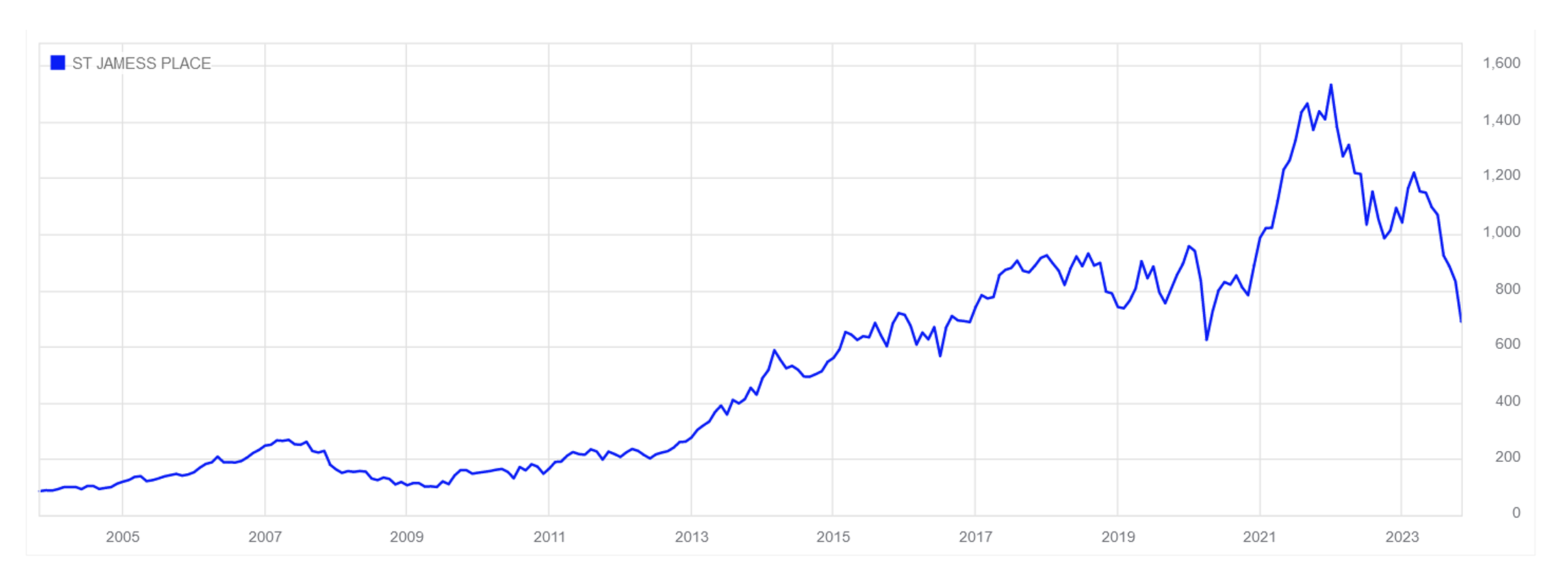
Some suggest that this is the regulator placing pressure on SJP. I might suggest that treating customers fairly (TCF) was introduced by the regulator in 2006, so one might conclude that it has taken them nearly two decades to comply. Then from 2013 fees or rather adviser remuneration had to be agreed with the client under what was known as RDR (Retail Distribution Review) and a banning of commission. The introduction of the new Consumer Duty rules in July 2023 together with some scathing pieces in mainstream media and a drop in their share price (halving since the end of July as investors appreciate that previous revenues may be ‘threatened’) all appear to have prompted appeasement. One might say that the penny finally dropped.

SJP are obviously a financially successful company, some very flattering marketing materials and beautiful offices, which would be the envy of most in the sector. Their advisers currently make up about 1 in 10 of all advisers. They are also a restricted firm, meaning that they sell a limited range of financial products and funds, unlike an independent firm who selects from the whole market.

SJP Share price (30/10-2003 -17/10/2023)

One thing is for certain, there is no denying that their 900,000 clients with around £168bn generally like what they do, despite expensive and rather poor performance of investment portfolios. The truth is that SJP are excellent at branding, and this extends to the advisers (who work and market themselves as ‘partners’) who they put in front of clients. They are well trained and very good at relationship selling (for the record – selling is a good and necessary skill and process). It’s rarely easy to move someone away from SJP by merely stating facts about price and performance.

As someone who believes that the UK needs better advice and more people in receipt of it (including politicians and their Parties), I don’t really have much of a problem with SJP other than until now it has been incredibly difficult to properly compare their charges (because they have been deliberately obfuscated – I don’t think there is another way to honestly view it). They are now set to address this which will almost certainly mean their profit margins are lower, but also that some, perhaps not many, of their clients will seek advice elsewhere.

My main gripe is that our sector needs to earn and demonstrate trust and fairness whilst having integrity. It has taken the regulator far too long to take seriously what the entire sector has known about SJP charges for decades … it’s not the amount, but the lack of clarity.

A POTTED HISTORY AND OTHER PEOPLE’S MONEY

St James’s Place was formed in 1991 but under the name of the Rothschild Assurance Group and began trading in 1992. The name changed formally in October 2000 not long after Halifax took a majority stake (60%) in the business. You may recall that Halifax merged with the Bank of Scotland forming HBOS in 2001. We had the credit crunch and despite Lloyds writing off £200m of US subprime debt in December 2007 and then seeing first half profits fall 70% in 2008, they stepped in to acquire HBOS, but traders were ripping them to shreds seeing the share price halve at one point. On October 13, 2008, Alistair Darling announced that the UK Government was bringing the banking system back from the brink, with a 43.4% stake in Lloyds. Just four months later Lloyds stunned the City announcing £11bn in losses at HBOS; and before the end of 2009, the Government stumped up a further £5.7bn for Lloyds. It wasn’t until the end of 2013 that Lloyds finally disposed of its holding in SJP just a few months before it moved from its FTSE250 listing into the illustrious FTSE100.

By way of comparison, I formed Solomon’s in 1999 and it remains independently owned and operating as an independent financial adviser. Since the outset, we removed commission from all protection products and implemented a level playing field of fees, meaning that there was no higher adviser fee for any particular investment product (Investment Bonds and Pensions normally paid advisers much more). There have never been exit penalties on anything we have arranged, except specific products such as VCT, EIS and SEIS, which is due to HMRC regulations regarding minimum durations to qualify for tax relief and nothing to do with advisers or indeed the product providers.

Clearly, we do not have 900,000 clients nor do we have £168bn under management. We have saved our clients an awful lot in costs for investments (cheaper than 99% of the sector), platforms, product selection, reduced losses and taxation. Hopefully our clients are also reassured that they have ample financial protection should the worst happen (we have seen how this has made substantial differences to those who have experienced such matters). In addition, having a clear financial plan that provides for your personal lifestyle choices rather than an assumption that you must want a yacht. Our clients are able to achieve high degree of peace of mind, whilst living in the reality of an uncertain, flawed and at times broken world.

Last exit before…2024-02-01T09:20:06+00:00

Taxing times

Dominic Thomas
Jan 2024  •  5 min read

Taxing times

Tax is perhaps one of the most divisive issues.  At the time of writing, just before the Christmas break 2023, the Scottish Government has announced that it is imposing the additional rate of income tax (45%) at a much lower level.  Unlike England and Wales, the Additional Rate will start at £75,000.

Here in England and Wales, the 45% rate starts at that “only a quango could come up with it” number of £125,140 for tax year 2023/24.  So someone earning more than £125,140 pays 45% income tax, but in Scotland the line is drawn much sooner.

By comparison, a Scottish resident earning £125,140 will pay an extra £2,507 on the same income. I doubt that the extra tax is enough to prompt thoughts about moving south, but it may well alter behaviour at the ballot box.

As a reminder, the tax rates for this tax year (2023/24) which comes to a close on 5th April 2024 are as follows:

Band Taxable Income Tax Rate
Personal Allowance Up to £12,570 0%
Basic rate £12,571-£50,270 20%
Higher Rate £50,271-£125,140 40%
Additional Rate Over £125,140 45%

These are the income tax rates on earned income, not dividends (which have lower tax rates).

If you are breathing a sigh of relief because you live in England or Wales, remember that this tax year saw the Government reduce the higher rate band so that Additional Rate begins at £125,140 rather than £150,000.

Most of us have been impacted by inflation, yet the personal allowance remained frozen as did the basic rate tax band. So more people pay more income tax. This is what the media and whoever is in opposition, like to call “stealth taxes” basically an increase in tax in real terms.

Additional Rate tax was introduced in the tax year 2010-11, and saw 236,000 people pay 45% raising £34.5billion. Ten years later, the HMRC 2020-21 data saw this number increase to 481,000. There is no doubt that whichever way one observes the data produced by HMRC, we all pay more tax.

There are of course some things that you can do about reducing tax or even obtaining tax reliefs, these are all part of a good financial plan. However what I often observe is how little attention is paid to good arrangement of financial ‘stuff’ so that you can minimise tax payments. How much and where from become really important when drawing money from your portfolio. It’s one thing to get tax relief or use an allowance, it’s another to draw money out so that you pay less than 20% tax.

I recently produced a White Paper that you may find of interest called ‘Understanding Adviser Fees’, which includes and explanation about the value that we bring. Whilst I firmly believe that every little helps, if you focus purely on costs and ignore taxes, you will quickly wonder why you bothered. You can find the paper (which is designed to be readable – feedback welcome) here.

Taxing times2024-02-01T09:21:01+00:00

The Autumn Statement – the Ghost of Christmas Past

Dominic Thomas
Nov 2023  •  2 min read

The Autumn Statement – the Ghost of Christmas Past

We are in the closing weeks of the year. Our thoughts turn to Christmas celebrations and perhaps looking ahead to the New Year. The familiarity of our traditions poses a challenge to attempts to change them, yet even the harshest of men, Mr Scrooge, managed to pay attention to what is important and change his behaviour.

I don’t think it is contentious to say that the Conservatives are a party of tax cutting and yet we currently have one of the highest rates of personal taxes in the main economies. Few of us enjoy paying taxes, perhaps because often it seems that our hard-earned money is wasted on expensive ideas and ‘kit’ that doesn’t work very well at all … anyone tried the NHS IT system or indeed any ‘converting to digital’ Governmental system, let alone the military’s ability to spend a fortune on malfunctioning weaponry to cite just a couple of examples. We all have opinions. (As an aside the Power of Attorney system is going digital in 2024, so I urge you to sort yours before they muck it up and make the backlog even longer).

The Conservatives came to power in May 2010, admittedly with the assistance of the LibDems, but then we have had an entire mess of Government ever since.

According to Jeremy Paxton in 2018, David Cameron was the worst Prime Minister since Eden:

“[He] got to the top of a tree in order to set it on fire and cleared off, put the interests of his party before the country and decided to have this referendum, believed one thing was the only right outcome for the country, didn’t campaign for it, got the opposite outcome and XXX off. It doesn’t seem like leadership to me”.

Given the PMs we have had since 2018, Cameron might actually look a lot better, the bar seems woefully low, anyway, for now Cameron is back, this time as Foreign Secretary.

The backdrop of a Covid enquiry which merely proves what most of us thought, that Mr Johnson is an unreliable character (I am being polite), we have the prospect of an election looming by the end of January 2025. The Labour party seems set on sabotage and the plethora of political open goals being squandered is lamentable. The traditional approach of appealing to the notion “everyone has their price” is in the hands of the Chancellor, who is being tempted to cut taxes now that inflation appears to be returning to a more comfortable figure (4.7% October 2023 ONS).

Which of us doesn’t want to pay less tax? In an environment of rising prices, seeing your net pay remain pitifully stagnant is irksome. Yet we also know that tax pays to keep society running in some vaguely civil way. We can all find things to disagree with, it’s almost a rite of passage into a fifth decade. It’s clear that ‘the system’ doesn’t work for all, and indeed seems to generally work best for the few. The sadness is that there seems to be so few alternatives to the binary choices we have here in the UK; stuck in traditions that don’t work for the good of the country. Creativity and visionary leadership remain sadly elusive.

There was a time when the economy was thought about as a way of serving society, yet here in 2023 we are evidently a society that is serving the economy. There is no good reason why this cannot change, and despite experience, I remain an optimist in a sufficient number of decent people.

For the record, I have no intention of offending your political beliefs, but I do think we all deserve rather better than we have had. On 22 November 2023 we shall get further notice …

The Autumn Statement – the Ghost of Christmas Past2025-01-23T10:49:36+00:00

Crypto King

Dominic Thomas
Oct 2023  •  3 min read

Crypto King

The appeal of cryptocurrencies is really twofold, firstly some people seem to be making a lot of money from investments into them. Secondly, some people seem to be making a load of money from investing into them. Oh, ok the better reason, is that digital currency enables finance to be arranged more promptly without the dreaded interference of those nasty ‘Bankers’ and avoid problems of exchange rates.

Perhaps I am oversimplifying, but the truth is that cryptocurrency is generally fuelled by greed and a belief that money is very easy to make. The evidence for investment is generally a conversation with a specialist or anecdotal discussions with friends and perhaps a bit of ‘research’ online.

Let me be clear, I am not saying that the banking system is good, it’s terrible frankly, but there is something to be said for ‘better the devil you know’ than the backroom hack shops beholden to organised crime. I am not a crypto expert, I know a couple, but as of right now in 2023, I cannot see a good reason for the typical long-term investor to muck around in the sector.

We see story after story of failed currencies and platforms, where supposed fortunes become worthless. Unlike your portfolio, there are no real assets behind most cryptocurrencies, often just other cryptocurrencies.

I will likely be proven wrong by a friend of yours who makes several million from a couple of pounds.  I can live with that, but can you live with your investment portfolio becoming worthless?

The mistakes that investors consistently make are invariably due to four key beliefs

  1. They know what they are doing
  2. They have done their ‘research’
  3. The opportunity is too good to miss
  4. This time it’s different.

Delusion is very powerful and is alive and well in all aspects of professional life. You may have read the BBC story about the ‘King of Crypto’ (Sam Bankman-Fried and FTX).  Panorama had a look at the whole sorry mess (have a look on BBC iplayer).

Crypto King2023-12-04T12:17:19+00:00

Don’t leave it to the last minute

Dominic Thomas
April 2023  •  3 min read

Don’t leave it to the last minute

One of the things we take seriously here at Solomon’s is finding ways to improve what we do for our clients and how we do it.

The tax year end period in the last few years has been very busy indeed with a number of transactions being processed very close to the deadline of 5th April.  The team here (once again) stepped up marvellously this year and we all worked incredibly hard to ensure good outcomes for all – but we would like to try and ensure that we don’t have a similar ‘last minute rush’ next year!

So what’s the answer?  Possible solutions rely fairly heavily on our clients joining with us in our endeavours.  I have been encouraging clients for many years to set up monthly Direct Debit payments to ISAs and pensions (where appropriate) and many of our clients are now doing this (and reaping the benefits of pound cost averaging – see our video here!).  I would be happy to discuss this with you if you haven’t already had ‘that conversation’ with me.  The alternative (for clients who are able and would prefer to make their contributions in lump sum payments) is to make sure that you do this as early in the tax year as possible (you can invest from the 6th April onwards).

Don’t leave it to the last minute2025-01-28T10:04:43+00:00

Inflammatory budget?

Dominic Thomas
March 2023  •  10 min read

Inflammatory budget?

These are the days of being offended. It seems that, unsurprisingly, opposition parties and in particular the Labour party are having kittens about announcements around pensions in the Budget. The criticism is that this helps the rich and not the poor. There is some truth in this of course, but this goes to the political heart of wealth redistribution. In case you are concerned about my political bias, I don’t like any of them.

A million pounds seems like a lot, (it is!) but it’s not as much as it was. The sense we have of £1m is due to ‘anchoring’ as most of us grew up believing that £1m was a lot of money; a millionaire was a very rich person. Search for a home online in the south east and quickly you appreciate that perhaps a million doesn’t buy very much. The TV show “Who Wants to be a Millionaire” with the prize of £1m was first aired in April 1998, almost 25 years ago. £1m then bought you rather more than the same prize fund does today. In fact in real terms, the prize should be adjusted to £1,776,802 … but that doesn’t really fit with the show’s title.

An adult approach is of course to recognise the impact of inflation. I’m going to speculate that politicians know this, but are always selective about the things that vex them. Your house is worth more perhaps because you have done some refurbishment, but also due to inflation. Anyone living in the South East (or indeed swathes of the country) knows that house prices are eye-watering and this is a problem for those trying to buy and for those paying inheritance tax. Inflation in house prices has been higher.

THE PENSION REFORMS WERE REALLY ABOUT NHS CONSULTANTS

The main thrust of the pension reforms are aimed at NHS Consultants, because they have been leaving in droves, because simply by working a normal week they end up owing tax on income that they have not had, in a pension they dont get until 67 at best. Ask any doctor. If we assume health and the NHS is important, it would seem that Labour politicians suggesting that they will reverse pension changes announced in the Spring Budget 2023 have not understood very much at all. If Labour are serious about looking after the health of the nation, we need to rethink pension rules that basically punish them from working. Sadly, few politicians understand the true impact of pension rules.

An alternative would perhaps be to have a simplistic approach, cut doctors and those in similar schemes out of the annual allowance tax calculations entirely. I suspect this would make them happy, it would certainly make my life easier. However the NHS pension is a Defined Benefit or Final Salary scheme, what you do for one, legally you have to do for others. The only other group of people with excellent “old school” final salary pensions are people with long service in big companies or institutions and almost certainly on high incomes – precisely the sort of people that Labour seem to loathe along with their multinational employers. So such a “cut out the problem” isnt actually a solution.

Reality is always an irritation for an MP or political party of any persuasion. A few non-partisan (I hope) facts for you to consider. The last time Labour won an election was in 2005. David Cameron formed a Coalition Government following the election in May 2010 (tax year 2010/11).

  1. Under the new proposals, those earning £200,000 or more do not get an automatic allowance of £60,000 into pensions. This is the threshold at which a lot of calculations need to be done, some doctors will still have to do this. As a result, they may well suffer a reduced annual allowance (how much they can put into a pension).
  2. Those earning £260,000 or more will certainly have a reduced (tapered) annual allowance from £60,000 and will need to do some sums.
  3. Those earning £360,000 or more can only contribute £10,000 gross into pensions, which is less than they can pay into an ISA. So these three facts would suggest that Labour are not happy that people paying 45% tax and have no personal allowance are somehow able to load pensions like a kid in a sweet shop. Its not true.
  4. The tax-free cash from a pension is capped at 25% of today’s lifetime allowance (£268,275). That means those retiring in the future have an allowance that does not keep pace with inflation, meaning in real-terms lower tax-free cash sums will be available. Tax-free cash of 25% of £1.8m or Primary/Enhanced protection, was higher under the last Labour Government than at any point since. Pension income is taxable, it is a future revenue for HMRC. It is also a possible solution to care costs rather than the State paying, I digress.
  5. The last Labour Government had an annual allowance (how much can be paid into a pension) of £255,000, there was no Tapered or reduced Annual Allowance.
  6. The main gripe of Labour about salary austerity wage inflation would appear not to apply to pension benefits being inflation/austerity-repaired since 2010. In short, the LTA would be £1.8m+ inflation, the Annual Allowance would be £255,000+inflation. Tax-free cash from pensions would be higher at a minimum of £450,000+ inflation. Additionally, the £100,000 income threshold for loss of the personal allowance has reduced in real terms. In short they are using the same facts to argue for higher wages, but not higher allowances that benefit… well, taxpayers.
  7. A-Day was introduced by Labour and will turn adult (18) on 6/4/2023. Perhaps adults should be allowed to save for their own financial independence rather than penalised/restricted on both what you can pay in and what you can take out. The original intention of pension simplification and A-Day was to increase the Lifetime Allowance, it started at £1.5m and increased substantially each year until 2010.
  8. The current Government will, from 6/4/2023 take more tax, starting the 45% rate of tax at £125,140 rather than £150,000. There are more people are paying additional rate tax.
  9. The personal allowance is currently £12,570 (up substantially from 2010 but removed from those earning over £100,000. In tax year 2009/10 it was £6,475, the rule to gradually remove the personal allowance for those earning £100,000+ came into effect in 2010/11 set by Labour, in the likely event of a change of Government and in light of the credit crunch.
  10. According to the Bank of England’s own inflation calculator, £100 in 2010 would be £141.10 now. If this were applied the following might be observed.
  • The £6,475 personal allowance would be lower at £9,155.82 (its actually £12,570, so brownie points for Conservatives?)
  • £100,000 income before loss of personal allowance would be £141,402 (it’s still £100,000)
  • The Lifetime allowance of £1,800,000 would be £2,545,248 (its currently £1,073,100 and about to be abolished, this is what they are complaining about)
  • 25% tax free cash would be £636,312 but it is not even half that amount, capped at £268,275, reducing in real terms every year.
  • The annual allowance of £255,000 would have become £360,576, yet apparently it is act of serving the wealthy to increase it from 6/4/23 from £40,000 to £60,000. Note that those “rich people” earning over £360,000 will be able to put in £10,000 as opposed to £4,000 into their pension, which has been the case for several years now. Just for the record someone earning £360,000 pays a lot of income tax.
  • In Labour’s last tax year, the basic rate of income tax (20%) applied to £37,400 if this had been linked to inflation, it would now be £52,885, the higher rate extended up to £150,000, which would otherwise be £212,104. In short, Conservatives have evidently cut allowances and increased tax

Chancellors of all persuasions have a knack are implying positive changes are their own doing all whilst completely ignoring the impact of inflation. You think you have been paying more tax? Well, clearly you have. We all have paid for the mismanagement of the economy by our underqualified political masters. Despite what is said in the media, even by supposed pension experts, if you earn more than £360,000 you can only place £10,000 into a pension and get tax relief, for the record a minor (child) can place £9,000 into a tax free Junior ISA.

We will have to see if Labour really will win an election and then change the lifetime allowance again. It seems entirely unhelpful to keep messing around with people’s planning for retirement and financial independence, apparently this is democracy in action. It would seem that politicians from both parties do not really like you benefitting from earning more, particularly if you earn between £100,000 and £200,000 or have I missed something? As for the media, well they don’t like you either unless you own the newspaper you are reading.

Inflammatory budget?2023-12-01T12:12:35+00:00

THE SPRING BUDGET 2023

Dominic Thomas
March 2023  •  10 min read

Pension reforms of sorts…

If you are under 75 and have a pension, today is a better day than yesterday. You may breathe a sigh of relief; the Chancellor has done something to directly benefit you. As with all Chancellors, there is of course some politics at play. Whatever your view of the rabble at the House of Commons, we finally have a Chancellor who seems to both understand maths and has an ability for some long-term thinking as well as valuing the concept of financial independence in his Spring Budget 2023.

As a reminder, it was the Blair Government who introduced the Finance Act 2004 which ushered in new pension rules from April 6th 2006 known as A-Day and termed “Pension Simplification”. The basic premise was to simplify pension funding, enabling anyone to make payments and get tax relief, restricted by a maximum annual contribution allowance and a lifetime allowance for the value of your pensions, be they final salary or investment based. It sounded so simple, something akin to the battery level on your mobile phone.

Next month, “pension simplification” turns 18 years old. Simple is certainly not a term that anyone would consider in the same breath as pension rules. A veritable smorgasbord of metrics are needed to monitor if you fall foul of the rules.

A-DAY TURNS ADULT

Today though, Mr Hunt has abolished the Lifetime Allowance, a welcome and grown up but unexpected move (it had been hinted that it would return to the level at which the Conservative Government inherited it at £1.8m. No, it’s abolished, completely! The Lifetime Allowance, which is something everyone had to assess pension benefits against will be gone from 6th April 2023. Do not retire before then – or more accurately do not crystallise any pension until then.

ANNUAL ALLOWANCE – UP BUT STILL TAPERED

He has not however returned the Annual Allowance to the 2010 level of £255,000 but has increased it from £40,000 to £60,000. In addition, the Tapered Annual Allowance has not been scrapped, but increased from £240,000 to £260,000 from 6 April 2023. The threshold test at income of £200,000 has not been altered. In theory therefore the new standard annual allowance of £60,000 will still reduce by £0.50 for each £1 over £260,000 but stopped at £360,000 when you will get the minimum maximum annual allowance of £10,000.

By way of example, someone with income of £300,000 would be £40,000 over the £260,000 threshold and thus see the annual allowance reduce from £60,000 to £40,000.

Those of you that have taken income from a personal pension (not a defined benefit/final salary pension) will be able to continue towards a pension under the Money Purchase Annual Allowance (MPAA) which is being increased from £4,000 back to £10,000. I understand this will double up as the minimum maximum (if you see what I mean) that anyone with income over £360,000 can also contribute (gross).

NEGATIVE TURNS POSITIVE

Medics (and a few others) that on occasion have a negative pension value for the year will now be able to offset this, something that was not possible previously.

25% TAX FREE CASH IS GOING FOR BIG PENSION POTS

There is a slight “fly in the ointment”. Under pension rules tax free cash is capped at 25% of the fund value, buried in page 100 of the Budget is the statement that advisers understand but most investors do not. “The maximum Pension Commencement Lump Sum for those without protections will be retained at its current level of £268,275 and will be frozen thereafter”. In other words, the tax free cash lump sum (PCLS) link is to be broken. 25% of the current lifetime allowance is £268,275 and this is therefore being retained, meaning that whether your pension fund is more than this, you cannot withdraw more than £268,275 as a tax free lump sum. In plain a pension fund of £2m does not produce tax free cash of £500,000 (25%) but £268,275.

One other “minor” point is that those with Primary, Enhanced, Fixed or even Individual Protection from 2006, 2012 (max £450,000), 2014 (max £375,000) and 2016 (max £312,500). Therefore some people will have a higher tax free cash entitlement than the new limit of £268,275).

ISAs, JISAs, VCTs, EIS, SEIS

All as previously.

INCOME TAX, CORPORATION TAX, CAPITAL GAINS TAX, INHERITANCE TAX

As previously announced for 2023/24.

On occasion, Budget plans get revised (remember the glove puppet of a PM?) so there is a possibility that after a little more thought, pressure and checking, some of the points in the Budget might need a tweak, but in general this is a rarity.

If you have questions, that I have the realistic possibility of answering (not “where is Cloddach Bridge?” which gets a sum for refurbishment…. which I imagine is one of those times we may remark, “what, a million pounds?” (actually £1.5m) is either a lot or a little, that old price and value thing… much like the criticism that will inevitably be made of the abolition of the lifetime allowance, which is, from my perspective of working with you, a very good thing indeed.

THE SPRING BUDGET 20232025-01-27T17:01:00+00:00

Tax year ending

Dominic Thomas
Feb 2023  •  12 min read

Tax year ending!

There are not many weeks left of the 22/23 tax year, which ends on Wednesday 5th April. As a brief reminder of the key issues, I have done a quick summary … if you are not sure of what you have used or what you can use, please get in touch with us as soon as you can.

PENSIONS

  • Everyone under the age of 75 can contribute £2,880 into a pension and get basic rate tax relief, irrespective of any income. This is as close as it gets to ‘money for nothing’
  • The annual allowance of £40,000 applies to those with incomes of £3,600 – £240,000. You and an employer may contribute up to 100% of your earned income (capped at £40,000) between you
  • Those earning over £240,000 need to be careful; your allowance reduces by £1 for every £2 of income over £240,000 until it reaches £4,000 – which includes any employer payments

ISAs – INDIVIDUAL SAVINGS ACCOUNTS

  • Any adult can invest up to £20,000 over the course of the tax year into an ISA which grows free of income tax and capital gains tax
  • Those aged 18-40 can use a Lifetime ISA allowance of £4,000 if this is for a deposit on a first ever home. The Government will add £1,000

CAPITAL GAINS

  • If you are selling an asset / investment (which would include rebalancing them) this triggers capital gains. The 22/23 allowance is £12,300 of gains before you pay any tax, but this is falling in 23/24 to just £6,000 and then £3,000 the following tax year. So if you are going to do this anyway, I would encourage you to get on with it – perhaps you have some shares that you don’t really want …
  • Trusts also pay capital gains, but only have half of the personal allowance, so even more incentive to take profits and rebalance
  • You can delay payment of capital gains tax using some investments (ask/see below)

INCOME

  • If your income exceeds £100,000, you begin to have your personal allowance of £12,570 reduced by 50p for every £1 above £100,000. The personal allowance is the amount of income taxed at 0%. So it would be prudent to have bonuses paid into pensions for example
  • Dividends – the first £2,000 of dividends is tax-free in 22/23
  • Interest for non or basic rate taxpayers is 0% on the first £1,000 of interest (savings allowance) and £500 for higher rate taxpayers. Additional rate (45%) taxpayers don’t get the allowance. As some deposit accounts now pay 3% or 4%, you may be drawn into this (a higher rate taxpayer only needs £16,666 in savings earning 3% interest of £499. You need to declare all income to HMRC through self assessment
  • If you really must insist on a cash ISA (please only for ‘short-term parking’ of money) then this would ensure the interest is tax-free, but rates on cash ISAs are much lower than savings accounts now
  • If you are not using your full personal allowance and have investments that provide taxable income, this may be a sensible moment to trigger income that uses your allowance
  • If you rent a room in your home, there is a tax-free rent-a-room allowance of £7,500

ANNUAL GIVING

  • You can gift £3,000 to any individual without recourse to tax by the recipient or your estate. If you do any substantial giving please put a scan of a signed note of this on our portal
  • If you are feeling generous, you are also permitted to gift your newlywed children £5,000 or grandchildren £2,500

SPOUSE ALLOWANCES

  • If you have a spouse who does not earn up to the personal allowance of £12,570, you can elect to have 10% of this (£1,257) added to your own allowance
  • Spouses also can benefit from sharing assets and effectively doubling exemptions and allowances

ALTERNATIVES & HIGH-RISK INVESTING

It is generally thought that VCTs, EIS and SEIS are really for more sophisticated investors, about 3% of the population. All are long term in nature – meaning 6-10 years. Unlike your portfolio elsewhere (which – if we are managing it – will be an enormous portfolio of global equities), these are very small by comparison. Do not do these on your own unless you know your Sharpe ratio from your Beta. Unlike the above, the investments below can experience permanent loss:

Venture Capital Trusts

  • Tax-free income from your investment
  • Tax-free capital gains
  • Tax relief of 30% on your initial investment (tax reducer)

Enterprise Investment Schemes

  • 30% tax relief on your investment
  • The ability to defer owed capital gains tax
  • Loss relief
  • Exempt from inheritance tax

Seed Enterprise Investment Schemes

  • 50% tax relief on your investment
  • Reduce your due capital gains tax bill by 50% immediately
  • Exempt from inheritance tax

DON’T FORGET

Income taxes are tiered. Each slice of your income is taxed at a different rate.

Band Taxable income Tax rate
Personal Allowance Up to £12,570 0%
Basic rate £12,571 to £50,270 20%
Higher rate £50,271 to £150,000 40%
Additional rate over £150,000 45%

Please remember that HMRC will apply penalties for late payment and fines for non-payment which can result in the very worst of punitive measures – a custodial sentence.

As ever, be sure of two things – death and taxes. Neither are terribly welcome.

Tax year ending2025-01-21T16:33:56+00:00

Tax deadline: 31 Jan 2023

Dominic Thomas
Jan 2023  •  8 min read

THE TAX DEADLINE – 31 JAN 2023

As I write the 31 January 2023 tax deadline is fast approaching. Hopefully if you are self employed or have some taxes to pay, you have set aside the funds to pay your dues to HMRC. Few of us like paying taxes, yet we all know how vital they are. Some people brag about how little tax they pay, even scoffing as they “stick it to the system” including the male that managed to convince Americans in the United States to elect him as President.

We have our own politicians with tax problems of course. This is nothing new. The complexity of international taxes and in particular offshore tax havens makes it all rather fuzzy, let alone some of the nefarious companies in which investments are held.

I suspect that you are affluent enough to be concerned about the custodial penalty if you fail to pay your taxes, not poor enough to dismiss it and not rich enough to presume you will be able to pay for the legal representation to keep you safely excluded.

Whether we like them or not, and I do appreciate that sometimes it feels as though we are simply working for HMRC, but tax pays for lots of our societal benefits. Roads to justice, welfare to pensions, care and healthcare, education and defence. Certainly there is a lot wasted and we seem set to remain locked in a battle of ideologies about how to make the system fairer and popular.

Our role is to ensure that you don’t pay tax unnecessarily. For example, consider wanting to withdraw £10,000 to spend from your investments.

Whilst we live in an imperfect world where Chancellors, Prime Ministers and Governments are quickly replaced, much like the rules and policies that they introduce we do our best to minimise taxes, which have an enormous impact on your investments.

Tax had a bigger impact on returns

Whilst journalists get very vexed by charges on investments, in the 2022/23 tax year there are lots of different rates of tax, these get altered regularly. Currently tax rates include 0%, 8.75%, 10%, 18%, 20%, 25%, 28%, 33.75%, 39.35%, 40%, 45%, 55% or 60% tax to draw money from your investment, this rather puts things into perspective. We attempt to minimise tax so that you do not pay it needlessly.

The table below shows the enormous difference in the amount you would actually have to withdraw in order to end up with £10,000 post taxes. Irrespective of how you vote, these are accurate tax rates for 2022/23.

TAX RATE GROSS WITHDRAWAL TAX PAID NET YOU KEEP
0% £10,000.00 £0 £10,000
8.75% £10,958.90 £958.90 £10,000
10% £11,111.11 £1,111.11 £10,000
18% £12,195.12 £2,195.12 £10,000
20% £12,500.00 £2,500.00 £10,000
25% £13,333.33 £3,333.33 £10,000
28% £13,888.89 £3,888.89 £10,000
33.75% £15,094.34 £5,094.34 £10,000
39.35% £16,488.05 £6,488.05 £10,000
40% £16,666.66 £6,666.66 £10,000
45% £18,181.82 £8,181.82 £10,000
55% £22,222.22 £12,222.22 £10,000
60% £25,000.00 £15,000.00 £10,000

The above table ought to indicate how important it is to have the right advice and a good understanding of the UK tax system of allowances, reliefs and exemptions. Sadly we cannot rely on Government to simplify taxes or even maintain levels predictably.

Clearly using investment products and solutions that prevent tax or enable you to minimise it through careful management makes a lot of sense.

As the new tax year 2023/23 approaches (6th April) many of us will likely find ourselves paying rather more tax.

UK HMRC Tax Receipts 2021-22

Tax deadline: 31 Jan 20232025-01-21T16:33:56+00:00
Go to Top