
The November budget

The November budget

The problem of having a deadline for publication is that life tends to throw up some new important information just at the wrong time. The chaos of the ‘mini-budget’ resulted in a new Prime Minister and Chancellor. The Budget on 17th November was set to herald tax rises. So, what has been announced?

NOVEMBER – INCOME TAX

Tax thresholds have been frozen, save the additional rate of tax threshold, which now begins sooner, meaning that more people will pay 45% tax, starting at £125,140 instead of £150,000. What this means in practice for someone now brought into additional rate (earning £150,000) is that they pay 5% more income tax on their earnings above £125,140.  If you earn £150,000 you would pay £1,243 more income tax as a result of this change, (£11,187 as opposed to £9,944) effectively £103.58 a month more. Whilst politicians talk of short-term pain, the projections show this measure for 5 years.

NOVEMBER – CAPITAL GAINS TAX

Capital Gains allowances have been cut substantially, reducing from £12,500 to £6,000 from April 2023 and then to £3,000 from April 2024.  Trusts have a CGT allowance of half the personal allowance. So realising gains this tax year will be more effective than in future years.

As a reminder, this is the permitted gains on assets being sold with a 0% tax rate before being taxed at 10% or 20%, unless that asset is a second property in which case its 18% or 28%. So if you are a landlord, sell before April 5th to maximise your allowances.

I had expected the rates of tax to increase in line with income taxes rather than the allowance being altered and mostly scrapped entirely. In any event, capital gains tax allowance reductions makes your annual ISA, Pension, VCT, EIS allowances all even more attractive, sheltering funds from CGT in different ways.

NOVEMBER- DIVIDENDS

The Dividend allowance has also been slashed. This will mostly impact those with a small business whereby family members or staff can have a share of profits (dividends) tax free. The first £2,000 of dividends are currently tax free, this will reduce to £1,000 from the new tax year and then £500 in the next ..

NOVEMBER – PENSIONS

It would seem that there are no changes, which is frankly a bit of a surprise. The annual allowance remains at £40,000 unless you have income over £200,000 when a reduced (tapered) allowance would apply. The Lifetime Allowance has remained in place. If you are an NHS employee, I cannot find anything in the 70 page statement to help you with your annual allowance problems and there is nothing about the tapered annual allowance. So, sadly, more senior doctors will likely reduce their NHS hours or otherwise face tax charges on income that they have not had. We can help crunch the numbers, but if anyone is in a position to ‘get it’, Mr Hunt is but seems to have chosen not to.

NOVEMBER – STATE PENSIONS

If you are receiving your State Pension, it’s going to increase by 10% in April. If you haven’t started taking yours, well you are also likely to have to wait until you are much older to get one. Everyone knows this is a political ‘hot potato’ and the younger generations are unlikely to receive a State Pension until at least 68 (and this will probably be increased in the announcement in early 2023).

NOVEMBER – FEELING FROZEN?

You are going to need to ‘let it go’ … that is – hopes of seeing the end of frozen allowances ending any time soon. The personal allowance, slice of basic rate and higher rate tax tiers were all frozen anyway, but the deep freeze has been extended by two further years. Due to inflation and rising salaries, this will in itself raise more tax. This is part of what critics call ‘stealth taxes’ – the sort you don’t really register (much like inflation eroding your cash) – you only tend to notice after a few years of going backwards.

The Energy Price Guarantee will be maintained through the Winter, limiting typical energy bills to £2,500, this will increase to £3,000 from April. It is generally expected that energy prices will remain high for the next 12 months. To be blunt, nobody knows because it all rather depends on the Russians. One point to note is that the energy savings you may be making now will likely continue as the Government intend to reduce energy consumption by 15% by the end of the decade. To put that into perspective, that’s about the same as making your use of energy in 10 months last a year.

PROPERTY

The British obsession with houses continues to be supported by Government policy. The tax when buying property (Stamp Duty Land Tax) was reduced in September doubling the first tier of SDLT with a 0% tax rate from £125,000 to £250,000. For First Time Buyers this is extended from £300,000 to £425,000. These measures will end on 31st March 2025. If you are going to move or buy your first home and want to benefit from this fully, do so before March 2025.

You can read more articles about Pensions, Wealth Management, Retirement, Investments, Financial Planning and Estate Planning on my blog which gets updated every week. If you would like to talk to me about your personal wealth planning and how we can make you stay wealthier for longer then please get in touch by calling 08000 736 273 or email [email protected]

The November budget2023-12-01T12:12:41+00:00

If Carlsberg made politicians

If Carlsberg made politicians

… they wouldn’t look much like the current bunch. As I write, it’s Monday morning, a new day, new week, new Chancellor and the continued conversation around whether the current Prime Minister is (or ever was) fit for purpose. The new Chancellor was handed the ultimate hospital pass and elected to pretty much shred his predecessor’s “mini budget”. Most people have an opinion on this and I’m going to make the wild assumption that you will have yours already.

So what has changed? The underlying problems that all countries have is income versus spending, this sounds familiar to anyone who has a financial plan. The only real difference is that a country doesn’t have an expiry date … at least in the normal course of life, and barring the ultimate catastrophe, we expect our nation to continue into the future, well beyond ourselves. As a result, money needs to last and debts ultimately need to be repaid or at least sustained.

So where are we in terms of your tax … essentially where we were a few months ago. Some rising taxes (full details yet to be released) and rising inflation, though hopefully this will begin to abate due to the recent interest rate rises, but we aren’t through the woods yet.

The supply chain problems caused by Brexit, the pandemic and a war in Ukraine have all pushed prices up and delayed delivery of many goods. The knock-on effects are significant and particularly to Britain, who deliberately decided to end global trade agreements and still do not have one with the United States.

Price rises lead to pressure on personal spending, savings levels tend to fall (hence interest rates are increased to encourage saving and reduce spending). Businesses face a cycle of holding off rises whilst trying to remain competitive but facing serious challenges on most fronts, from the very basic ‘heating the building’ to agreeing international contracts where the pound is ‘precarious’. We have been here before and there are always casualties. What has vexed (and angered) markets recently in particular has been the unwillingness to state assumptions in the plan.

Your financial plan always needs to be adaptable. We review this together every year. Perhaps some changes need to be made, but remember that your portfolio is global and not UK centric. The UK stock market is about 6% of the global market. So, let’s keep things in proportion. The problems are not unique to the UK (except Brexit).  Facing problems is always better than ignoring them.

It would seem likely that 2022 will be one of those negative years for markets. The brave see this as an opportunity to buy cheaply; the nervous panic and sell. Those with a long-term mindset know this truth but how it is felt is always a challenge to our nervous system. Those with the best financial planning are those that adapt in the short term but stick to the long-term plan, for probably the best planning in the world …

You can read more articles about Pensions, Wealth Management, Retirement, Investments, Financial Planning and Estate Planning on my blog which gets updated every week. If you would like to talk to me about your personal wealth planning and how we can make you stay wealthier for longer then please get in touch by calling 08000 736 273 or email [email protected]

If Carlsberg made politicians2025-01-28T10:05:26+00:00

The mini budget – Sept 2022

The mini budget – September 2022

You may have gathered that I ended up pouring myself a stiff drink after I listened to the ‘mini budget’ last week. To say that it wasn’t quite as expected would be an understatement. Some would have us believe that we live in an age of being offended by any old opinion, the truth is quite different, but as ever these societal messages all have a purpose to serve, just usually not yours or mine. I felt the heading here ought to have a date, as there may be another one along any minute now … it’s a bit of a mini adventure!

Setting aside partisan politics, which is relatively easy to do these days, because no party looks anything like they should. I give you the budgie … I mean budget, a mini one, though probably one of those BMW minis on steroids that runs off a wall socket and can easily swallow a double bed.

TAX CUTS

We had tax cuts… well, more accurately, we have been promised tax cuts from April and National Insurance cuts from November. Anyone who has built up 35 tax years of NI payments since 16 will barely wake up to this marvellous news, the rest however have had an increase removed … or it will be. A saving of 1.25% within the NI threshold. As a well-known supermarket may say, every little helps … yes – if you believe that somehow your NI is not simply another tax, that for most of us is the price of membership to get a State Pension. Yes, it does provide a few other things.

A BRIMFUL OF ASHA ON THE 45… (YOU KNOW, OR YOU GOOGLE)

The big news is really the additional rate of tax being abolished. That’s the extra 5% tax that anyone with income over £150,000 must pay. Instead, they will simply continue to pay 40% on all income from the higher rate threshold. That also means that the additional rate is abolished on dividends and additional rate taxpayers can have back a £500 personal savings allowance (non-taxpayers and basic rate taxpayers have £1,000 allowance, higher rate taxpayers £500). That’s £500 of interest tax-free (all interest is taxable, it’s just that there is a personal savings allowance, which until the recent interest rate rises you’d need £50,000 to £100,000 on deposit to achieve).

For context, anyone earning £150,000 does not get a personal allowance of £12,570 which has a 0% tax rate … apparently, they don’t deserve it. Anyone earning over £240,000 a year (heaven forbid – it’s actually just about enough to get a mortgage to buy a 2up2down terraced house in Edna Road, SW20) can only contribute 10% of the £40,000 annual allowance towards a pension, meaning they are actually penalised from saving into pensions. If you are an NHS doctor in the pension scheme, you don’t even have to earn anything like these sums to get clobbered with tax on money you will not get until you retire, as you well know, but Joe Public seems oblivious to. These measures have not been altered, but the great injustice of the day is to allow them to retain an extra 5% of income above £150,000. That’s 5p in every £1 or £5,000 for every £100,000 (on which they still pay 40% or £40,000 in every £100,000).

STYLUS and STYLE LESS

What we deem fair depends on who you are and what you earn. However, one thing is clear, the Chancellor has failed to read the room, much like he did at a recent funeral. This is the age of appearances, in all but hairstyles (I write with no sense of envy at the naturally enforced lack of one).

What we have is messages that miss the target, appearing to help and appease the ‘wealthy’ which I would argue is never income, always capital when talking about money. When many will evidently struggle to pay for power and heating this winter (our little office in SW20 has had a tenfold increase, 10x good grief, I am definitely in the wrong industry!). The appearance and indeed the impact of the cuts is woefully poor messaging. Bankers’ bonuses being uncapped to most of us sounds insane, until you realise that the cap resulted in higher salaries (fixed costs) for poor performance and many that couldn’t keep the score they wanted decided to pay income tax in Paris, Frankfurt or the Caymans… scrap that last one. Anyway, keeping them here paying 40% of everything seems logical to me as opposed to nothing of nothing.

But facts don’t make for good news or even bluff and thunder. Equally neither does the promise to pay for it all at some point in the future. This is the age-old problem of Government printing money (Bonds) as an IOU and hoping enough of us buy them and believe that, as previously there will be enough tax revenues to enable them to keep paying the coupons (interest) and ultimately return the capital at redemption date.

THE GREAT RECKONING OR REDEMPTION?

Redemption is perhaps the right word – can Liz Truss salvage the car crash of politics that Mr Johnson left. Johnson has had many forgive him, at least three wives have done so at times. Whether this is a gamble that Truss has the hand or nerve to match remains to be seen. I am hopeful; but deeply sceptical. As she clearly can drive a tank, I won’t suggest we watch to see if she can parallel park a mini.

WHEN LESS IS LESS (YES REALLY)

Side note. Lower basic rate tax at 19% means on the first £37,700 (after the personal allowance) you will pay income tax of £7,173 rather than £7,540 a saving of £377 a year or £31.42 a month … the milky bars are on me! (I jest at the price of confectionary and anyone old enough will recall the advert).

Additional side note, that means your basic rate tax relief on pensions will also reduce from 20% to 19%. In maths we can relate to, £81 invested by you sees £19 added by HMRC rather than £80 and £20. So for those paying say £300 gross a month into a pension (as I advise many people to do even if retired and under 75) that means you will now pay £243 a month rather than £240 (from 6th April). Yes it costs a little more…. it’s the classic giveth and taketh away (all Chancellors do this).

I imagine you may have questions, some are being answered by the markets (which seem to be calling this a game of bluff and double-bluff). Some will appear in your newspapers, though I suspect they will be full of rather more conjecture and opinion than fact. If you wish to genuinely understand the impact of reduced taxes on your wealth, get in touch or hold fast until your next review. We are all playing the long game here, but none of us know how long.

No politicians were hurt in the writing of this article.

According to the ONS in 2020/21 the average disposable (after tax and NI) income is £37,622 but the median (the mid-point if you lined up everyone) is £31,385. If you separate out the non-retired and retired, the former has an average of £39,349 and mean of £32,934. Retirees see this considerably lower at £29,408 and £25,405. It is generally true that retirees have no mortgage payments and unless they are our clients, apparently never have any fun either (joke!).

Government Sanctioned information here

You can read more articles about Pensions, Wealth Management, Retirement, Investments, Financial Planning and Estate Planning on my blog which gets updated every week. If you would like to talk to me about your personal wealth planning and how we can make you stay wealthier for longer then please get in touch by calling 08000 736 273 or email [email protected]

The mini budget – Sept 20222025-01-23T10:49:37+00:00

TAX TRUTHS – A PARTY OF TAX CUTTING?

TODAY’S BLOG

NEW TAXES CLAIM £50BN AHEAD OF NI RISES

I’m going to assume that you are old enough to know that what a political party says and what it does are not the same thing at all. Here in the UK we tend to vote for the “least bad” option, at least, thats the only way I make sense of it.

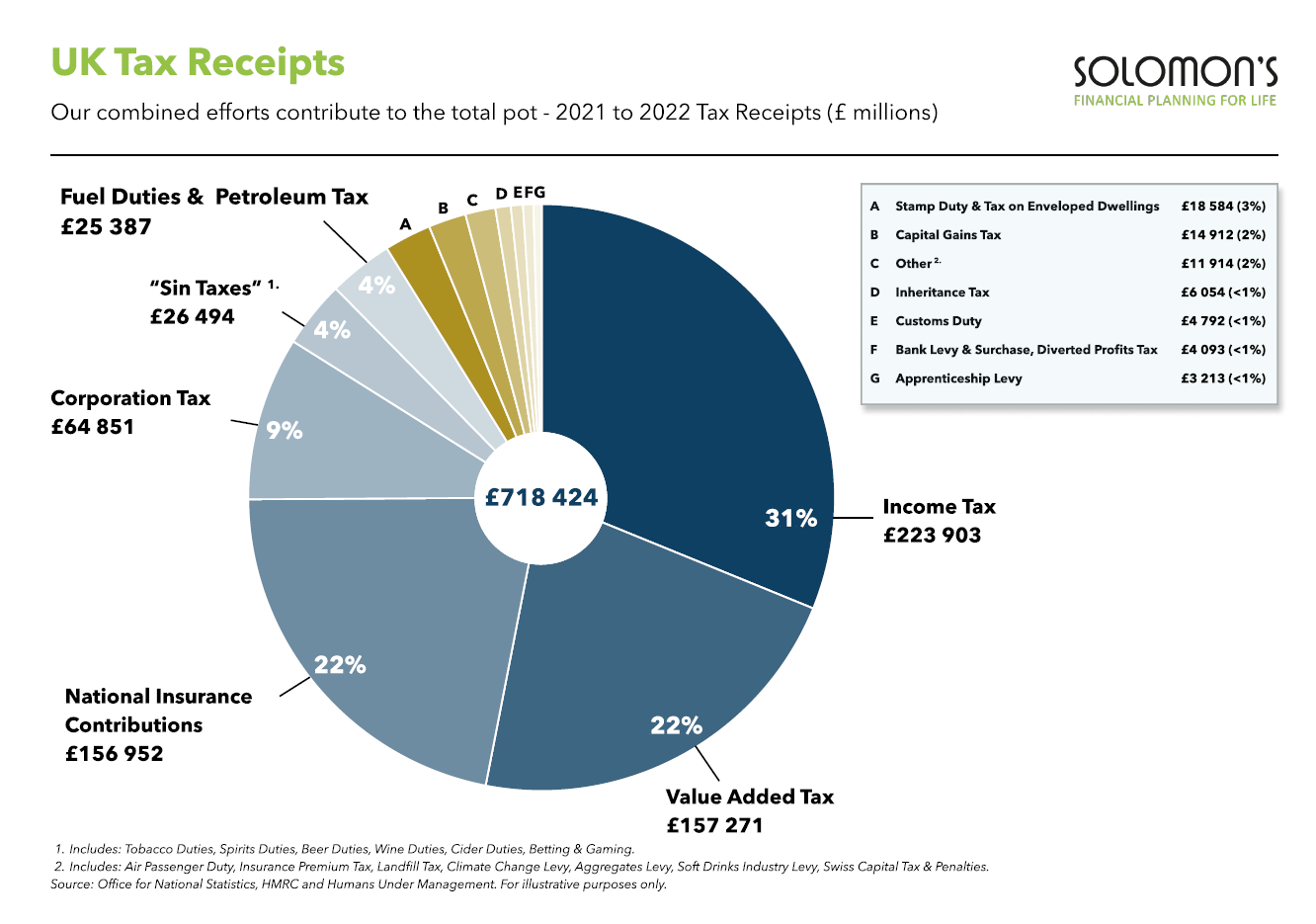
New levies imposed on businesses over the last decade have raked in more than £50bn for the Treasury, as the UK’s tax burden rises to its highest level since the 1950s. The bank levy, apprenticeship levy, soft drinks tax and a range of other charges have all contributed to the public purse, according to analysis by Thomson Reuters.

It comes as National Insurance is set to rise in April 2022, adding 1.25 percentage points to the tax levied on employers and on their workers’ pay packets. These new taxes have proven themselves to be a successful way to bring in billions of pounds in a relatively short space of time. The new National Insurance surcharge is sure to be a success from a public purse perspective, but will add considerable financial and compliance stresses to both businesses and individuals.

The extra National Insurance fee, which will be known as the health and social care levy from 2023-24, is set to raise around £17bn per year, outweighing even the largest of the previous new taxes.

Here is a link to NI rates for 2022/23

SOFT DRINKS TAX

GET IN TOUCH

Solomon’s Independent Financial Advisers
The Old Mill Cobham Park Road, COBHAM Surrey, KT11 3NE

Email – [email protected] 
Call – 020 8542 8084

7 QUESTIONS, NO WAFFLE

Are we a good fit for you?

GET IN TOUCH

Solomon’s Independent Financial Advisers
The Old Mill Cobham Park Road, COBHAM Surrey, KT11 3NE

Email – [email protected]    Call – 020 8542 8084

7 QUESTIONS, NO WAFFLE

Are we a good fit for you?

TAX TRUTHS – A PARTY OF TAX CUTTING?2025-01-21T16:33:57+00:00

THE AUTUMN BUDGET 2021

TODAY’S BLOG

THE AUTUMN BUDGET 2021

In terms of your personal finance, not a lot has changed. Indeed, most of the announcements merely confirmed previous announcements, such is the way of our politicians. As a reminder, the next tax year begins on 6th April 2022. The main changes for most are really for those that receive dividends or pay National Insurance

iNCOME TAX RATE ON DIVIDENDS 2022/23 2021/22 (NOW)
Basic rate taxpayer 8.75% 7.50%
Higher rate taxpayer 33.75% 32.50%
Additional rate taxpayer 39.45% 38.10%
Rate for Trusts 39.35% 38.10%

National Insurance for employers increases from 13.8% to 15.05% which basically makes it more expensive to employ people. Employees will also pay rather more at the main rate, rising from 12% to 13.25% and then at the upper or higher rate increased from 2% to 3.25%. Remember the thing about National Insurance is that there is a threshold for the main rate after which you simply pay a flat, reduced rate (currently 2% but increasing to 3.25%). The self-employed main rate increases from 9% to 10.25%. Self-employed people do not fully enjoy the same benefits for their NI payments.

MAIN ALLOWANCES

For those of you using your pensions, the annual allowance remains at £40,000 but if you have begun drawing income from investment-based pensions it is restricted to £4,000 the delightfully named “Money Purchase Annual Allowance” or MPAA. The Lifetime Allowance (the total value of your pensions permitted before excess charges) remains frozen as previously indicated at £1,073,100. This is equivalent to a pension income of £53,655.

ISA and JISA limits remain as they were (£20,000 and £9,000) which are fairly substantial allowances but indicate a “kick the can down the road” policy of Government worrying about tax in the future. Capital Gains Tax (CGT) allowances and rates remain as they are (which is daft).

If you own a second property or inherit one, the capital gains rate and requirement for payment are important to understand. However, one small improvement is that you now have 60 days to pay the liability rather than 30 (with immediate effect). I imagine one of Rishi’s friends was offloading and was worried about an extra charge (surely not!).

As for inheritance, the nil rate remains at £325,000 per person and those with children inheriting the family home the residential nil rate band adds a further £175,000. However, this is tapered when an estate is worth more than £2m.

In short, for all the bluff and thunder and 200 pages, not much is in it for you and I. Remember – death and taxes.

Dominic Thomas
Solomons IFA

You can read more articles about Pensions, Wealth Management, Retirement, Investments, Financial Planning and Estate Planning on my blog which gets updated every week. If you would like to talk to me about your personal wealth planning and how we can make you stay wealthier for longer then please get in touch by calling 08000 736 273 or email [email protected]

GET IN TOUCH

Solomon’s Independent Financial Advisers
The Old Mill Cobham Park Road, COBHAM Surrey, KT11 3NE

Email – [email protected] 
Call – 020 8542 8084

7 QUESTIONS, NO WAFFLE

Are we a good fit for you?

GET IN TOUCH

Solomon’s Independent Financial Advisers
The Old Mill Cobham Park Road, COBHAM Surrey, KT11 3NE

Email – [email protected]    Call – 020 8542 8084

7 QUESTIONS, NO WAFFLE

Are we a good fit for you?

THE AUTUMN BUDGET 20212025-01-21T16:33:57+00:00

RISING COST OF A SECOND HOME

TODAY’S BLOG

RISING COST OF A SECOND HOME

Second home owners face a clampdown over a tax loophole that can save them money by claiming the properties are available for holiday lets. Currently around 60,000 properties classed as holiday lets are liable for business tax rather than council tax, which in the vast majority of cases currently means paying nothing at all. The Treasury said it would “ensure that owners of properties that are not genuine businesses are not able to reduce their tax liability by declaring that a property is available for let but make little or no realistic effort to actually let it out”. It was announced as part of a raft of consultation documents on tax published by the Treasury which also included plans to shake up air passenger duty (APD).

SOLOMONS IFA RISING COSTS OF A Holiday Home

THE TAXMAN COMETH

The holiday lets move relates to properties in England which the owner declares are intended to be made available to let 140 days in the coming year, making them liable for business rates rather than council tax. In about 96% of cases, they have such a low rateable value that they qualify for small business rates relief which means they pay nothing at all.

There is currently no requirement for checks to verify that the properties are actually commercially rented out.

Following a consultation launched in 2018, the government said it would now legislate to tighten the rules. Also included in the series of consultations were proposals to cut down on inheritance tax red tape, reducing the paperwork families need to fill out. The government also published an interim report on its review of the business rates system – long the subject of calls for change from the retail sector – detailing responses from some firms. But a final report will not be published until the autumn.

Dominic Thomas
Solomons IFA

You can read more articles about Pensions, Wealth Management, Retirement, Investments, Financial Planning and Estate Planning on my blog which gets updated every week. If you would like to talk to me about your personal wealth planning and how we can make you stay wealthier for longer then please get in touch by calling 08000 736 273 or email [email protected]

GET IN TOUCH

Solomon’s Independent Financial Advisers
The Old Mill Cobham Park Road, COBHAM Surrey, KT11 3NE

Email – [email protected] 
Call – 020 8542 8084

7 QUESTIONS, NO WAFFLE

Are we a good fit for you?

GET IN TOUCH

Solomon’s Independent Financial Advisers
The Old Mill Cobham Park Road, COBHAM Surrey, KT11 3NE

Email – [email protected]    Call – 020 8542 8084

7 QUESTIONS, NO WAFFLE

Are we a good fit for you?

RISING COST OF A SECOND HOME2025-01-21T16:33:57+00:00

THE BUDGET 3 MARCH 2021

TODAY’S BLOG

THE BUDGET 03 MARCH 2021

The House of Commons was unusually civil during the Chancellors Budget Statement largely because hardly anyone was there due to social distancing and making the task rather easy to identify who is behaving like a spoiled child. Normally the Speaker has a harder job. As for the Budget – well, it’s a good job I am not a betting man.

The Chancellor believes that support over the pandemic will run to £407bn in various forms. This needs to be repaid if future generations are not to be saddled with debt forever, thereby hampering how future Governments can help them.

I did warn that taxes would rise, I thought capital gains tax would be the most obvious tax to increase. It has not. The only actual increased tax rate is Corporation Tax, which impacts business owners running profitable businesses (with profits over £250,000). Corporation tax will rise from 19% to 25% – that’s an increase of 31%. It may surprise you to learn that only 10% of businesses claim to make profits over £250,000.

Almost everything else stayed the same – but staying the same really means changing. Of course, this knock-on effect means reduced profit to share out in the larger businesses (like those you invest in via a fund) so returns may be dampened – but then this is simply a UK issue and most of your equity holdings are not in the UK now (your portfolio is global).

SOLOMONS IFA FROZEN ALLOWANCE BUDGET

THE SAME DOES NOT MEAN NO CHANGE

Pensions, Capital Gains, Inheritance tax all remain unchanged, which means that as incomes or the values of assets rise, the excess taxes begin to hurt rather more.

Those approaching retirement have the spectre of a 5-year freeze of the Lifetime Allowance at £1,073,100. Anything above this sees the excess taxed at 55% – so more likely. How much and how you can contribute to pensions is also frozen, as it is for ISAs and Junior ISAs. These are probably the “nice to have” problems if you are running a business that is struggling or have an income that has fallen dramatically due to the pandemic.

Your Personal allowance (income you can have at 0% tax rate) rises by £70 on 6th April to £12,570 but then stays at that level for 5 years. Higher rate and Additional Rate tiers also remain frozen. What this really means is that if your income rises due to inflation or promotion etc, you will pay more tax.

The most notable help to younger generations is the Apprentice Scheme and the re-opening of 95% mortgages by lenders, who have been given Government guarantees. There may be some window dressing here, a borrower will still be made to jump through a variety of hoops to prove that they can become an owner (or more accurately, a borrower) rather than a renter, with a 5% deposit. Those that have taken advantage of the reduce Stamp Duty ending in March, have a little longer to complete their purchase.

If you are asking me what I would have done differently, (you aren’t) well there is a very long list and most of it involves simplifying pensions and tax rates. Complexity enables some to thrive and others to become rather entangled. HMRC are due to have a whopping £180m spent on further technology to help ensure you report your taxes correctly with fairly dire consequences for those that do not. I do hope that the track and trace lot are not “awarded” the HMRC technology contract.

DETAIL IS A DEVIL

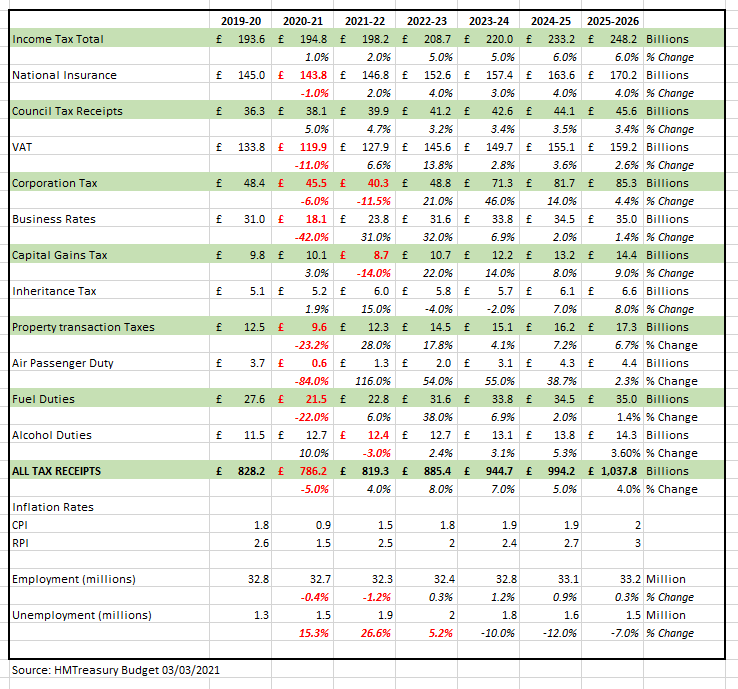
Politicians rely on our short-term memories, they must do otherwise so few would ever be re-elected. When you cut through the words it is best to look at the numbers. These are some key forecasts that I have pulled from the Budget Statement (which you can see here).

SOLOMONS IFA BLOG BUDGET ASSUMPTIONS

How you view life will likely influence how you select data from the table above (which is all lifted directly from the Budget) I have only shown the year on year changes as a percentage and drawn attention to some of the data (of which there is a lot!). Long story short, we will be paying more income tax. The Chancellor seems to be expecting unemployment  to increase by 500,000 over the next 2 years before reducing, but still above current levels. Inheritance tax receipts peak in the coming tax year perhaps reflecting the consequences of the fatalities from the virus.

The property market looks predicted to return to normality shortly, but really picking up next year. Council tax looks likely to increase rather faster than inflation. Fuel duties will begin to rise, and oddly over the next 12 months, once hopefully this is over, duties from alcohol actually fall in 2021/22 (which I think is odd unless you have all been knocking back the booze over the last year or so more than normal with a plan to cut back).  Air Passenger duty has rather obviously collapsed and will likely return to pre-pandemic levels in 4-5 years time, that’s quite a slow recovery.

Corporation tax will really bite in 3-4 years time. Business rates also begin to pick up, which when combined with loan repayments and more VAT, I imagine that some business owners may be looking at cost reductions. There may well be “pent up demand” and a good supply of labour, the Chancellor is understandably encouraging investment in growth, through new technology and digital business combined with Apprenticeships. It (business growth and development) is certainly what needs to happen, but whether it will remains to be seen.

Every Budget has lots of assumptions about the future, but you will be paying more tax, so use the allowances you can.

Dominic Thomas
Solomons IFA

You can read more articles about Pensions, Wealth Management, Retirement, Investments, Financial Planning and Estate Planning on my blog which gets updated every week. If you would like to talk to me about your personal wealth planning and how we can make you stay wealthier for longer then please get in touch by calling 08000 736 273 or email [email protected]

GET IN TOUCH

Solomon’s Independent Financial Advisers
The Old Mill Cobham Park Road, COBHAM Surrey, KT11 3NE

Email – [email protected] 
Call – 020 8542 8084

7 QUESTIONS, NO WAFFLE

Are we a good fit for you?

GET IN TOUCH

Solomon’s Independent Financial Advisers
The Old Mill Cobham Park Road, COBHAM Surrey, KT11 3NE

Email – [email protected]    Call – 020 8542 8084

7 QUESTIONS, NO WAFFLE

Are we a good fit for you?

THE BUDGET 3 MARCH 20212025-01-21T16:33:57+00:00

TAX YEAR END 2020/21 PLANNING

TODAY’S BLOG

TAX YEAR END 2020/21 PLANNING – OVERVIEW

It probably goes without saying, but the tax year end is something that we are always mindful of. There has already been a lot of coverage in the media about what the Chancellor might do. We get to find out on 3rd March 2021. The reality is that due to the pandemic and enormous spending by the Government (and some very expensive contracts awarded to Conservative party donors), there is a obvious pressure to refill the public purse.

Last year, Autumn arrived without an Autumn Budget. To be fair, the Chancellor, Rishi Sunak, had already presented one 2020 Budget – in March – and the pandemic made forecasting for 2021/22 all but impossible. The result was that, for the second year running, the Budget was deferred to the Spring. Whether Mr Sunak’s reading of the economic runes will prove any easier on 3 March 2021 is a moot point.

It is equally difficult to assess what the Chancellor might do in his second Budget. On the one hand, he will be ending the current financial year with a record-breaking government deficit of around £400bn. On the other hand, he will be wary of trying to fill the large black hole with the near inevitable tax increases until an economic recovery is well under way. It could be one of those Budgets where the bad news is announced but has a deferred start date or is, at least initially, targeted at the more affluent.

Every year there is speculation about tax relief reducing or ending. Every year. Every year I largely ignore the speculation. However this year, to be blunt, the changes to taxes are more likely than any in the last 3 decades. There are some things that we can consider together. In truth as the Budget is 3rd March, time is against us. Whilst normally we expect Budget announcements to forewarn of rules for the following April, George Osborne was one of the few Chancellors to initiate immediate pension changes. You have been warned. As the tax year end is on the Easter Bank Holiday, the reality is that the last week of March is really your deadline. If you make allowance for slow post, many working from home, the normal efficiency of a tax year end is arguably “not as normal”… so the sooner you take action on anything important the better.

GET TUIT TAX YEAR END PLANNING SOLOMONS IFA

PENSIONS

A change in the personal tax relief on pension contributions from marginal income tax rates to a single flat rate is a regular pre-Budget rumour. That could mean a cut from a maximum rate of relief of 45% (46% in Scotland) to perhaps a flat rate of 20%-25%. Higher and additional rate taxpayers would thus lose out.

Depending upon where the Treasury pitched the flat rate, it could save billions while making most pension contributors – basic rate taxpayers – better off or at worst unaffected. Even without the revenue benefit, the result has a clear appeal to a government that regularly talks of ‘levelling up’.

Last year Mr Sunak increased the cost of pension tax relief by adding £90,000 to the two income thresholds that govern the tapering of the annual allowance. That could mean in 2020/21 you have an opportunity to make a higher contribution than in previous tax years. In any case, it is worth checking whether you have scope to take advantage of unused annual allowances from the past three years (back to 2017/18) at current rates of tax relief.

ISAs – INDIVIDUAL SAVINGS ACCOUNTS

Plans to put a cap on ISAs were reportedly considered by the Treasury in 2013, an idea that was recently revised by the Resolution Foundation in a paper examining ways to repair public finances. As with reforming pension contribution relief, the main impact would be on those who pay tax at more than the basic rate. For most basic rate taxpayers, the combined effect of the personal savings allowance, dividend allowance and CGT annual exemption is to render ISAs of little relevance.

If you pay tax at more than the basic rate, all types of ISA offer a quartet of tax benefits:

  • Interest earned on cash or fixed interest securities is free of UK income tax.
  • Dividends are also free of UK income tax.
  • Capital gains are free of UK capital gains tax (CGT).
  • ISA income and gains do not have to be reported on your tax return.

In addition, if you are eligible, the Lifetime ISA (which the Resolution Foundation said should be scrapped) gives a 25% government top-up on contributions.  The overall total contribution limit for ISAs has been frozen since April 2017 at £20,000 (of which the Lifetime ISA ceiling is £4,000). However, the limit for Junior ISAs was more than doubled to £9,000 in last year’s Budget.

CAPITAL GAINS TAX

In July 2020,Rishi Sunak asked the Office of Tax Simplification (OTS) to review Capital Gains Tax (CGT). The request came out of the blue but arrived at a time when increasing the CGT tax take was being discussed by several think tanks. It had also been proposed in the 2019 Election manifestos of both Labour and the Liberal Democrats. Mr Sunak would not be the first Chancellor to ‘borrow’ money-raising ideas from the Opposition.

The OTS published the first of what will be two reports on CGT reform in November. Its suggestions included:

  • ‘More closely aligning Capital Gains Tax rates with Income Tax rates’, which could mean more than a doubling of the current tax rates in some instances.
  • Reducing the level of the annual exemption from the current £12,300 to an ‘administrative de minimis’ of between £2,000 and £4,000.
  • Removing the rule which gives a capital gains tax uplift on death. As a result, if you inherited an asset its base value for CGT purposes would be that of the deceased, not the value at the date of death.

That trio of measures, which could be introduced with immediate effect on 3 March, is a good reason to review the unrealised gains in your investments as soon as possible. Although it is no longer possible to sell holdings one day and buy them back the next to crystallise capital gains, there are options which can achieve a similar effect, such as making the reinvestment via an ISA or a pension.

INHERITANCE TAX

A report on CGT is not the only OTS document on capital taxes occupying the Chancellor’s in tray. On taking over the job last February, he inherited a pair of reports on Inheritance Tax (IHT) which had been commissioned by Philip Hammond. These had been expected to feed through into last year’s Spring Budget. They may still do so in the forthcoming Budget, possibly alongside – and complimentary to – CGT reforms. The consequence could be a radical restructuring of capital taxation.

Ahead you should consider using the three main IHT annual exemptions:

1.    The Annual Exemption Each tax year you can give away £3,000 free of IHT. If you do not use all of the exemption in one year, you can carry forward the unused element, but only to the following tax year, when it can only be used after that year’s exemption has been exhausted.

2.    The Small Gifts Exemption You can give up to £250 outright per tax year free of IHT to as many people as you wish, so long as they do not receive any part of the £3,000 exemption.

3.    The Normal Expenditure Exemption  The normal expenditure exemption is potentially the most valuable of the yearly IHT exemptions and one most likely to be reformed. Currently, any gift is exempt from IHT provided that:

a.     you make it regularly;

b.    it is made out of income (including ISA income); and

c.    it does not reduce your standard of living.

If you have the surplus capital available, you should also think about making large lifetime gifts. This could include gifting investments, thereby also using your CGT annual exemption. One of the OTS reform suggestions was the abolition of the normal expenditure rule and the introduction of an annual limit of IHT-free lifetime gifts.

Dominic Thomas
Solomons IFA

You can read more articles about Pensions, Wealth Management, Retirement, Investments, Financial Planning and Estate Planning on my blog which gets updated every week. If you would like to talk to me about your personal wealth planning and how we can make you stay wealthier for longer then please get in touch by calling 08000 736 273 or email [email protected]

GET IN TOUCH

Solomon’s Independent Financial Advisers
The Old Mill Cobham Park Road, COBHAM Surrey, KT11 3NE

Email – [email protected] 
Call – 020 8542 8084

7 QUESTIONS, NO WAFFLE

Are we a good fit for you?

GET IN TOUCH

Solomon’s Independent Financial Advisers
The Old Mill Cobham Park Road, COBHAM Surrey, KT11 3NE

Email – [email protected]    Call – 020 8542 8084

7 QUESTIONS, NO WAFFLE

Are we a good fit for you?

TAX YEAR END 2020/21 PLANNING2025-01-21T16:33:58+00:00

TAXED INCOME ?

TODAY’S BLOG

TAXED INCOME?

We have all applauded those that work in the NHS to help reduce deaths and improve recovery of anyone suffering from COVID19 or frankly any other life-threatening condition. We have also become aware of our reliance on people, who are not terribly well paid, but ensure that our local food is picked, packed, stocked, stacked and delivered and or course countless other services.

We have marvelled at the amount of money raised by a man aged 99 who celebrated his 100th birthday and was honoured for his efforts. These are all good things, but it must surely leave you wondering why the extra money is needed to pay for the NHS. Blaming multinationals like Amazon is all too easy, perhaps we need to reflect on our own tax system.

Here is my problem – we know that taxes are required, but we also know that the State wastes money. We all have an opinion on who, what, why and how our taxes should be made available to. My job is to help you to ensure that your money outlasts you. I do this by using investments, getting you to think and plan ahead for all manner of possibilities and I use the prevailing legitimate tax system properly.

INCOME TAXED

£2,500 A MONTH – THE NEW BASE LINE?

The Government seem to believe that most people can survive on £2,500 a month (taxable), that’s £30,000 a year. In practice excluding national insurance, that would be a net income of roughly £26,500 with basic rate tax paid of £3,500. I have also excluded any pension payments or charitable giving. You will recall that there is a personal allowance of £12,500 (0% income tax) for those with income below £100,000.

By way of simply showing how an adviser can achieve this level of income for you (tax free) here are some options. Doing them all would far exceed the target £26,500 income, but hopefully you will see my point.

  • If aged 55 but not yet drawing a State Pension. You could crystallise £16,665 of an investment-based pension. This would generate £4,166.25 as tax free cash and £12,498.75 as taxable income, but as it is within the £12,500 threshold there would be no income tax to pay. However you would then find yourself restricted to a maximum £4000pa of new contributions to pensions (called the Money Purchase Annual Allowance or MPAA).
  • Alternatively, you could simply crystallise £106,000 of an investment based pension, take 25% (£26,500) as tax free cash and leave the balance to grow.
  • An investment portfolio will regularly have gains (that’s the point after all). A growth of say 5% over a year on a fund of £234,000 can use £12,300 of the capital gains tax allowance – 0% tax. Trigger a larger gain and the gains above £12,300 are taxed at a lower rate of 10% or maybe 20% (but not if you do these other things).
  • Perhaps rent a room for a tax free £7,500 a year
  • Draw 5% of your capital back from an investment bond, so a Bond of £100,000 would provide £5,000
  • Any money drawn from ISAs would be tax free, but taking say £8,535 from an ISA would take the total “income” from all these to £50,000 and not a penny of income tax would be paid.

EARNED INCOME IS TAXED MORE

Yet if this was earned income in 2020/21 income tax of £7,498.20 would be due with a further £4,860 of National Insurance a total of £12,358.20 leaving a net income of £37,641.80. This is makes full use of the basic rate tax, any income above this would be taxed at 40% or 45%.

The point I am making is that how much tax is paid is very much dependent on where your money is and how it is generated. It’s certainly the case that not everyone has these sums of money (which are likely to have been taxed before). However, this is only the basic stuff and exposes the problem of a complex tax system that punishes those earning income far more than those with capital.

IF YOU ARE NOT A CLIENT

If you are reading this and not a client, do not conclude that the above is advice to you, it is not. The calculations that we do can be complex and relate to each individual situation, never rely on generic information about money, except for spend less than you earn.

Dominic Thomas
Solomons IFA

You can read more articles about Pensions, Wealth Management, Retirement, Investments, Financial Planning and Estate Planning on my blog which gets updated every week. If you would like to talk to me about your personal wealth planning and how we can make you stay wealthier for longer then please get in touch by calling 08000 736 273 or email [email protected]

GET IN TOUCH

Solomon’s Independent Financial Advisers
The Old Mill Cobham Park Road, COBHAM Surrey, KT11 3NE

Email – [email protected] 
Call – 020 8542 8084

7 QUESTIONS, NO WAFFLE

Are we a good fit for you?

GET IN TOUCH

Solomon’s Independent Financial Advisers
The Old Mill Cobham Park Road, COBHAM Surrey, KT11 3NE

Email – [email protected]    Call – 020 8542 8084

7 QUESTIONS, NO WAFFLE

Are we a good fit for you?

TAXED INCOME ?2025-01-21T16:33:58+00:00

RISHI TO THE RESCUE

TODAY’S BLOG

RISHI TO THE RESCUE

Well – I, perhaps like you have just watched Friday (20th March 2020) evening’s PM announcement. It included a huge set of commitments and financial stimulus from the Chancellor Rishi Sunak. I’m just going to leave it here, with a slight lump in my throat, that this is fantastic news. Compassion and help. The enormity of his financial package will eb scrutinised and assessed, but the point is bluntly – a shot of confidence, we are in this mess together and we will help each other out of it.

There is fantastic news for employers, with a scheme to pay 80% of salary up to £2,500 a month. That is a huge commitment. July 31st self-employed tax payment can be deferred until January 2021 and VAT is also deferred by 3 months. This is not saying that taxes will not be paid but giving a very direct and real injection of cash into the system to protect each one of us.

The detail we will turn to, but for now, I’m going down the path of the optimist and if my hunch is right, Rishi has just scored a hat trick in the world cup final… well the equivalent. I hope you agree that this is good news. We rise together.

RISHI TO THE RESCUE

Dominic Thomas
Solomons IFA

You can read more articles about Pensions, Wealth Management, Retirement, Investments, Financial Planning and Estate Planning on my blog which gets updated every week. If you would like to talk to me about your personal wealth planning and how we can make you stay wealthier for longer then please get in touch by calling 08000 736 273 or email [email protected]

GET IN TOUCH

Solomon’s Independent Financial Advisers
The Old Mill Cobham Park Road, COBHAM Surrey, KT11 3NE

Email – [email protected] 
Call – 020 8542 8084

7 QUESTIONS, NO WAFFLE

Are we a good fit for you?

GET IN TOUCH

Solomon’s Independent Financial Advisers
The Old Mill Cobham Park Road, COBHAM Surrey, KT11 3NE

Email – [email protected]    Call – 020 8542 8084

7 QUESTIONS, NO WAFFLE

Are we a good fit for you?

RISHI TO THE RESCUE2025-01-21T16:33:58+00:00
Go to Top