HOW TO PROTECT YOUR TAX ALLOWANCES

TODAY’S BLOG

HOW TO PROTECT YOUR TAX ALLOWANCES

The government has committed to an awful lot of new spending. But the money has to come from somewhere. The unwritten rule of electioneering is to announce the spending increases during campaigning, and wait for the first post-election Budget to reveal the bad news about tax. Over the past few weeks we’ve seen suggestions of everything from some form of ‘mansion tax’ on more expensive homes, to changes in capital gains tax and tweaks in pension tax relief.

Sajid Javid’s resignation as chancellor – the person in charge of the Budget – might have derailed some of the plans in progress, but commentators are divided on what’s likely to happen next. Some think fiscal (tax) rules will be relaxed, so there’s less pressure to balance the books and spending can rise alongside tax cuts.

TAX ALLOWANCES

Let us not forget the small matter of an election manifesto pledge to get rid of ‘arbitrary tax advantages’ for the wealthy. Unfortunately we don’t have a working crystal ball to know what tax changes if any will come to fruition. We think the best way to shelter yourself from any potential tax changes is to take as much advantage as you can with the appropriate current breaks, while they still last:

  • Take advantage of ISAs (£20,000)
  • Consider a Lifetime ISA (£4,000)
  • Don’t forget Junior ISAs (£4,368)
  • Top up your pension (£40,000 and the abilty to use up unused allowances from the 3 previous tax years)
  • Consider salary sacrifice (employer pays your reduced NI and tax into your pension)
  • Take advantage of your spousal exemptions (share capital gains etc)
  • Claim the marriage allowance (transfer £1,250 to your spouse)
  • Consider your annual gifting allowance of £3,000
  • Use your 2019/20 Capital Gains Tax Allowance of £12,000
  • VCT, EIS, SEIS investment options for those that are more adventurous

Dominic Thomas
Solomons IFA

You can read more articles about Pensions, Wealth Management, Retirement, Investments, Financial Planning and Estate Planning on my blog which gets updated every week. If you would like to talk to me about your personal wealth planning and how we can make you stay wealthier for longer then please get in touch by calling 08000 736 273 or email info@solomonsifa.co.uk

GET IN TOUCH

Solomon’s Independent Financial Advisers
The Old Mill Cobham Park Road, COBHAM Surrey, KT11 3NE

Email – info@solomonsifa.co.uk 
Call – 020 8542 8084

7 QUESTIONS, NO WAFFLE

Are we a good fit for you?

GET IN TOUCH

Solomon’s Independent Financial Advisers
The Old Mill Cobham Park Road, COBHAM Surrey, KT11 3NE

Email – info@solomonsifa.co.uk    Call – 020 8542 8084

7 QUESTIONS, NO WAFFLE

Are we a good fit for you?

HOW TO PROTECT YOUR TAX ALLOWANCES2025-01-21T16:33:58+00:00

TAX YEAR END PLANNING PART 1

TODAY’S BLOG

TAX YEAR END PLANNING PART 1

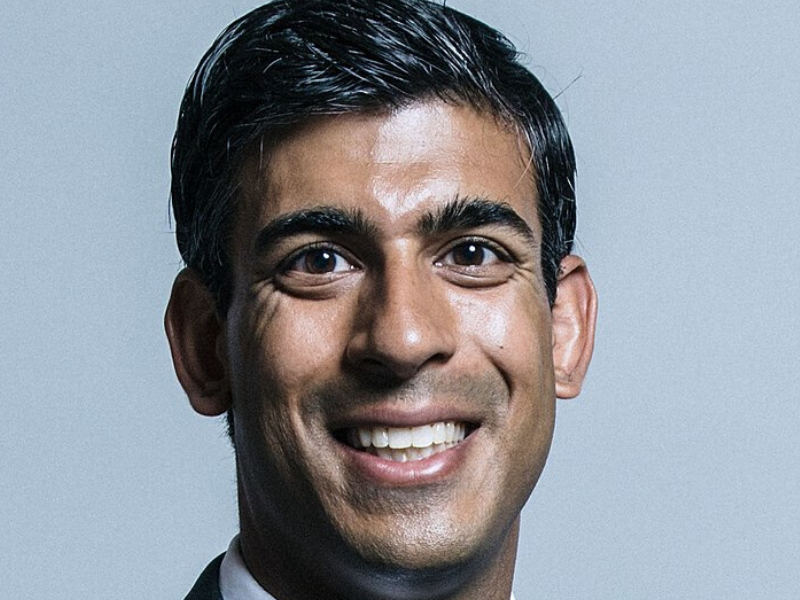
As you will have gathered, the Chancellor Sajid Javid resigned on 13 February just a month before his first Budget. There will be many that offer reasons for this, perhaps some of them will be something resembling the truth, but as they say “a week in politics is a long time”. We have a new Chancellor – Rishi Sunak (who?) … who sent most of us into a google spin. He’s the 39 year-old who worked for Goldman Sachs immediately following graduating from Oxford in 2001, who he left in 2004 to become a Hedge Fund 2006-2010. He became an MP in 2015 taking over William Hague’s seat in Richmond, Yorkshire.

As a result of the rather sudden changes in arguably the most important job in UK politics, there was concern that the Budget may have to be resceduled. However we have been reassured that 11 March remains the date for the 2020 Budget date. We also have an effective deadline for tax-year-end planning. There could be a range of measures announced on 11 March (normally operative from the beginning of Budget day) which could impact on such planning. The Government has loosened the purse strings on capital investment, but in terms of day-to-day spending it has little room for manoeuvre. The Treasury may thus be tempted to make some subtle tax changes to boost its coffers.

Rishi Sunak - UK Chancellor

PENSIONS

More than in most years, 2020 is the year to ensure you make your pension contributions before the Chancellor delivers his speech. As explained earlier, the risk of a major pension tax reform, potentially reducing higher rate tax relief, is greater now than for some while.

One important point to check is whether you have any unused annual allowance from 2016/17, when the maximum annual allowance (before tapering) was £40,000. You have until the end of 2019/20 to use up this past allowance, or it is lost forever. However, it can only be utilised once your full annual allowance for the current tax year is exhausted. So, for example, if you are not affected by the taper rules and you have £10,000 annual allowance unused from 2016/17, to mop it up completely would require a total contribution of £50,000 in 2019/20 – £40,000 for the current tax year and £10,000 carried back three years.

Unused relief can also be used from later years, but once you have paid the current year ‘entrance fee’, the excess contribution is offset in chronological order, starting with 2016/17. Under current rules unused relief can be carried forward for three tax years (hence the 2016/17 deadline), but that principle – and the rate of tax relief – could change.

Dominic Thomas
Solomons IFA

You can read more articles about Pensions, Wealth Management, Retirement, Investments, Financial Planning and Estate Planning on my blog which gets updated every week. If you would like to talk to me about your personal wealth planning and how we can make you stay wealthier for longer then please get in touch by calling 08000 736 273 or email info@solomonsifa.co.uk

GET IN TOUCH

Solomon’s Independent Financial Advisers
The Old Mill Cobham Park Road, COBHAM Surrey, KT11 3NE

Email – info@solomonsifa.co.uk 
Call – 020 8542 8084

7 QUESTIONS, NO WAFFLE

Are we a good fit for you?

GET IN TOUCH

Solomon’s Independent Financial Advisers
The Old Mill Cobham Park Road, COBHAM Surrey, KT11 3NE

Email – info@solomonsifa.co.uk    Call – 020 8542 8084

7 QUESTIONS, NO WAFFLE

Are we a good fit for you?

TAX YEAR END PLANNING PART 12025-01-27T17:01:21+00:00

TAPERED ANNUAL ALLOWANCE – NHS

TODAY’S BLOG

TAPERED ANNUAL ALLOWANCE – NHS

The Tapered Annual Allowance was introduced from 6 April 2016. It has caused considerable problems for members of the NHS pension scheme in terms of excess tax charges due to the formulas used in the calculations.

Admittedly having a good pension is a nice problem to have, but when faced with an excess of say £60,000 (by calculation) this generates a tax bill of typically £27,000. I have seen some that are much higher.

Therefore, many Consultants and senior NHS staff have really been forced to reduce their sessions (NHS pay) or take a break from or leave the pension scheme entirely – which is nuts. This is essentially a tax charge on money that has not yet been paid (it is paid at retirement).

After much badgering, a compromise has been reached for the current tax year 2019/20. In that a political promise has been made that the excess tax charge will permit the pension scheme to pay the charge and the employing NHS Trust will pay now compensate for this when the pension starts (my short version). This has now been confirmed for the English and Welsh NHS Pension Scheme.

NHS Annual Allowance 2019/20

Superficial Fix

There is as yet, nothing NEW stated about the 2020/21 tax year (there are restrospective juggling adjustments that can be made towards the end of the year, but these are daft) – but we do have a Budget coming in March, so we hope the ludicrous Tapered Annual Allowance will be scrapped then. However, this ought to apply to everyone, not simply NHS employees.

The Annual Allowance – Simplified, Quick Overview

In very simple terms the Annual Allowance is a maximum of £40,000. This is the total that can be paid into pensions by you and your employer. It reduces by £1 for every £2 of income over £150,000.  The allowance reduces to a minimum of £10,000 once an income of £210,000 is earned. In short, you can invest more into your ISA. However, for those in final salary schemes and the NHS in particular, the calculation is not really about how much is paid in, but how much the pension grows by and then multiplied by 16. So, if your pension increased by £1500 for the year that’s £24,000. Not the 14.5% of salary you must pay to be in the scheme. Its way more complex than this, but to save time, go with my summary.

It Is Political – Government and the NHS always are

In view of the impact that pension rules are having on senior NHS staff and their ability to work their normal hours, and with winter bringing the usual rise in demand for NHS services, NHS England and now NHS Wales and NHS Improvement have decided to take exceptional action. An extract from the announcement is given below:

‘This action will mean that:

·         Clinicians who are members of the NHS Pension Scheme and face a tax charge in respect of work undertaken this year (2019/20) as a result of breaching their annual pension allowance will be able to defer this charge (by choosing ‘Scheme Pays’ on their pension form) meaning that they don’t have to worry about paying the charge now out of their own pocket.

and:

·         The NHS employer will make a contractually binding commitment to pay them a corresponding amount on retirement, ensuring that they are fully compensated in retirement for the effect of the 2019/20 Scheme Pays deduction on their income from the NHS Pension Scheme in retirement.

Watch Out For…

Clinicians are therefore now immediately able to take on additional shifts or sessions without worrying about an annual allowance charge on their pension for 2019/20.

Local NHS employers are being asked to actively promote this development to affected staff as they plan for extra capacity and staffing over the winter period.’

This measure will only apply to the 2019/20 tax year as new flexibilities are being introduced from 2020/21.

Dominic Thomas
Solomons IFA

You can read more articles about Pensions, Wealth Management, Retirement, Investments, Financial Planning and Estate Planning on my blog which gets updated every week. If you would like to talk to me about your personal wealth planning and how we can make you stay wealthier for longer then please get in touch by calling 08000 736 273 or email info@solomonsifa.co.uk

GET IN TOUCH

Solomon’s Independent Financial Advisers
The Old Mill Cobham Park Road, COBHAM Surrey, KT11 3NE

Email – info@solomonsifa.co.uk 
Call – 020 8542 8084

7 QUESTIONS, NO WAFFLE

Are we a good fit for you?

GET IN TOUCH

Solomon’s Independent Financial Advisers
The Old Mill Cobham Park Road, COBHAM Surrey, KT11 3NE

Email – info@solomonsifa.co.uk    Call – 020 8542 8084

7 QUESTIONS, NO WAFFLE

Are we a good fit for you?

TAPERED ANNUAL ALLOWANCE – NHS2023-12-01T12:17:03+00:00

TAX FREE AT 65 – IT’S ABOUT TIME…

TODAY’S BLOG

TAX FREE AT 65, IT’S ABOUT TIME…

I am going to have to put a lot of caveats with this item on tax free money. There are lots of ways to have tax free money, but I want to highlight a couple of issues, the first being the different tax treatment of different financial products and secondly how these might be used in conjunction with the current tax rules.

Joan is 65 and now finally retired – it’s about time!

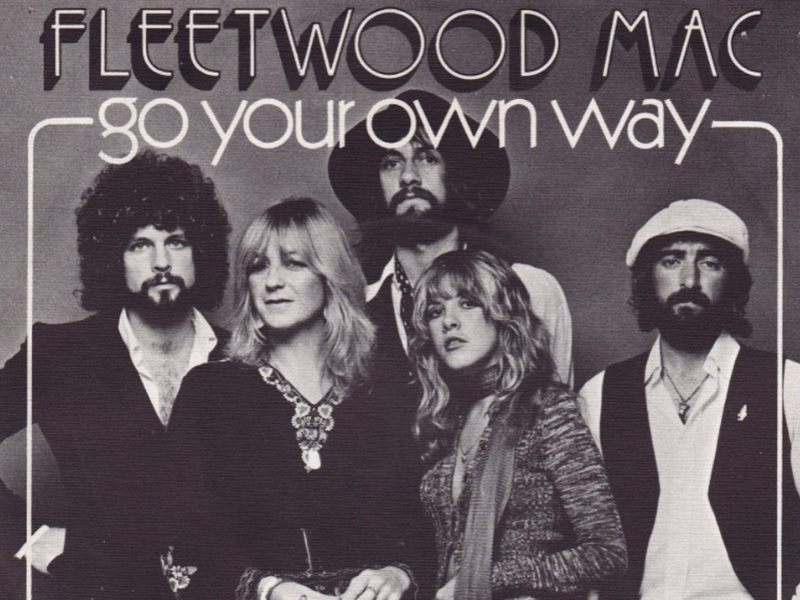
Joan (10/02/1954) was 65 at the start of the tax year but she stopped working in February when she turned 65. She is single and back in the late 80’s a dead-ringer for Kim Bassinger. She has worked since leaving University in 1977 and much like her favourite band Fleetwood Mac, she has gone her own way. She did a bit of employed work whilst at Uni, but got her “first proper job” working as a junior assistant in an advertising company. Over the years she worked for various employers, most didn’t have pension schemes, anyway most wouldn’t let you join them until you were 30, so by the time she actually joined a scheme at 35 (in 1989), she didn’t really feel that she was too late to the party.  She didn’t really like pensions, or rather the sharp suited, red-tie wearing blokes from Merchant Investors that sold them, they reminded her of some of the worst people in advertising. Then there was Robert Maxwell, no she didn’t like pensions at all. Mind you she was quite pleased that her current adviser found an old Contracted Out of SERPS pension, worth about £85,000 – so one of those fellas must have persuaded her to sign a form at some point. It helped top up her pension fund quite a lot to about £400,000.

At the age of 30 Joan bought her Wimbledon house in 1984 for £34,000 which was a lot back then.  She recalls a great house warming party – lots of Wham! and Duran Duran. Looking back she wondered how she afforded it, (the house, not the party) given that interest rates were about 10% and kept going up. However property prices seemed to be rising (hers had doubled in value in 5 years) and she was forming a habit for nice things, which nearly got out of hand, but she spoke to her bank and remortgaged, increasing her loan in 1988 to almost £60,000. When the property crash happened shortly afterwards life got a little tricky, she had to economise. She enjoyed applying tips to improve her home from Tessa Shaw and the team on Home Front.  She loved relaxing in the evening having done a bit of decorating whilst listening to Simply Red’s “Stars” curled up on the sofa. It heped her manage her feelings about her large mortgage which barely seemed to reduce in the first 10 years, but at least it was – and she hung in there. She finally paid off her mortgage 10 years ago at the age of 55. She still believes it was her best investment.

Joan quite liked PEPs and ISAs. She remembered getting a little lucky with a few Building Societies that demutualised and even put the proceeds into a Single Company PEP. She wasn’t sure why she liked them, perhaps it was because she was told she could get her money out if she needed to (she never did) or perhaps it was because it seemed that they were more glamorous, or was that because she seemed to remember a tune by Right Said Fred called “I’m Too Sexy For My Shirt” that was playing a lot at the time. It wasn’t, that was 1991, no perhaps it was all those boy bands like Westlife and Boyzone that she secretly liked she remembers them being around in 1999, that was Tony Blair and all the optimism  and promise of equality of new Labour. She kept up her regular savings and built up her ISAs, which began 20 years ago in 1999.

Joan had learned a bit about investing, the important things like ignoring what everyone else said, she first learned this as her Yuppie thirtysomething friends got into a panic in the crash of October ’87 which she ignored. Then shortly after opening her new ISA learned never to invest in a technology themed fund when the dot-com bubble burst. She chalked it up to “experience”. Other than that, she took investment news in her stride, largely ignoring the mountains of paper that seemed to pile up each year. Over time she observed that stock markets tend to go up and down and up again. Admittedly Joan got a little lucky – 10 years ago at 55 when she had cleared off her mortgage, her career was going well and she had a decent disposable income. She saw an adviser who suggested she add more to her pension and ISA, as luck would have it the Government increased the amount she could contribute and she took advantage of 40% tax relief. It was just as well as her State Pension Age was being pushed even further into the future.

Not long afterwards, she started investing into VCTs, (Venture Capital Trusts) well, she had a few friends that had some good business ideas, she had watched The Apprentice and Dragon’s Den and thought a little bit of a flutter was probably ok. She saved into a VCT for few years ago but has since stopped adding money.

Joan has always paid her National Insurance and has a full State Pension which only started in the summer when she was 65, 4 months and 26 days old. Her State pension is £168 a week. She was a bit miffed that it wasn’t 65 (and when she started out at Uni, it would have been 60) but she had enjoyed the benefits of working until 65.

Joan’s Portfolio

  • £400,000 – Personal Pension Plan
  • £400,000 – Stocks and Shares ISA Portfolio
  • £80,000 – VCT (Venture Capital Trust)
  • £50,000 – Bank Deposit Account
  • £600,000 – Home

Not an unreasonable sum of money – in fact having paid off her mortgage and owning her home, Joan has savings and investments of £930,000. Her home is not an investment, its where she lives. Though her friends regularly tell her that it is an investment if she sells and moves away from Wimbledon. However what would be the point? her friends all live in the area, she loves going jogging on the Common with some of them. Her mum (91) is still alive and living nearby, though Joan is worried that she may need care at some point and the cost of care in Wimbledon is, well… there may not be much of an inheritance.

Fleetwod Mac - Go Your Own Way

Tax Free Allowances

In the current tax year 2019/20. Joan has a personal allowance of £12,500 before she pays any income tax. Her State Pension will use up a lot of this. Income up to £50,000 is taxed at 20% (when the personal allowance is considered).

The VCT is a fairly “high-risk” type of investment, she isn’t paying any money into it any longer, but does enjoy income from it of 3% a year, this is tax free within a VCT. That’s £2,400 a year.

Her ISA is doing well, she has set up a monthly payment from it to her of £4,000 a quarter (£16,000 a year). As this is an ISA, the income that she takes (or capital) is tax free. By way of note £16,000 4% of £400,000.

The State Pension – Joan is caught by equalisation.

Joan originally expected her State Pension to start when she was 60, but following various rule changes and seeking advice in the early 2000’s she realised that it would be later than that. Joan’s State Pension actually began this summer on 6 July 2019. Over the full remainder of the tax year she will have 38 payments of £168 (£6,384) normally in a full tax year it would obviously be 52 weeks (£8,736) but she is one of many women that saw their State Pension Age increased. She’s a little miffed at having an extra 5 years to wait and wanted to know how she can minimise her tax payments.

Joan would like to know how much she could take from her pension without paying any tax. As her other investments are tax free, the only taxable income she has is money from her State pension (£6,384 in 2019/20) the personal allowance is £12,500. She puts £8,154 of her pension into a Flexible Access Drawdown pension. This enables her to take £2,038.50 as a tax free lump sum (25%) and £6,115 as taxable income. So rather like this:

  • State Pension £6,384 (taxable at 0%)
  • Drawdown Pension £6,115 (taxable at 0%)
  • Tax Free lump sum from pension £2,038 (tax free)
  • VCT income £2,400 (tax free)
  • ISA income £16,000 (tax free)
  • TOTAL income £32,927 and NO INCOME TAX

More and Less

The first point to make is that the above is not the maximum income that Joan could have. I simply want to identify some options. She could take more from her ISA, she is entitled to tax free interest on her money at the bank. She could take more from her pension (a larger tax free lump sum and no income from the pension if she was so minded). As an employed income £32,927 in 2019/20 would for most people result in about £7,000 paid in tax and national insurance.

Joan will need advice to adjust her portfolios and determine the most suitable way for her to draw income. Next year she will have a larger State pension, using more of her personal allowance as it will be a full year of income for her (and a likely increase in April).

Annuity Option

When she retired at the start of the year at 65, Joan had investigated using her pension to buy an annuity. She was going to simply take the 25% from her fund and put it in the bank and then use the £300,000 to buy an annuity. As a single person in very good health, she wanted an inflation-proofed income. The best annuity available would guarantee that she receives £9,851 a year rising by 3% a year. Job done. That’s an annuity rate of roughly 3.2%, but the income is taxable. In the first year she would have total income of £16,255 from the annuity and her State Pension, paying tax of £747. Her VCT and ISA income remain the same at £18,400 in all. So her total income would be £34,655 (more) but with tax of £747 (net £33,908) She has £300,000 less on her personal balance sheet and has £981 extra income in the year.

In the second year, she would expect £10,146 from the annuity and a State Pension of £8,736 a total of £18,882, which if the personal allowance remains at £12,500 would mean that £6,382 is taxed at 20% (£1,276.40 tax). Whilst there are good things about an annuity (it’s a guaranteed income) this is also a problem for tax planning as the income cannot be switched off and is taxable.

The purpose of this fictional case study is simply meant to highlight the issues involved, everyone’s circumstances will be different. I have not considered that Joan may live a very long time and whether taking 4% from her ISA is a good idea or indeed if she has a suitable globally diverse portfolio. I have done no inheritance tax planning and no contributions to anything that might get tax relief. Had Joan had other investments, she could also use her capital gains tax allowance. There are lots of options.

Dominic Thomas
Solomons IFA

You can read more articles about Pensions, Wealth Management, Retirement, Investments, Financial Planning and Estate Planning on my blog which gets updated every week. If you would like to talk to me about your personal wealth planning and how we can make you stay wealthier for longer then please get in touch by calling 08000 736 273 or email info@solomonsifa.co.uk

GET IN TOUCH

Solomon’s Independent Financial Advisers
The Old Mill Cobham Park Road, COBHAM Surrey, KT11 3NE

Email – info@solomonsifa.co.uk 
Call – 020 8542 8084

7 QUESTIONS, NO WAFFLE

Are we a good fit for you?

GET IN TOUCH

Solomon’s Independent Financial Advisers
The Old Mill Cobham Park Road, COBHAM Surrey, KT11 3NE

Email – info@solomonsifa.co.uk    Call – 020 8542 8084

7 QUESTIONS, NO WAFFLE

Are we a good fit for you?

TAX FREE AT 65 – IT’S ABOUT TIME…2023-12-01T12:17:07+00:00

YOUR PORTFOLIO

TODAY’S BLOG

YOUR PORTFOLIO

I suspect that you have heard the expression “look after the pennies and the pounds look after themselves”. Well, a small win this week in that your investment costs will have reduced for clients using our portfolios. One of the fund management groups that we use (Vanguard) decided to reduce their annual management charges. Its not a massive reduction when taken in the context of a larger portfolio of funds, but every little helps. The reduced charges have been applied already.

We have also been reviewing our ESG portfolios. I was challenged the other day by suggesting that clients be opted into ESG portfolios with the option of opting out rather than being asked if they would like to opt in. I can see some merit in this, but it seems somewhat problematic when you consider that ESG portfolios are generally a little more expensive.

Dominic Thomas
Solomons IFA

You can read more articles about Pensions, Wealth Management, Retirement, Investments, Financial Planning and Estate Planning on my blog which gets updated every week. If you would like to talk to me about your personal wealth planning and how we can make you stay wealthier for longer then please get in touch by calling 08000 736 273 or email info@solomonsifa.co.uk

GET IN TOUCH

Solomon’s Independent Financial Advisers
The Old Mill Cobham Park Road, COBHAM Surrey, KT11 3NE

Email – info@solomonsifa.co.uk 
Call – 020 8542 8084

7 QUESTIONS, NO WAFFLE

Are we a good fit for you?

GET IN TOUCH

Solomon’s Independent Financial Advisers
The Old Mill Cobham Park Road, COBHAM Surrey, KT11 3NE

Email – info@solomonsifa.co.uk    Call – 020 8542 8084

7 QUESTIONS, NO WAFFLE

Are we a good fit for you?

YOUR PORTFOLIO2023-12-01T12:17:09+00:00

ANNUAL ALLOWANCE EXCESS

The Annual Allowance Charge

Arguably the most dreadful bit of recent pension changes is the annual allowance charge. This arises for anyone that contributes more than the annual allowance towards pensions during a tax year. To most people £40,000 a year into pensions is a lot of money so on the surface this is nothing short of yet another raid on higher-earners.

The annual allowance is really £40,000 or 100% of your earned income, whichever is lower. However, if your income is over £150,000 then the allowance reduces gradually down to £10,000 for anyone earning £210,000 or more, this is termed the Tapered Annual Allowance. Just for some context anyone earning over £150,000 has lost their personal allowance (income before any tax is paid) and pays a tax rate of 45% on income above £150,000.

Excessive Tax? Not Enough Voters

You can exceed the annual allowance in various ways – the amount for those investing money to build a pension is straight-forward. If you and your employer pay more than your annual allowance into pensions, you suffer an income tax charge on the excess at 45%. Easy, maybe not fair, but easy.

However, if you are a member of a good old-fashioned final salary (defined benefit) pension, well it’s a little more complex. The annual allowance is not calculated based upon how much you paid into a scheme, but on how much your pension improved by. So if you had a pay rise… this makes life more complex. If your pension increased by more than £2,500 a year (which admittedly is a very good pension for another year of employment) then you are likely to exceed the annual allowance of £40,000. If you have the minimum annual allowance as a high earner, then your pension only needs to improve by probably £527 – £625 a year.

£561m Extra Tax

This all became the new norm from the 2015/16 tax year. HMRC collected £179m in extra tax revenue as a result. However, this has now jumped massively as the reality sinks home for many high earners, rising to £561m for 2016/17.

Some people can get their employer pension scheme to pay the “fine” (tax) most cannot. In 2016/17 only 2,340 people achieved this which accounted for £44m (8%) of the tax however the clear majority had to pay up themselves – all 16,590 of those that realised!

I might call this a disincentive to save for your retirement, or daylight robbery…. Take your pick, but fair and sensible is most certainly is not.

Dominic Thomas
Solomons IFA

You can read more articles about Pensions, Wealth Management, Retirement, Investments, Financial Planning and Estate Planning on my blog which gets updated every week. If you would like to talk to me about your personal wealth planning and how we can make you stay wealthier for longer then please get in touch by calling 08000 736 273 or email info@solomonsifa.co.uk

ANNUAL ALLOWANCE EXCESS2023-12-01T12:17:49+00:00

The Hurdles We Face

Like most advisers, I regularly have enquiries as a result of the new pension freedoms. In essence, someone wants to move money out of a pension and the Pension company have told them that they cannot do so unless an adviser signs the forms, by which they really mean, takes responsibility for the advice if or when it all goes wrong. So after attempting to explain why I will not do this for the umpteenth time, I thought that perhaps a post about it would be easier… its lengthy, but provides context. If you are in this position and cannot find the time or energy to read 4 pages, then you really should not be messing around with your pension.

The Hurdles We Face

In the past, most people received a poor service from their financial adviser. As advisers were paid based on selling products, some of which were good, some of which were awful. The majority were unlikely to see “their” financial adviser (assuming s/he stuck around) unless the adviser believed that there was another chance to sell a product and thus earn some money.

Free Advice Illusion

The illusion of “free advice” was perpetuated by the product providers (the big life assurance and pension companies). They made it worse by having incredibly complex charging structures. They competed for business based on spurious data about past performance coupled with extra commission, above the agreed standard LAUTRO rate. Unhelpfully each product had a different rate of commission anyway so it was always likely that you would end up with a product that suited the adviser rather more than it suited the investor. In the late 1980s there was also the added problem of Independent Advisers being forced to disclose commission whereas Tied Agents didn’t (and couldn’t) Tied Agents were paid much more commission in any event. It was Tied Agents that were largely responsible for mis-selling of pensions. The collective advising legacy of Tied Agents is now shaped in the form of the largest financial advice company in Britain.

Suits you sir…

As an example, £200 into a pension typically paid commission to the adviser of around £2,300 and then about £5 a month after 4 years until payments stopped. The same amount invested into a PEP or ISA would pay typically £6 a month for as long as the payments were made (£72 a year). PEPs and ISAs did also include a fund based commission of 0.5% as well, so on a fund worth £2400 this would generate another £12 a year (plus growth) – £2,300 now or £84 over the year? (not hard maths).

This invariably resulted in bad selling practices and inappropriate advice. The result was marginally better regulation, improved qualification requirements for advisers and a ban on commission for investments from 2013. All advisers had to charge fees and agree these with their clients.

Unfortunately, this has not prevented criminals being criminals. The digital revolution which has helped on many levels is now under constant threat from fraud. Standards have had to be raised. What most people don’t appreciate is that the advice provided by financial advisers needs to be suitable, it sounds rather obvious but has implications. The most significant being that the adviser is liable for his or her advice not simply at the time, or their working career or indeed their lifetime, but for eternity. We are the only group on earth that can be sued posthumously (our estates).

Tongue-tied about risk

As a direct consequence of the historic mis-selling, any insurer providing professional indemnity insurance (a mandatory requirement to hold) takes a fairly negative view of bad practice and particularly “risky” products – which don’t necessarily mean investor risk, but those that invariably have been used to scam people. This has resulted in fewer insurers, higher premiums to the point that many advisers consider this a tax on good practice rather than an insurance against unlikely complaints.

Common Sense Revolution

A good adviser will always want to look after their clients well, forming a long-term relationship where a good service is provided and is financially rewarding to both the adviser and the client. Most advisers now look after their clients much better, adding significant value over time. There is much documented evidence for this (google adviser alpha).

The risk to the adviser is now more likely to be a bad relationship with a client, that results in a complaint, so service is vital and actually serves both client and adviser much better anyway. So very few advisers are now willing to take on a “one off” piece of work. The risk of things going wrong is too great.

Getting to know you

In a typical process an adviser must demonstrate that s/he knows their client before offering advice. This means sufficiently understanding the clients existing arrangements, circumstances and plans for the future, all within the context of the current real world. Here’s a brief list of the sort of things we require.

·         Evidence of your identity and residency (are you a potential fraudster?)

·         Family circumstances, context (who else is impacted?)

·         Income and tax information (to reduce but also to avoid fraud and evasion)

·         Assets (on a global basis)

·         Liabilities (on a global basis)

·         Existing arrangements (old employer pensions etc)

·         Giving (historic, present and planned)

·         Current spending levels (where does it go? How much does life cost you?)

·         Goals (why, when, who, what, how?)

·         Attitude to risk and capacity for loss

·         The content of your Will (where will all the above go?)

I could go on, but you probably get the point. Obtaining all of this isn’t as straight-forward as you may imagine either. Whilst you may loathe insurance companies, I can assure you that tracking down and obtaining the right information from them about you is enough to test the frustration boundaries of anyone.  Additionally, some people are simply not good at facing difficult truths – such as their own lack of financial control and an unwillingness to confront the basics of something that reveals where it all goes (like an expenses statement).

Trust me, I’m a…

So we’ve now gathered the above, we need to assess it and analyse it properly. Then in light of your aims, what’s realistic given your resources, appetite for risk and ability to cope with loss, we can put together solutions from everything that is “out there”…. Which to remind you is an ever evolving, changing, competitive marketplace, so what’s “best” last week may not be so today.

Committed to paper

We then provide a suitability report, which is meant to be read. Most are long because a lot needs to be said, but we also operate in a climate of complaint and many complaints are won based on what was not said by the adviser than what was done or even whether the adviser was “right”. The client is a human and wants to simply get on with life and not read a very long document about financial stuff.

Then there is the issue of fees and investment costs. We have evolved from the delusion that advice is free, but most people still believe that it is cheap. Even with very good technology (none of it joins up) completing the list earlier and creating a “file” takes about 2 days for the typical person, that assumes the information has arrived.

Fees

Anyway, fees – most charge to look after your money, so will take a percentage of this. The more you have the more you pay (as with most things in life). However in our unnecessarily complex tax system, the more you have invariably means the greater your options and the greater the complexity. Just for a benchmark, complexity probably starts at income of £80,000, but could be a lot lower depending on your age.

Fees come in all forms, but in essence I see six  

1.       The first is to implement or arrange something (i.e.. ISA). Some call this an initial charge. In essence, it is the result of a recommendation to use XYZ investing in a portfolio of funds with ABC, which is suitable because…. Charges are typically 1%-5%

2.       Ongoing management and looking after of the arrangement – the idea being that stuff changes, you need to make adjustments to keep within the parameters that were established. Perhaps switching funds within the portfolio, rebalancing or changing the “shell” of the investment to something now better. Charges are typically 1%

Both of these rely on you having money to invest and look after. Its not that different from commission, invariably taken from the investment rather than your bank account. It works but its not perfect. We know that it isn’t perfect as well, but its how most of us work.

3.       The service fee, this is often paid as a retainer and provides for the cost of meetings and keeping all your stuff (old style and new style) up to date and keeping you in the loop, charges are typically £50 – £500 a month

4.       Ad hoc fees – for specific, often complex pieces of work but of course nobody does this unless they are fully furnished with all the facts about you (as per my list). Charges typically a minimum of £300

5.       The financial planning fee – this is really where the best advisers are heading. In theory you don’t need any money to be invested with your adviser, they design a financial plan, which will take account of all you have and reveal a version of the future so that you can actually know how much is enough, what you need to do and so on, irrespective of who ends up investing the money. A financial plan can be a mammoth document covering the reasons for each assumption made, or it can be reduced to the headline charts, showing you the what and why with a list of action points. A financial plan will cost at least £1500, some ten times this (remember complexity and options). Some advisers recognise that this is often “new” for their clients and discount it heavily to £500-£750 be warned that this also indicates their lack of confidence in the value that they are offering. Financial planning is a real skill, not simply a new label.

6.       The no strings fee. This is the latest attempt to separate financial planning and perhaps behavioural coaching from your money. You pay all fees directly from your bank account, irrespective of how much you have. Naturally there will be some expectation of a correlation between how much value is added or work done, but payment is separate. As a result, there will be no adviser charge shown on any illustrations as the adviser is paid separately. This of course, makes the illustrative projections look much better. The adviser will be paid what was agreed irrespective of results. To be blunt most of us would prefer to work this way, but don’t have clients wealthy enough to do so. Those that do, successfully tend to charge £5,000 – £30,000 a year for their services.  Note that the fee is not necessarily related to time, but more likely value. Consider a tax planning saving of £800,000 what is that worth?

Show me the money

In the attempt to protect and help consumers the regulator has ensured that fees and costs are reflected in all illustrations (evolving since 1995 with “commission disclosure requirements”). Illustrations now show the impact of investment charges and adviser charges. These are significant and appear to cannibalise your investments. When coupled with low rates of growth used for illustrations and a well-intended “remember the impact of inflation” the resulting illustration far from helps consumers, but puts them off ever bothering to move money out of their bank account, (which if run by the same illustrative rules, would have you spitting blood).

Full circle…. Back to affordability and making it appear cheap

The truth, as uncomfortable as it may be, is that financial planning and good financial advice are now largely out of reach (price wise) to most people, due to our operational costs and the need to make a profit so that we can come back next year and do this all again so that our clients are looked after properly within the context of accurate information. It is an exhausting process. Most advisers I know (and I know a lot) would all want everyone to have better financial advice and are actively seeking ways to help through new media (podcasts, blogs, Vlogs, books, seminars, free downloads etc). Naturally, we hope to attract some new good clients, but we are also keen to help educate and improve financial literacy. We call it the savings gap. It’s in all our interests to help Britain become a nation of financially independent adults….the alternative is really rather frightening.

In conclusion (finally!) I cannot do a one-off piece of work for you. It isn’t in my long-term interests to do so (and probably not yours) without doing a proper job. Any adviser that offers to do so is at best deluded and perhaps desperate for money; at worst somewhat economical with the truth and likely running the risk of taking cash for forms, aiding scammers, knowingly or foolishly. This will result in further complaint, the inevitable failing of his or her business, and a compensation bill that the remaining good firms have to split between them (known as FSCS levies). Such a system has numbered days and is currently being reviewed in a fairly timid fashion. This really infuriates most advisers, many of whom vent in online sector forums and can easily be found on topics like Unregulated Collective Investment Schemes (UCIS) or Defined Benefit Pension Transfers or any recent receipt of a regulatory invoice from the FCA or FSCS, despite this there has been little appetite for opposition to a regulator that appears powerful yet out of touch.

When all is said and done, nobody can guarantee anything in financial services. Trust needs to be earned, I believe that this is done by being transparent and keeping promises. Quite how or even how much advisers are paid becomes largely irrelevant under such conditions. Any good financial planner or adviser wants a good long-term relationship with clients.

I genuinely wish you good luck in your endeavour to find a trustworthy, ethical adviser that has possesses business acumen. At one point there were over 250,000 people selling pensions and insurance products, there are now about 25,000 registered individuals who are licensed to do so across 5,720 firms, the vast majority of which are not yet financial planners. You could search my social media account to find some, but in general those are the elite advisers. Beware that search engines or directories are also paid-for marketing tools.

Think I’m wrong? today a report about pension transfers from final salary (“gold-plated pensions”) continues to press the point that advisers cannot be trusted. Nobody appears to have any notion of the cost or risk involved, everything is assessed in terms of a price for filling out forms. See Professional Adviser item by Hannah Godfrey.

Dominic Thomas
Solomons IFA

You can read more articles about Pensions, Wealth Management, Retirement, Investments, Financial Planning and Estate Planning on my blog which gets updated every week. If you would like to talk to me about your personal wealth planning and how we can make you stay wealthier for longer then please get in touch by calling 08000 736 273 or email info@solomonsifa.co.uk

The Hurdles We Face2025-01-27T16:07:36+00:00

Another Concerning Survey

Another Concerning Survey

If you have followed me for any reasonable time, you will have gathered that I am fairly suspicious about surveys and opinion polls, primarily due to the very small sample sizes and the eagerness to extrapolate data from, well, frankly not very much.

That said, yet another survey has revealed more of the problems that, if correct, are concerning for the country. Paymentsense (a card payment service) clearly have an insight into how people spend money. They surveyed 1000 people last month (July 2017) of all ages, whether this is a truly representative sample… well, it won’t be. However, the findings are certainly of concern.

30% of UK Have No Savings

Firstly 30% have no savings at all for a “rainy day”. Of those that had savings 21% used them for a holiday and only 17% put savings towards their retirement. Here is where I also have an issue with the line of questioning (which is unclear from what I have seen) but this could have been interpreted as using cash deposits to add to a pension (into which they may already be saving). Some people may of course be already retired and have no purpose in “saving for retirement”. In any event, a pension would be what springs to mind when asked about saving for retirement, but of course there are a huge number of ways to invest into something which will ultimately provide an income and/or capital.

Nothing in reserve?

However, the headline grabbing figure is really the extrapolation of the data. This leads to the conclusion that some 45.5m people have less than one month’s salary set aside in “savings”. The population is now an estimated 65.6m, which obviously includes children, pensioners and anyone simply unable to work and “earn” income. The current “unemployment” rate is 4.4% (for 16-64 year-olds). In short, a significant economic blip would be likely to cause significant hardship for a lot of people if they lost their income for whatever reason.

Signs of uncertainty shown in house sales

As Government continue with plans to leave the EU and a growing awareness of the likely implications for UK jobs, it would appear logical to be concerned. Hence the property market isn’t exactly booming, but property prices do continue to rise (4.9% over 12 months to June 2017) according to the Land Registry, however the number of sales continues to fall from 98,152 in August 2016 to 69,545 in April 2017. As a matter of note, the lowest number of house sales was in 32,752 in January 2009. The highest was June 2006 with 153,465 (for all the UK). If it is of interest, over the last 20 years, the average property in the UK was £65,092 in August 1997 and now stands at £223,257 (June 2017).

If you like short animated films, then Borrowed Time is a delightful one and a powerful message. Here is the trailer (almost as long as the film).

Dominic Thomas
Solomons IFA

You can read more articles about Pensions, Wealth Management, Retirement, Investments, Financial Planning and Estate Planning on my blog which gets updated every week. If you would like to talk to me about your personal wealth planning and how we can make you stay wealthier for longer then please get in touch by calling 08000 736 273 or email info@solomonsifa.co.uk

Another Concerning Survey2023-12-01T12:18:26+00:00

Talking Money…. again

Talking Money… again

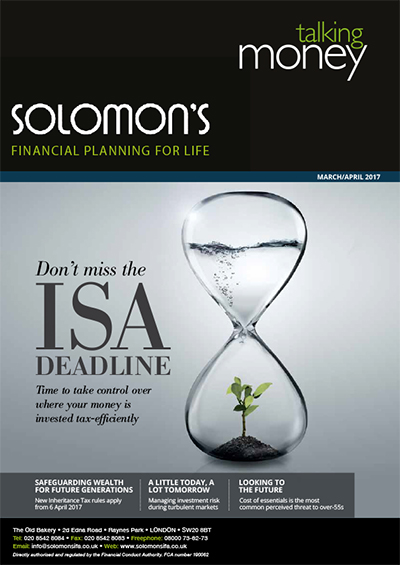
As you will have gathered from the plethora of adverts in the weekend papers and advertising hoardings everywhere, the tax year is coming to a close. This means it is your last chance to use up your 2016/17 ISA allowance of £15,240 or perhaps a Junior ISA for those young enough.

This tax year has had many unwelcome changes, most significantly the pension tapered annual allowance, which has reduced the annual allowance (normally capped at £40,000) to a £10,000. This applies to anyone with “adjusted income” over £150,000. But that doesn’t make you “safe” if you don’ earn £150,000. As the annual allowance is £40,000, the maths starts at £110,000 of income. Pension contributions paid are added to income, indeed any income, be it rent, dividends or interest are all counted. So many may well find that they have exceeded the annual allowance.

Deliberate Complexity

Yes, the Government could have made things easier, but why bother when there are so many willing voters who will forget the hassle at the ballot box. In fact, Mr Hammond, the Chancellor has had two opportunities to abolish this utterly ludicrous rule in either in his Autumn Statement or his Budget last week. There are tax penalties and charges if this is exceeded and you don’t have any unused relief from any of the three previous tax years 2015/16, 2014/15 and 2013/14. Pensions have the ability to go back 3 tax years if you exceed your annual allowance.

Shrinking heads?

To provide a little more context – ten years ago, the annual allowance was £215,000 in 2006/17, it rose each tax year to £255,000 by 2010/11. It was then slashed to £50,000 for 2011/12 and remained at that level until 2014/15 when it became £40,000. Today in 2016/17 it is likely to be £10,000 for many high earners.

Of course the Government knows what they are doing, by encouraging us all to save for our retirement and financial independence…. I expect that we will soon hear “lessons will be learned”. Oh and no, this is not fake news, its just unwelcome news.

Clients will be receiving a printed copy of Talking money this week, which has some more facts.

Dominic Thomas
Solomons IFA

You can read more articles about Pensions, Wealth Management, Retirement, Investments, Financial Planning and Estate Planning on my blog which gets updated every week. If you would like to talk to me about your personal wealth planning and how we can make you stay wealthier for longer then please get in touch by calling 08000 736 273 or email info@solomonsifa.co.uk

Talking Money…. again2025-01-27T16:08:19+00:00

Ban Cold Calling Pension Scammers

Ban Cold Calling Pension Scammers

Since my post on 25 October about a petition by one of my peers to attempt to encourage the Government to address the problem of people being swindled out of their pensions, there is now a new dedicated website. Can I ask that you get involved by signing the petition and sharing it with your contacts.

Why? Well, if you are a client of ours you have protection and have our support and regulated advice. The new pension freedoms mean that many people in their late 50’s or older are being targetted to move their pensions into some very poor (rip off) arrangements. OK, so this may not be you, but pension funds can now last a lifetime, rather than until retirement, which was normally when people bought an annuity. Now most are holding the investments for life, meaning that ongoing advice will be required (to get the portfolio delivering what is needed each year)… but that also means that long after I retire you will likely still need advice for your pension portfolio. So imagine yourself in 15, 20, 25 or 30 years time, being bombarded by calls or emails promising you all sorts of wonderful things…. are you really going to resist?

So please sign the petition, we need to push through to 10,000 signatures. OK cold calling may not be banned, but the issue being raised may result in new policy or regulation that protects people from this.

BAN COLD CALLING WEBSITE

Dominic Thomas
Solomons IFA

You can read more articles about Pensions, Wealth Management, Retirement, Investments, Financial Planning and Estate Planning on my blog which gets updated every week. If you would like to talk to me about your personal wealth planning and how we can make you stay wealthier for longer then please get in touch by calling 08000 736 273 or email info@solomonsifa.co.uk

Ban Cold Calling Pension Scammers2023-12-01T12:19:01+00:00
Go to Top