
Performing under pressure?

Dominic Thomas 
Post written: Sept 2026  •  Published: Sept 2026
4 min read

Performing under pressure?

The world can often feel like a pressure cooker.  Politics has divided the world, social media has amplified division and impartial investigative journalism is both in short supply, overwhelmed and silenced. A timely reminder of the significance of choices and their consequences has arrived at cinemas. Pressure is the “untold story” of some of the events leading to the D-Day landings, an event, which we all know, marked the turning point in the war against Nazi Germany.

I’m going to draw some thoughts about the film and here is where any sensible person would heed a “spoiler warning” but one of the major achievements of the film is that it is surprisingly gripping when you consider that we all know the outcome and result before the opening titles have begun.

The film is familiar ground and we are re-introduced to a different type of D-Day hero – James Stagg CB, OBE, FRSE who is called upon to act as chief meteorologist for Eisenhower in his preparation for D-Day. At its core there is a battle between what we want to believe and what we need to know. A conflict, but one where competing arguments have potentially vastly different consequences. Stagg and his “opponent” the American, Irving Krick contested the forecast, with Eisenhower finally being persuaded by Stagg that a delay to the invasion would be wise.

Unfortunately we do need to remember that film is a genre and often shorthand, this is not a documentary. Whilst Stagg was head of the team, it was actually the Norwegian, Sverre Petterssen who noted the inbound storms that contradicted Krick’s forecast.

The main contention was that the Americans, who prior to the war, had been unusually successful in weather forecasts and had monetised this successfully, and… well money talks. Their methods were primarily using data to search for patterns and how they appear to repeat. Stagg and Petterssen were unimpressed by their pseudo-scientific approach. They used data, historic and current and sought nuance in context acknowledging that any forecast is not certain. The main point here is that Eisenhower had to take a leap of faith in a forecast that was not certain and contradictory to what he wanted to hear.

This is where the financial planning bit begins – humans like patterns. We look for reassurance in them. We often use terms like “history repeats itself”. We get comfort from notions like “success breeds success” and we certainly appear to believe that those who have amassed vast fortunes must have some special talent that the rest of us lack.

Your financial plan is a “best guess”; it is not a certainty. We do not know the future. Many years ago I bought a crystal ball as a prop to joke that it doesn’t work, designed to bring some levity to the task of forecasting, but I’ve never actually got it off the shelf for a meeting. Instead, at times I have used data, graphics and charts. You may have seen them (hopefully) and note that often it depends on the time we have together and the content and direction of our discussion. I will regularly show a chart of the world stock market with a lot of noted disastrous events over the last 100 years, yet the long-term trend of markets is relentlessly upwards.

Sometimes I use the “best performing markets” which often looks like a patchwork quilt – the pattern is that there is no pattern. Anyone who attempts to predict which assets, markets or sectors will be “top performers” next year is confronted by the data that tells us that this is extremely difficult to get right once, let alone repeat and those who do will not find comfort in the data from Standard and Poors which shows that the longer term success of investors outperforming the market is little more than luck – mathematically.

Enormous financial services companies, the Investment Banks with billions under management, give the impression that they have some special insight into the future. They employ very clever people with excellent credentials. They may have a reasonable amount of success and are well remunerated for it, but in the end, it’s mathematically inevitable that their outperformance reverts to mean (average) due to their weighted “bets” on sectors, companies etc. Big banks can charge big fees for their apparent success and it’s worth noting that our meteorologist Krick was an accomplished salesman for his services in California prior to the war.

We want to believe that some people have special insight. In reality, certainly in the business world and financial one in particular, that insight is often gained through questionable means. Information is deemed an advantage, and it can be, particularly if you pay $100,000 a month for a pre-leased feed of tweets before they are “officially” released by the most corrupt US administration to exist. A small advantage can be used to advantage, particularly in a rigged system.

Investors look for patterns in markets and stock prices, we often refer to events that help justify our beliefs (typically great crashes). Your financial plan is designed for your lifetime – hopefully decades, so the short-term challenges are really a blip on the charts. However, that truth doesn’t really comfort the reality of living through storms and attempts to predict, prepare and plan for them. As investors, we cannot control the metaphorical weather, we can merely control our responses.

So advisers and investors differ in their beliefs and it’s important to acknowledge this. Some will be convincing that short term advantages can be captured, that they have a system and process to do so and that it is reliable and repeatable. A lot (and I do mean a lot) of money is at stake and spent trying to persuade you that they do know best; that their crystal ball really does work. The long-term evidence does not support this view. What it does evidence is that a lot of people want to believe comforting stories that make the storyteller much richer, bigger, more successful, which in itself is evidence of their “wisdom”. To quote the James Stagg of the film “we must face the facts, however frightening they may be”.

The fact that your plan is a very good educated guess, does not mean it’s worthless, quite the opposite, but I hope that you will appreciate that we aren’t merely providing a forecast and leaving you to negotiate the stomach churning crossing to France, the Nazi machine guns and mines on the beaches and the assault on Hitler’s forces. We plan enormous importance of reviewing progress and keeping updated on the unfolding action (your circumstances and the real challenges).

Forecasting is incredibly difficult and even the appearance of success may have more to do with luck, which is why evidence is so important as well as proper regular reviews. We all want to live in a world of good news, but the truth is that the news we don’t want to hear is invariably the information we really need. Yes it does come with pressure.

I thoroughly enjoyed the film, Andrew Scott is typically great as is Brendan Fraser and watch out for Kerry Condon. Here is the official trailer.

Have a question or feedback about this article?

Please share this with a friend

Performing under pressure?2026-09-25T17:08:34+01:00

NS&I Big Data and the WOPR Problem?

Dominic Thomas 
Post written: March 2026  •  Published: July 2026
3 min read

NS&I Big Data and the WOPR Problem?

Adapting to the new world is far from straight-forward and NS&I are yet another publicly humiliated organisation that has failed to migrate data to a new system, costing billions. These sorts of problems are common and normally don’t come to light in the private sector, unless there has been a GDPR data breach.

Getting your money into someone’s system is easy, getting it out often isn’t as simple as it could be. That’s why when we review who we use to hold your investments we consider what is required. Customer service is something that is overlooked when assessing solutions, yet can become a significant barrier.

In order to provide “better” (cheaper) services to their millions (250m) of customers, NS&I undertook a £2bn Business Transformation Programme in 2020 to modernise their systems. Two years into the project red flags were all over the place, signalling that it would be unachievable, so in 2024 they rebooted the project and over £1.3bn more has been required. It certainly seems that the project is still unlikely to be delivered before 2028 and the Committee of Public Accounts have, I think it fair to conclude, torn the management team of NS&I to shreds, noting weak controls, poor and delayed decisions and frankly a naïve lack of understanding of the complexity of the issues. They are still not of the view that NS&I really are up to the task or owning the scale of the problem.

Most of us have a soft spot for the old Post Office, trusted by many families for generations. Sadly, sentiments are not the way to assess service, which is shaped by experience.  Unfortunately, my experience of NS&I isn’t terribly good. Not too long ago they offered advisers the opportunity to digitally connect with client accounts, we have had minimal success with this, but honestly, it’s been something of a nightmare, with links and passwords not working. Registration processes have been awful.

You probably have seen in the news in late March that NS&I have made so many blunders that they are now in the position of having to pay significant compensation to savers whose accounts seem to be either inaccurate or missing.  At the time of writing, there is nothing on NS&I’s website that even mentions the debacle.

Remember that NS&I are basically a front for HM Treasury to raise funds from the public safely; using the money to fund capital projects in the country. Essentially, you are lending your money to the Government.

If you have NS&I products, Premium Bonds, Savings Certificates, Cash ISA etc, please get in touch and we will attempt to include these in our reports to you and will hopefully provide you with additional support should you experience problems with them.

Here is a reminder of the dramatic warning about data security that many of us received over four decades ago in 1983 when a student (Matthew Broderick) hacked the NORAD defence system WOPR (War Operational Plan Response) in the film War Games. The issue isn’t really the technology, but the lack of good human thinking.

(War Games (1983), Directed by John Badham, Starring Matthew Broderick, Ally Sheedy and John Wood Produced by United Artists)

Let us know about your NS&I Accounts.

References:

Public Accounts Report Feb 2026: https://committees.parliament.uk/publications/51662/documents/286154/default/

NS&I Transformation Programme: https://committees.parliament.uk/work/9280/nsis-transformation-programme/

NS&I Board: https://nsandi-corporate.com/governance/who-we-are

NS&I Prize Checker: https://www.nsandi.com/prize-checker

War Games (1983): https://www.imdb.com/title/tt0086567/

What we do: https://www.solomonsifa.co.uk/what-we-do/
Have a question or feedback about this article?

Please share this with a friend

NS&I Big Data and the WOPR Problem?2026-07-03T11:54:26+01:00

How About Some Actual Intelligence?

Dominic Thomas
Post written: March 2026  •  Published: June 2026
2 min read

How About Some Actual Intelligence?

It’s evident to anyone who has ever read a book without pictures, that the majority of world leaders are some of the most inept and corrupt people available from the 8.3 billion alive. There is a category of small-town fool that used to be the exception rather than the rule. Yet, here we are, all older, wiser, more politically aware of our choice of words and yet the United States is run by some of the most foolish people to self-identify as ‘leaders’. What I am always surprised by is the way that they are believed, followed and adored.

I know a number of you have enjoyed the deliberately slow pace of a barge holiday and some even own one, so I thought I’d share a true story that I learned recently which highlights the condition of blind faith.

A man had planned a family holiday on a barge, he had done some investigation into his route using ChatGPT (software) about the vessel, the route and the locks that he would encounter. He met with Ben, a young man who has been working on barges for some time and despite his youth was skilled in operating, maintaining and repairing a barge and was very familiar with the local canal network.

The man, wishing to display his newfound knowledge, asked about the route to the beautiful Roman city and drew attention to a stretch of five locks along the way. This seemed to make him anxious about the additional “work” and delay that it would cause him. Ben reassured him that it would take far longer, two days longer, to reach the first lock and this would be a small challenge, easily mastered and this would provide him ample confidence to tackle each of the remaining locks which were very similar and actually many hours and in some cases days apart.

He would not accept the young expert’s advice or reassurance, preferring to draw out his mobile phone and asking it for advice to go in the other direction. Ben listened, aghast at the nonsense that ChatGPT provided, listing obstacles and warnings that were in either in the wrong order or completely false. The man would not listen, choosing to rely on and believe the accuracy of his own ‘pocket expert’. Despite protestation and warning, Ben reluctantly bid him and his family farewell as they set off confidently in the wrong direction for their week long barge holiday.

In this age of individualism, it seems that many are happier turning to the ‘expertise’ of artificial intelligence, and placing a high degree of trust and confidence in the output. They fail to appreciate that artificial intelligence is largely pattern recognition software, cobbling together stolen (“scraped”) information from the web. We have begun to see the errors of this within financial planning already. Of misplaced faith in the ‘answers’ and lack of real understanding of the risks involved, creating a disastrous combination of confidence (and fear) in all the wrong elements. This is not simply going to create a minor delay or deviation, but a completely different result from the one intended, both much more expensive and disappointing.

Your financial plan is unique to you, based on your values, resources, skills and desired outcomes. This is what we have trained for, what we do all day long and have gained decades of experience at; meeting and helping countless people all trying to navigate their own financial journey. We may not be physically with you throughout every inch of your journey, but our skill is helping plot it, course correct, maintain and refuel, knowing when to put to harbour and when to set sail, to assess the conditions sensibly to minimise anxiety rather than to watch you head off in the wrong direction because of something you heard on the news, in the paper, online, in the pub or around your dining table or worse, from your phone. Beware of artificial intelligence, embrace and seek actual intelligence, or expertise, in a world that is complex.

References:

The Limitations of ChatGPT with Emily Bender: https://www.radicalai.org/chatgpt-limitations

The AI Con by Emily Bender: https://www.worldofbooks.com/en-gb/products/ai-con-book-emily-m-bender-9781847928610

Canals of Britain: https://canalrivertrust.org.uk/canals-and-rivers

History of Britains Canals: https://www.historic-uk.com/HistoryMagazine/DestinationsUK/The-Canals-of-Britain/

Inland Waterways Charity: https://waterways.org.uk/about-us/the-charity

What is financial planning: https://www.solomonsifa.co.uk/what-we-do/

Refer us: https://www.solomonsifa.co.uk/refer-us/

World Population: https://www.worldometers.info/world-population/

Have a question or feedback about this article?

Please share this with a friend

How About Some Actual Intelligence?2026-06-17T19:02:39+01:00

Was this the biggest moment of the year?

Dominic Thomas
Post written: March 2026  •  Post published: May 2026
4 min read

Was this the biggest moment of the year?

We are all aware that all is not well in our own nation. You are right, society does need to change, but possibly not for the reasons you think. This is a political piece, it may offend you, that is not my intention.

As yet another person is murdered by ICE, and the Trump Government lie about it, attempting to justify extreme violence towards an ordinary person like you and me, calling the individual a domestic terrorist (again) as part of their plan to remove opposition or dissenting voices through intimidation, arrest and execution.

It is the total lack of remorse, accountability or integrity that is displayed. These people are who they show themselves to be, as much as some wish to pretend otherwise, they are fascists and they won’t stop grabbing power and wealth until they are ended and it won’t be by “democratic means”.

Here in the UK, thankfully we don’t have anything like the same level of weapons or guns, but remember the Reform leader and his candidates invariably support Trump or Putin in their authoritarian approach. They don’t condemn heinous crimes by them, in fact they want their own version, they want to copy it and they push false narratives about anyone not white. If anything, their push for Brexit and independence has made us more vulnerable and isolated.

I understand why poor people might feel unheard, disrespected, ignored and don’t seem to have many prospects in life, want change – but they are being lied to, that this has anything to do with skin colour or religion or people fleeing war, starvation and persecution. How things appear often isn’t how they actually are. It is the structure of society and the truly wealthy and multinational companies not contributing a fair share to the social pot. The marches and the flags are attempts to be seen, but are also designed to intimidate and threaten. This is deeply wrong and racist and not what Britain is. Our flag should be something to gather around in celebration of what we are today, not stolen by white nationalists trying to tell us what we are not. Epsom take note.

Those who are ‘well off’ (our clients) have money and financial security, with connections and a sense of place in society. Many of you pay a lot in tax, some of which I would agree is desperately unfair. However, as noted in Spotlight, tax rates are actually lower than they were 40 years ago. Our top rate of tax is 45%.

None of us like to see our money wasted, yes it is easy to spend other people’s money, yes you are not thanked properly, yes we have to acknowledge that you need to look after your own, the tax system isn’t good, it’s far from simple and far from perfect, I know that very well, but it’s that which needs to change, not simply to cut away from those who need our support so that we can have a thriving and just society.

We need entrepreneurs who create jobs and wealth and are encouraged to do so, but this should not be at the expense of people. Nobody needs a billion, nobody. Those who feel hard done by that make a lot of noise in the media really should reassess their good fortune. We also need artists, poets, carers, thinkers, therapists, medics, engineers, designers and community leaders to inspire us to better. We need proper investigative journalists to bring corruption to light and the law to act justly. We need each other – wasn’t that the learned message from the pandemic?

You know that London isn’t a war zone, that actually it’s a thriving city, in fact you prosper as it does. The only shame I feel about London is the fact that we have homeless people. They need help. We are told that we pay tax to support lazy people, yet it’s these people (people like me and you) who can largely select our hours of work for a good income. Yet the irony is that these beliefs and arguments are very reductive lazy thinking.  Granted, we may have worked hard, but we had opportunities, tools, sufficient encouragement, health and even the setbacks were things we could overcome, we don’t work 2 or 3 jobs with vile employers just to be able to feed ourselves. We have not lost any rights or advantages other than those reduced by Brexit.

Racism isn’t always deliberate or obvious, it’s born through the gradual acceptance and accumulation of bad data. We all have unconscious biases and fears. It is the continual work of character formation that helps understand ourselves and change. Often we need confronting about what we presume. It doesn’t help when we are fed easy answers to difficult problems, (who doesn’t want easy solutions!) by people who have no intention of understanding, but merely regurgitating their own badly formed opinions.

Racists eventually hate any minority in any form because they are afraid of difference. Just because Reform has some women and some non-whites in view, does not mean that they want this, as ever, it’s a means to an end (power) and if once established, you will see the same regressive policies as in the US…(yes Donald Trump does the window dressing with plastic women, he’s a salesman) which at best is a gradual removal of economic and social independence, dismantling democracy, but ends with no jobs for women, increasingly reducing their freedoms (no say, no vote, no personal property) and of course removal of anyone who isn’t on board with the white replacement nonsense. This is deceitfully packaged at true patriotism, or traditional values or even ‘Christian’. This is what far right is. Any male with a mother, sister, aunt, wife, daughter, niece or female friend should think very carefully.

There will inevitably come a point where I won’t be able to see the good in those whose default position is to defend the indefensible racist garbage, where people are viewed as non-people.

These are dreadful individuals, vile – yes that’s Trump, Farage, Musk, Theil, Fox and those that platform them and their inner circle. They don’t care about society and certainly don’t care about you and me.

There is a heap of evidence about all this, it is deeply concerning and pretending that it’s not the same here is naive – look at the way American democracy is being rapidly destroyed, listen to Mark Carney. As he said in Davos:

“We know the old order is not coming back. We shouldn’t mourn it. Nostalgia is not a strategy, but we believe that from the fracture, we can build something bigger, better, stronger, more just. This is the task of the middle powers, the countries that have the most to lose from a world of fortresses and most to gain from genuine cooperation.”

Of course, Trump attempted to chastise Carney in his own ‘speech’, but as ever, he can barely string a few words together coherently. As Greenpeace say, if you are not part of the solution, you are part of the problem. Hating is never a solution and we have a diverse group of clients who we like and serve.

Carney video: https://youtu.be/JnE2HTfDivQ?si=dz7qygn4Dfmims0W

Was this the biggest moment of the year?2026-05-03T22:04:07+01:00

Has the sales pitch become the prompt?

Dominic Thomas
April 2026  •  3 min read

Has the sales pitch become the prompt?

One of the many criticisms of financial stuff is its inaccessibility – the jargon, terms, mathematics and mountains of tax rules that are embedded in ‘the system’ which seems stacked against the ordinary person. When I started in financial advice in 1991,  it was largely a world of sales people and administrators; some very well paid successful sales people and an awful lot of ‘failed’ salesmen with huge debts unable to make ends meet each month.

Training requirements were initially met within a few days, before you were unleashed on your audience, which for most of them was their personal address book. It was crucial to learn a sales script. Perhaps you met some of them – Milldon, Merchant Investors, Allied Dunbar, Cannon Lincoln, Laurentian and even ‘the man from the Pru’. This culture resulted in a lot of bad advice by commission-hungry salespeople and the result was lasting damage to trust and a massive increase in regulation.

Scroll forward three decades or so and our own training programme is three years (minimum) to become Diploma qualified and potentially a further seven years or so to become Chartered. Technical understanding has rightly brought about knowledge requirements. The number of ‘advisers’ has fallen from about 200,000 to around 27,000 – a reduction of nearly 90%.

It’s 2026 and ‘AI’ (a marketing term, not a thing) is still in its infancy since 1956, but already being used to offer up answers to technical questions. Unfortunately, being able to trust the accuracy of the answers is more than a little problematic (you shouldn’t). As with other forms of media, when your own field of expertise is covered in the news, you appreciate how poorly it is understood by those forming the questions and presenting their findings.

It doesn’t help that our culture celebrates the wealthy like Bill Gates, who offers opinions on any topic which sound authoritative; making unfounded and highly improbable claims about technology – in particular that it will replace doctors and teachers.

The noble intention of helping to democratise information is, it seems, deeply flawed, you really need to understand context and the question you are asking with implications that you aren’t aware need consideration.  We see this all the time, and politicians play the game, presenting baseless easy answers or raising common observations without any real depth of thought or application.

There are times that I wish I had known in 1991 what I know today, but it is the process of hard learning and building experience that are so vital when faced with real life matters. It’s also why our training of new advisers isn’t ‘high speed’. The temptation of AI is the speed of ‘learning’.  I have even been encouraged to offer you a better looking digital clone of myself to interact with you rather than build a team of people.

As the number of advisers has reduced and complexity increased (created by the sector, regulation and Government policy), the cost of advice and running an advisory firm has risen enormously. The salaries, software and tools have replaced self-employed advisers with a desk, phone and dictation machine.

‘Free’ AI tools and DIY services all, understandably, have appeal to many.  In fact as some will argue, the real goal of AI is to remove wages. However the thing that has been forgotten in this transition to adviser expertise is that money is deeply personal and financial planning is not about transactions, but about helping draw out deeply held beliefs, values, baggage, myth and aspiration and navigating the deliberately crafted landscape of a world filled with fear and greed.

It is the soft skills and critical thinking that have been largely ignored by regulation and a sector obsessed with numbers and speed. My concern with AI being widely used is that it is not designed to serve the interests of the individual posing the ‘prompt’. It largely is designed to remove as much human reflection as possible, whilst feigning understanding and nuance, whilst being steeped in bias. The real beneficiary of the AI answers are the owners of the technology, which is built on theft (data scraping) of other people’s work.

The pattern recognition system is ‘alive and well’ in flattering your ego with what you want to hear rather than what you need to hear. The problem is that we don’t appreciate how important this is until it’s too late.

It is the questions that we don’t know to ask, that we need to ask. This is where the human experience, actual reality, is so alive and necessary.

To be crystal clear, technology brings lots of helpful advantages, but it is a tool not a replacement for humans. It is not ‘better than nothing’; its far worse than nothing, particularly when ‘nothing’ is often an inexpensive book (or a free one in a library).

References:

The AI Con by Alex Hanna and Emily Bender. https://thecon.ai/ (don’t buy it from Amazon, that’s another story).

The history of AI and Eliza https://liacademy.co.uk/the-story-of-eliza-the-ai-that-fooled-the-world/

Bill Gates comments on AI: https://www.cnbc.com/2025/03/26/bill-gates-on-ai-humans-wont-be-needed-for-most-things.html

Retail Distribution Review: https://publications.parliament.uk/pa/cm201011/cmselect/cmtreasy/writev/rdr/m188.htm

50 Years of Regulation: FT Adviser (2016 David Severn): https://www.ftadviser.com/content/9de58b26-925f-522d-9bf7-faaf7feba22d

FSA Review of Polarisation (July 2000) https://londoneconomics.co.uk/wp-content/uploads/2011/09/106-Polarisation-and-Financial-Services-Intermediary-Regulation.pdf

HM Treasury FCA Financial Advice Market Review March 2016 https://www.fca.org.uk/publication/corporate/famr-final-report.pdf

How commission worked – Money Marketing (April 2001) https://www.moneymarketing.co.uk/news/out-with-the-old-in-with-the-new-style/

Money Marketing – The future of regulation (Simon Collins June 2022) https://www.moneymarketing.co.uk/opinion/financial-services-regulation/

FCA sector RMAR data 2024 (November 2025) https://www.fca.org.uk/data/retail-intermediary-market-data-2024  and data about adviser numbers: https://www.fca.org.uk/data/retail-intermediary-market-data-2024/retail-intermediary-market-interactive-analysis-2024#staff

FCA – The Mills Review The Impact of AI on financial services markets, a research initiative closing on 26 February 2026. https://www.fca.org.uk/publications/calls-input/review-long-term-impact-ai-retail-financial-services-mills-review#lf-chapter-id-your-thoughts-on-the-longer-term-impact-of-ai-on-retail-financial-services-

Solomons set up in 1999 without commission. https://www.solomonsifa.co.uk/financial-services-sector/


Has the sales pitch become the prompt?2026-04-21T15:09:30+01:00

What are the Twenty Lessons?

Dominic Thomas
April 2026  •  3 min read

What are the Twenty Lessons?

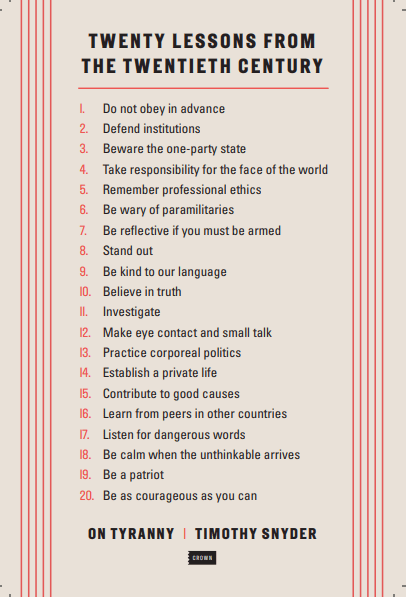
Most marketing people will advocate using a number as a way to increase engagement – seven ways to improve your marketing, five things you need to know about… and so on, as humans we seem to love a list, preferably a short one that’s a prime number. Timothy Snyder’s book On Tyranny has the subtitle “Twenty Lessons from the Twentieth Century” which caught my eye as worth my attention.

There is no denying that we live in challenging times, where truth has become harder to reach and there are so many powerful vested interests determined to treat us like mushrooms, kept in the dark and fed on…

Truth is a big deal in financial planning. It’s the partner of trust, without both – any advice provided needs some considerable investigation. My sector is not known for its transparency, trust or grasp of truth. We have powerful regulation which attempts to ensure that we are. Yet, over the last two decades in particular, I can attest to the fact that many of the advisers I meet are decent people, who are keen to share best practice, have a degree of vulnerability about their need to improve knowledge and admit that they don’t know everything. Most of those I meet, I believe to be trustworthy and genuinely want to help both advisers and clients to make money and investing better understood.

There is even a software package called “Truth” that aims to reveal the truth of your ambitions for your financial decisions.

Sadly, not all are truthful, many will claim to provide financial planning, but are really selling investments, building the engine before even knowing what is required. It’s not easy to tell from a website or indeed when you meet them. There are still a few who are only interested in extracting your wealth for their own benefit and they are occasionally caught.

Aside from the charlatans, who I can do little about, other than pay my regulatory fees which cover their failings and deal with the consequences of mistrust, my main concern is a lack of thinking. Not about products and tax legislation, or indeed sensible solutions, but the eagerness to embrace anything that appears to save time. It is easy not to think, to simply accept narratives of large, powerful players or persona’s and what they say from their platform.

It seems to me that good financial planning is all about helping uncover your values and helping you to achieve and maintain your lifestyle. The one you really want, not the one that vacuous individuals display for you to envy and strive for. All choices come with a consequence and there is a price for every decision – who you love, where you work, live, what you eat, how you exercise, what you read and so on. To pretend that political decisions have no bearing on these things is to fail to appreciate the fragility of the freedoms you currently enjoy, which are certainly under siege. The belief that taxes are always bad, that there are those who don’t deserve help, that we are all ‘self-made’ and need a heavy shot of ‘resilience’, is to miss the point and purpose of what it is to live as a human in a thriving, peaceful community, To be critical is not the same as to criticise.

We can all point to problems, but the real skill is to address root causes, invariably this is envy and greed. Something that is on constant display in our scrolling. Add in a dose of fear and mistrust, a sprinkling of inflammatory words and the rabbit hole opens up to swallow, perhaps consume.

In the context of a ‘good life’, we need a good society and a functioning democracy; something that it seems many advisers forget as they chastise yet another Chancellor whilst failing to pause to consider the source of their information. None of us get it right all the time, but an attitude of thoughtful reflection about vested interests is one that I encourage.

In this book, Snyder draws some uncomfortable lessons from history which have a very current application. He is under no illusions about the problems, but offers some thoughtful hope for facing what needs to be confronted. Snyder is a man who has committed his life to understanding the context of why we tend to war, how to spot the signs and what to do about it. Here are his twenty lessons.


What are the Twenty Lessons?2026-04-10T18:01:22+01:00

What profits?

Dominic Thomas
March 2026  •  3 min read

What profits?

I wonder if you have seen the recent BBC series Small Prophets written and directed by MacKenzie Crook. To be honest, I’m usually very wary of “written and directed by” – often it’s not a good combination, but here Crook has built upon the charming Detectorists (2014-2022) to deliver another feel good, amusing and poignant comedy that will leave a smile on your face.

This is a tale of the extraordinary in the very ordinary, an exploration of grief and hope, with a dash of wry wit and some daft divine magic. I won’t spoil the plot as it’s a series with a probable follow up.

In essence Michael Sleep (Pearce Quigley) is living with the knowledge that the love of his life, Clea, has disappeared. Most presume she took her own life with her car being found on the Severn bridge. He is waiting for her return as he goes about his mundane, ordinary life as a member of staff at the local DIY superstore. He visits his father Brian (Michael Palin) each day who is now living in a local care home. Apples don’t fall far from the tree, both are curious and have sharp minds, though Brian’s is now failing him.

Brian has the ludicrous certainty that he can grow truth-saying spirits (Homunculi) in a jar of rainwater, who have to speak truth. This, Brian asserts, will lay to rest the question of Clea’s mortality. The fantastical is set against the backdrop of the plainly defiant ordinariness of a fairly bland life. Yet we quickly witness many moments of magic in the ordinary and are reminded of our humanity and ability to connect and relate to one another with grace, patience and goodwill.

The contrasting lives and experiences are set against one another, the minimalist nosy neighbour who can barely tolerate Michael’s chaotic overgrown garden. The ‘brother-in-law’ who has lost everything as an adult, yet can find his childhood being restored. The lost treasure within our clutter. The hopes of superstore staff who dream of careers whilst serving others intent on their own DIY, most being oblivious to all that is in front of them (bucket scene) and missing the mystery and magic within the ordinary.

So what? It is so easy for us to forget the basics of life, to connect and be connected, to pause, to think and to thank. The talent and skill of genuinely caring. To be curious and to allow our curiosity to explore the mundane to the mystical. It reminds me of what I sometimes hear from clients “we have a fairly ordinary modest lifestyle” as though I may judge your life choices or maybe perhaps you aren’t sure if you are quite rich or ambitious enough.

The point of great financial planning is to live on your terms, not those of others. Whilst it may not be mathematically ‘best’ to repay your mortgage, the sense of liberation felt by doing so is priceless for many. To be able to live and give generously, on your own terms, without strings attached and to be able to see your legacy taking shape during your lifetime. These are things that are ordinary yet deeply fulfilling and are the true profits of a rich life.

The short 6-episode series, which I watched on the BBC iPlayer was a great way to end an evening, that may otherwise have been punctuated by a stream of “nothing good” on social media. I agree with those who gave it the high score of 8.5/10 on IMDB. Here is the trailer.

What profits?2026-03-27T15:01:26+00:00
Go to Top