

Dominic Thomas
April 2026 • 3 min read
What are the Twenty Lessons?
Most marketing people will advocate using a number as a way to increase engagement – seven ways to improve your marketing, five things you need to know about… and so on, as humans we seem to love a list, preferably a short one that’s a prime number. Timothy Snyder’s book On Tyranny has the subtitle “Twenty Lessons from the Twentieth Century” which caught my eye as worth my attention.
There is no denying that we live in challenging times, where truth has become harder to reach and there are so many powerful vested interests determined to treat us like mushrooms, kept in the dark and fed on…
Truth is a big deal in financial planning. It’s the partner of trust, without both – any advice provided needs some considerable investigation. My sector is not known for its transparency, trust or grasp of truth. We have powerful regulation which attempts to ensure that we are. Yet, over the last two decades in particular, I can attest to the fact that many of the advisers I meet are decent people, who are keen to share best practice, have a degree of vulnerability about their need to improve knowledge and admit that they don’t know everything. Most of those I meet, I believe to be trustworthy and genuinely want to help both advisers and clients to make money and investing better understood.
There is even a software package called “Truth” that aims to reveal the truth of your ambitions for your financial decisions.
Sadly, not all are truthful, many will claim to provide financial planning, but are really selling investments, building the engine before even knowing what is required. It’s not easy to tell from a website or indeed when you meet them. There are still a few who are only interested in extracting your wealth for their own benefit and they are occasionally caught.
Aside from the charlatans, who I can do little about, other than pay my regulatory fees which cover their failings and deal with the consequences of mistrust, my main concern is a lack of thinking. Not about products and tax legislation, or indeed sensible solutions, but the eagerness to embrace anything that appears to save time. It is easy not to think, to simply accept narratives of large, powerful players or persona’s and what they say from their platform.
It seems to me that good financial planning is all about helping uncover your values and helping you to achieve and maintain your lifestyle. The one you really want, not the one that vacuous individuals display for you to envy and strive for. All choices come with a consequence and there is a price for every decision – who you love, where you work, live, what you eat, how you exercise, what you read and so on. To pretend that political decisions have no bearing on these things is to fail to appreciate the fragility of the freedoms you currently enjoy, which are certainly under siege. The belief that taxes are always bad, that there are those who don’t deserve help, that we are all ‘self-made’ and need a heavy shot of ‘resilience’, is to miss the point and purpose of what it is to live as a human in a thriving, peaceful community, To be critical is not the same as to criticise.
We can all point to problems, but the real skill is to address root causes, invariably this is envy and greed. Something that is on constant display in our scrolling. Add in a dose of fear and mistrust, a sprinkling of inflammatory words and the rabbit hole opens up to swallow, perhaps consume.
In the context of a ‘good life’, we need a good society and a functioning democracy; something that it seems many advisers forget as they chastise yet another Chancellor whilst failing to pause to consider the source of their information. None of us get it right all the time, but an attitude of thoughtful reflection about vested interests is one that I encourage.
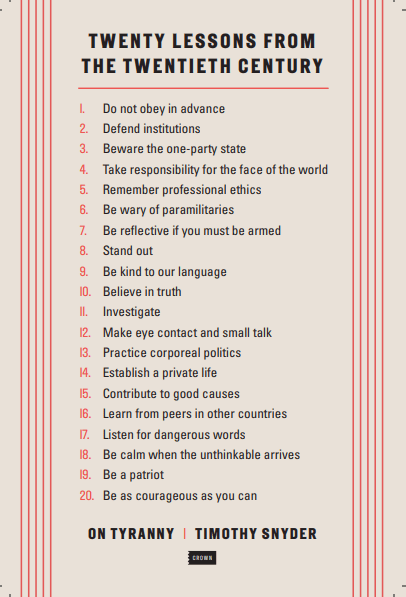
In this book, Snyder draws some uncomfortable lessons from history which have a very current application. He is under no illusions about the problems, but offers some thoughtful hope for facing what needs to be confronted. Snyder is a man who has committed his life to understanding the context of why we tend to war, how to spot the signs and what to do about it. Here are his twenty lessons.
References:
Order a copy, preferably not via Amazon: https://www.worldofbooks.com/en-gb/products/on-tyranny-book-timothy-snyder-9780804190114
Timothy Snyder website: https://timothysnyder.org/
Yale History Department: https://history.yale.edu/people/timothy-snyder
FCA latest fines in 2026: https://www.fca.org.uk/news/news-stories/2026-fines
The sort of bad advice before proper fee charging ushered in from 2013: https://www.thisismoney.co.uk/money/investing/article-1669499/The-true-cost-of-bad-financial-advice.html
What we do: https://www.solomonsifa.co.uk/what-we-do/