Have You Found Reasons to be Cheerful?

Dominic Thomas
April 2026  •  3 min read

Have You Found Reasons to be Cheerful?

It was a wet, cold March evening as I parked up in Hammersmith and walked across the bridge to the Apollo. A now familiar route that I enjoy with my wife since the closure of the bridge in 2019. This evening we were to see David Byrne in concert, an evening of songs that in truth, we weren’t that familiar with. A missing older brother meant that our first exposure to Talking Heads was the whacky, off-piste videos from their 1985 album Little Creatures and tunes that quickly became ear-worms like And She Was and Road to Nowhere, which introduced us to earlier songs Once in A Lifetime (1981) and Burning Down The House (1983).

The oddity of David Byrne amused me at the time, but I wasn’t in a place to be intrigued enough by his messages at the time; fun tunes but little else. As I’ve aged, read more and become more engaged with difference as a way of making sense of the world, Byrne has come to be a rather engaging subversive optimist, someone who points to the absurd and causes us to think again.

Optimism is needed by all investors, there is little point in investing in future growth if you don’t really believe in much of a future and at the moment, that sense of optimism is being severely challenged by the lunatics and sycophants in the White House. Our once reliable, thoughtful, intelligent allies have reverted to the very worst of failing school bullies. The Trump administration and the couldn’t-care-less way in which they brutally treat people and the planet is deeply depressing. I wake most days hoping for news of his arrest or end, and within the week he has managed to dig even deeper into the depths of depravity.

So I seek out stories of hope, taking minor actions (reading, discussing, writing and protesting) to counteract the mainstream narratives. To make a stand for decency and our sole inhabitable planet. Some days it is harder to do than others. When I meet with clients, the sentiments expressed are of the same exasperation. I have come to rediscover people like Byrne who provide some respite and relief and of course a genuine sense that most people are actually decent, not complicit in a march towards fascism, but struggling to cope with the overwhelming amount of chaos and stupidity on display not simply in the US, but here in the UK and around the world.

Byrne also gives me hope as he turns 74 in May and whilst having some breaks from public attention, has been relentless in his creativity. Byrne took inspiration from Ian Dury (yes the hit me with your rhythm stick, Dury) title Reasons to Be Cheerful (1979) and founded an organisation of the same name which provides stories from around the world that most people would find hopeful. He attempts to counteract the mainstream narratives of division and hatred, building a sense of togetherness and an appreciation for the beauty of life and our planet. So whilst the media and the US regime probably makes many of us feel both despair and disbelief, there are, thankfully many billions of us who have reasons to be cheerful. As you may have read or heard me say, I encourage clients to “tune out the noise” by which I mean – try not to listen to the news which leans towards pessimism and strife and gets you living in a state of permanent anxiety about the future and your portfolio. We never hear news like “billions wiped ON to the market this week”. Of course we all need to be informed, but I think careful selection of our choice of media is important, and sadly the traditional forms appear to be considerably compromised under any substantive inspection. Indeed, we have witnessed the Trump administration threaten, cancel and mock journalists, actual news stations, comedians and frankly anyone who challenges their lies.

So you may find it helpful to have a look at Byrne’s organisation and perhaps put some music on and dance. He danced and performed on the very large Hammersmith stage for a solid two hours – no small feat for a man of 73.

Have You Found Reasons to be Cheerful?2026-04-02T10:07:35+01:00

Do you feel invisible?

Dominic Thomas
Jan 2026  •  3 min read

Do you feel invisible?

One of the statements I hear increasingly, perhaps I am more aware of it myself, is that with age, there is a growing sense of feeling invisible. Lately a number of thrillers or crime stories have played with the idea of being invisible in plain sight.

I was struck by this and had the sense rather amplified by an exhibition at the Royal Academy of Art by Kerry James Marshall. His work depicts his background (a black man born in 1955 Alabama and living in the United States) and confronts this stark reality. An entire room is entitled Invisible Man based around the 1952 book by Ralph Ellison which I bought last year and still haven’t got around to reading. His study is fascinating and deeply unsettling at the same time.

His work confronts injustice, inequality and his African roots all whilst deeply engaged in various foundational aspects of art history and process; incorporating contemporary, even very temporary, aspects of pop culture. A striking piece is his 2003 Black Painting which is totally in black (a comedy sketch from The Fast Show immediately comes to mind as I write) but this is the polar opposite – a couple lying on a bed, the room gradually coming to life as you notice different items and symbols such as the Black Panther flag. It’s very potent indeed and may be an imagined depiction of Fred Hampton moments before he was murdered by Chicago Police in 1969.

What on earth has art got to do with financial planning? Nothing and everything. Art is story and an insight into how the world is seen through the eyes of an artist, yet of course we are largely surmising and viewing through our own lens. When we are building your financial plan, and you are asked about what you may wish to do in the future, it’s common to think that you are expected to offer up some ideas of the places you would like to visit, the beaches you wish to experience, on your yacht whilst popping off for a hot air balloon ride, the golf club membership and advanced skills that you can acquire. There is nothing wrong with any of these things of course, but they are invariably dreamt up by the Don Drapers (Mad Men) of this world and not necessarily what you really wish to do. The truth is that our unique sense of who we are can become invisible even to ourselves as we become so accustomed to social expectations of what we should want from life. I also tend to believe that “if you don’t sacrifice for what you want, what you want becomes the sacrifice”. The question I ask you may even be unfair in the sense that it is so rarely asked at a deep level, and to provide an answer immediately is far from straightforward.

Most of us will struggle to explore much of our personality beyond the boundaries of our upbringing, which is perhaps why there is currently a palpable sense of rose-tinted nostalgia of a time “when things were better”, for which most of us really mean – less different or less challenging to an inability to address the life force of life – growth. It is evident that the struggle for equality is ongoing, the word itself seems to be a nuclear trigger to right wingers.

To honour who you really are and to embed your values deeply into your financial plan, to my developing mind, seems to require a sense of where you wish to arrive (if indeed that is possible) but certainly what impact, memory, impression or legacy you wish to leave with those who care about you and hopefully ‘know’ you.

I suspect that a common problem is the notion of being ‘ordinary’, but I believe that ordinary is surely what we wish to be, an acceptance of who we are yet a willingness to learn, change and improve what we can. The inability of world leaders to own the reality of their ordinariness is the fuel for their narcissism and inability to actually serve. However there is the other sense of ordinary, being ordinary but uniquely appreciated.

Anyway, you are appreciated and certainly not invisible to our small team at Solomon’s. We recognise and value your story and seek to help you to allow it to unfold. Whether you realise it or not, you have already made an impression on us. I certainly hope that you do not feel invisible when dealing with any member of the team.

Remember, the goal isn’t more money, the goal is living life on your terms.

The Kerry James Marshall: The Histories exhibition runs at the RA until 18th January 2026. Here is a link to a video of Marshall talking about nine shades of black. https://www.royalacademy.org.uk/article/video-kerry-james-marshall-black-paint

Do you feel invisible?2026-01-26T11:51:55+00:00

London Money

Jemima Thomas
Dec 2025  •  2 min read

London Money

A big thank you to London Money!

Just in time for Christmas I bought and moved into my first flat! It’s been a chaotic but incredibly exciting end to the year, and I’m feeling very fortunate.

It’s not lost on me the gigantic privilege it has been to have been able to buy at the age of 30. Times are hard for my generation, and to live and buy (particularly in the South) is incredibly hard no matter how much others will beg to differ. I have been renting for the best part of 10+ years since university, and I wave a gigantic flag for all those who are having to do the same. Whilst it comes with many perks (moving to different areas, meeting and creating new friendships through all the different house-shares), I know how rough it can feel never being able to put your stamp on your ‘temporary’ home, as well as having zero control on when you may have to move again. At one point I moved every year for four years in a row … it was hard.

I want to give a massive shout out and huge thanks to London Money for being incredibly helpful and hands on whenever we’ve needed. Both Martin & Cathy have been invaluable support on our journey, right from our initial meeting with Martin last summer; they have both been reassuring and were able to get us the best mortgage right up until we exchanged contracts. We have previously mentioned them in our client magazine Spotlight which you can read here. Both Martin and Cathy’s dedication have truly made a difference in our experience, turning what could have been a daunting process into a smooth and manageable one. Personally, it feels rare to find such a committed team that genuinely cares about their clients’ success. Thank you once again, London Money, for your unwavering support and professionalism. I highly recommend anyone using them for mortgage-related needs.

Ref: London Money 

London Money2025-12-16T16:04:18+00:00

STORIES IN DISASTERS

TODAY’S BLOG

DISASTERS…

At the risk of sounding a little odd, I admit that I have been interested in the stories of natural and manmade disasters since I was a youngster. It wasn’t a morbid fascination for me; it was a genuine curiosity about the causes of tragic accidents and incidents. I wanted to understand how these catastrophes occurred. I wanted to learn about the ‘anatomy of disaster’

As I got a little older, other aspects of these types of events started to reveal to me how important they are in our collective history.  Time and again we see humanity triumphing over adversity and becoming stronger, better and wiser for it.

In more recent years, I have found that individual stories of ordinary people caught up in extraordinary circumstances have really resonated with me and inspired me. I have read many autobiographies from the survivors of these disasters and often the small details they remember serve to preserve not just the factual history of the event, but the human perception of the experience (it’s always about suffering but often accompanied by hope and joy).

My interest ranges from natural disasters (earthquakes, tornadoes, volcanic eruptions, tsunami) through to engineering and technological incidents (so-called ‘manmade’ disasters) – aircraft crashes, bridge collapses, mining cave-ins, explosions on oil rigs.

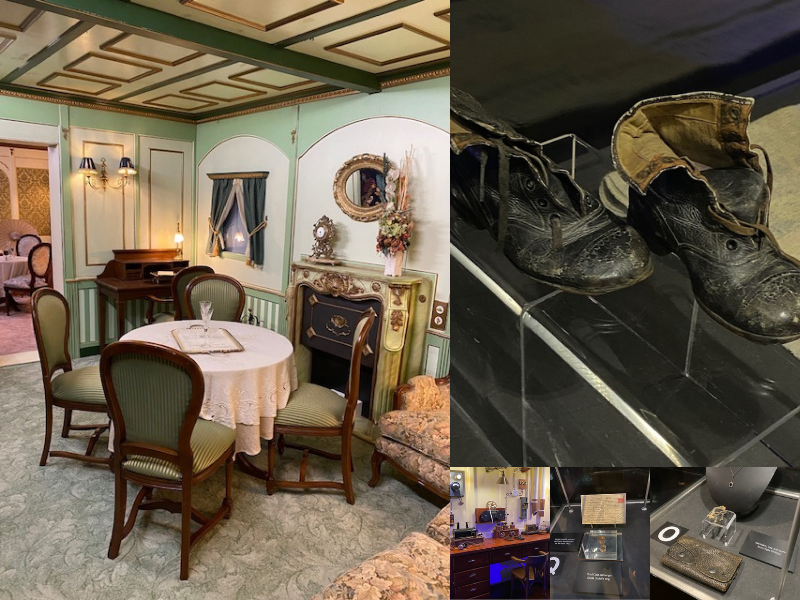
Very recently I visited the Titanic exhibition at Dock X, Canada Water and was overwhelmed by some of the artefacts on display. Not the big pieces of furniture or the heavy watertight doors from Titanic’s sister ship Olympic (impressive as they were to see!); but the tiny trinket of a victim; the shoes of a small child who had survived; the cuff links of one of the crew; the postcards that had been sent by passengers (such poignancy in the fact that the postcards arrived home, but some of the authors didn’t); the simple jewellery of a third-class woman who had ended up in the water but had been hauled into a lifeboat – she sadly died of hypothermia before the Carpathia was able to reach them.

As excited as I had been to see the exhibits, I was hit by a very illuminating thought as we made our way around the displays … it wasn’t the ‘things’ that fascinated me. It was the ‘stories’.

The personal effects preserved in this and various other exhibitions and museums around the globe are all simple symbols of lived lives and they stand alone – each piece a part of ‘the humanity of disaster’

I continue to read autobiographical work – Jim Lovell of Apollo 13 fame, Chesley Sullenberger – the pilot of US Airways Flight 1549 (the ‘Miracle on the Hudson’) and Violet Jessop (a stewardess on the Titanic) to name a few.

The stories of these lived lives never fail to inspire me and the ‘stories’ of our clients often have the same impact. I love reading the articles written by our clients and showcased in Spotlight (our client magazine) as we learn a little more about what matters to them and the things they care about. Their stories. (By the way – if Jemima has been in contact with you asking you to contribute to our next edition, I would encourage you to share ‘your story’ … each one of us has our own and they are all unique and precious).

As for the Titanic exhibition – it’s running until 20th March 2022 and is well worth a visit.

Debbie Harris
Solomons IFA

You can read more articles about Pensions, Wealth Management, Retirement, Investments, Financial Planning and Estate Planning on our blog which gets updated every week. If you would like to talk to us about your personal wealth planning and how we can make you stay wealthier for longer then please get in touch by calling 08000 736 273 or email [email protected]

GET IN TOUCH

Solomon’s Independent Financial Advisers
The Old Mill Cobham Park Road, COBHAM Surrey, KT11 3NE

Email – [email protected] 
Call – 020 8542 8084

7 QUESTIONS, NO WAFFLE

Are we a good fit for you?

GET IN TOUCH

Solomon’s Independent Financial Advisers
The Old Mill Cobham Park Road, COBHAM Surrey, KT11 3NE

Email – [email protected]    Call – 020 8542 8084

7 QUESTIONS, NO WAFFLE

Are we a good fit for you?

STORIES IN DISASTERS2023-12-01T12:12:55+00:00

Slow and steady…

Jemima Thomas
Jan 2022  •  3 min read

Slow and steady…

You would think (given that I work for a financial planning firm!) that I would be great at handling my finances.  Unfortunately, this is not something I have totally figured out…

I am a 20-something woman, living in and galivanting around London.  I like to keep myself busy with events and activities – I love the buzz and vitality of ‘city life’.  Whilst I am thoroughly enjoying my time and having some fabulous experiences, I also know that I need to say no sometimes to try and save for my future endeavours … right?

“YOU’RE YOUNG; YOU HAVE SO MUCH TIME; JUST ENJOY IT”

I am constantly torn between living ‘in the moment’, enjoying London whilst I’m here, and also saving for my future lifestyle (my needs and dreams are sure to alter as I get older).  I am frequently reminded by anyone remotely older than me, that I am ‘’SO YOUNG, you can do anything, you have no real responsibilities!” – which to me sounds like code for – you have no children or a mortgage so HAVE ALL THE FUN.  Which on the one hand makes a great deal of sense, but it’s hard to ignore the fact that living in the moment is all well in good, but thinking about my future is something I mustn’t avoid.  Whilst I enjoy hearing from others that I am in a period of my life where being young and free needs to be enjoyed, I still often hear people reflecting saying they wished they’d saved more when they were younger or they wished they had done xyz as well.  Hindsight is 20/20 vision of course.

In the last few years, I have started to see friends of roughly my age buying their first home, getting engaged or having children.  Whilst of course this is all a matter of perspective based on our individual choices, circumstances, income etc; I can’t help but feel I am now in a hurry to get on and do everything, as well as ‘save’ for ‘future me’.  I am told that I have all the time in the world, and yet I feel like I am starting to run out of it at the same time!

MY WISE OLD MANAGER …

As I was beginning to feel slightly overwhelmed trying to compartmentalise my financial life whilst enjoying life in the city, my lovely manager Debbie brilliantly guided me to a realisation that saving little by little was possible, and that I needn’t worry about saving huge chunks (I was never able to save huge chunks, but little chunks didn’t seem to be enough in my mind!).  She told me that every evening after having whatever fun I was having, I should move money into my savings account so that each night my account balance was left at a round number.  I remember laughing and saying that this would make no difference – moving 50p here, £3.80 there … what a long-winded approach!  And yet …  she was completely right.  Soon after starting to do this, I realised that each month I was actually saving!  And I was also made to be more mindful at the same time.  It didn’t hurt or stop me going out, it was done so subtly that it was easily doable.

It’s taken some time, and I still have moments of forgetting and missing a few days, but I feel I am finally at a place where I can feel comfortable and confident about putting away ‘a little something’.

And already in the new year, I’ve managed to keep saving.  Admittedly it’s not a lot – but it’s a start, and I’m proud of what I’ve managed to achieve.  It’s a reminder that it doesn’t matter how much it is, slowly I am beginning to create a little pot of gold for my future.

And in much the same way, it is incredibly satisfying for us to see the differences for our clients (which can be phenomenal) that a planned approach (even if ’slow but small’) can bring about … ultimately enabling choice and financial freedom.

Slow and steady…2025-02-17T16:04:13+00:00

HOT PROPERTY?

TODAY’S BLOG

HOT PROPERTY – WHAT YOU NEED TO KNOW

We are all aware that the world is a bit weird now.  The thoughtful self-reflection that occurred during lockdown appears to have given way to fatigue, thoughtlessness and sometimes an attitude of selfishness. The UK property market continues to confound reason.

We know that during the initial lockdown, which was really the duration of the second quarter of 2020, very little happened, then gradually restrictions have lifted. One of the often-cited reflections of working from home is the need for a quiet space at home, be that a spare bedroom, study or garden shed. As people became accustomed to not commuting, many found that they are in fact rather more productive. Some have found a better balance between the professional and the personal. Many have questioned why they are paying for an expensive small home that makes commuting quicker but now find it unnecessary. Some have noted the value of community and the desire to be closer to relatives. Space is cheaper elsewhere.

We know that big cities like London were struggling to encourage people back into the office, leading to an existential threat to many supporting businesses and organisations, from cafes and restaurants to meeting venues. We are now heading into the Winter with yet another Governmental set of directives, which may or may not be helpful.

Interest rates have never been lower in living memory. If ever there was a time to borrow it is now. However, lenders are all too familiar with bad debt and worry about an economy that may experience a prolonged recession, with rising unemployment and job insecurity. The usual domino effect of recessions. This results in lenders managing their own risk, limiting who, when and why they lend. They hold the cards. We may all find money a bit tighter if taxes increase to pay for furlough and various Covid bailouts.

SOLOMONS IFA MONEY FOCUS

STAMP DUTY: GOING, GOING…

The Chancellor has tried to stimulate house sales by removing Stamp Duty on sales under £500,000 until the end of March 2021. This is a tax break that is planned to end. Some of you may remember MIRAS, another tax break which ended 20 years ago. House sales in England typically account for 85% of all house sales in the UK, forgive me, but I’m going to focus on the sales in England. The ONS records sales over £40,000. In Q2 of 2020 a provisional 131,730 homes were sold in England, a year earlier the figure was 237,870. Sales had been gradually improving since the credit crunch. Numbers had not recovered to their 2006/07 which saw 1,433,200 homes sold, that collapsed in 08/09 to just 664,250. Sales have been recovering slowly and then dented again by the Brexit vote, before reaching 1,003,060 in 18/19.

SCORES ON THE DOORS…

2020 began fairly slowly, but reflective of seasonal normality with monthly sales in the 70,000 range. April sales collapsed to 32,350 (lockdown) but by July sales had returned to winter levels of 71,190. So despite what Estate Agents may be telling you, property sales are below average, down by something like 20%. You can dress it up, but that’s the reality of completed sales. That said, according to Nationwide average prices recovered in July and increased in August by 3.7%. They also note that the 2010s has been the weakest decade for property prices up 33% over the decade compared to 180% in the 1980s. Low interest rates and the credit crunch being the suggested main factors.

YOU HAVE MORE MONEY? LET ME SHOW YOU…

Some warn that the reduced stamp duty tax will not be passed on, as sellers push prices to cover their own stamp duty on property over £500,000. In short, the young are paying above the odds. Some expect prices to fall as demand slows in April next year when the stamp duty break ends. Then there is Brexit, which is now a sub-heading of the national conscience, but it would appear that the Government have little real idea if agreement can be reached.

This might prompt a reduction in prices (nobody knows) which tends to happen when a tax advantage ends and a recession is happening. So those thinking of buying this autumn or winter that are looking at property priced under £500,000 face the increased risk of buying at a peak value and a collapse. They have to counter this with the benefit of stamp duty savings. A property valued at say £400,000 currently has no stamp duty, from April such a sale price would result in £10,000 of Stamp Duty. That said, £10,000 is only 2.5% of the purchase price (£400,000) it would not be inconceivable to see prices fall by 15% (£60,000 in our example). This may wipe out your deposit and possibly mean that you have negative equity.

THE THING IS – WE DO FORGET

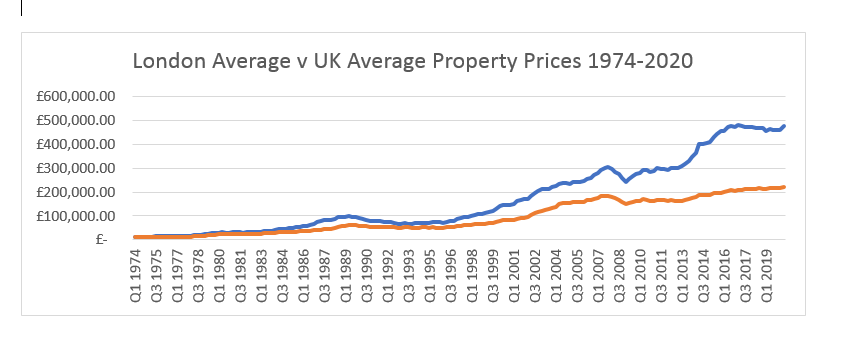
Turning to relatively recent property crashes, the 1990s provided some of the harshest lessons for homebuyers. The worst decade for price rises – even London only increased by 40%. Some of you may remember MIRAS, which was tax relief given to borrowers. Nigel Lawson changed the terms of MIRAS so that unmarried couples could not claim it from August 1988. He announced the changes in April 1998 which provided 4 months of “opportunity” which pushed up prices to bubbling point. When the relief was lost repayments went up. The overpriced market peaked in 1989 with an average price in London of £97,667 but then fell back to £66,573 by the end of 1992. A fall of £31,094 or more importantly 31%. When inflation is factored in, prices didn’t really recover from 1988 until 2001.

A decade later (April 1998) MIRAS was again reduced to the point of being almost worthless and finally abolished by Gordon Brown two years later in 2000. Its been 20 years since MIRAS ended. There has been some tinkering with Stamp Duty which was altered from a flat rate system to a tiered rate system from December 2014. This was done in an attempt to curb price rises particularly in London. In Q4 of 2014 the average national price was £189,002 by Q2 2020 it was £220,133 (up 16%). In London the average price was £406,730 and is now £475,448 (also up 16%). So the gap has not widened, but equally it has not shrunk (so the strategy neither worked not “failed” but it certainly didn’t change anything). The numbers are certainly larger and London remains the most expensive part of the UK.

IF IT WORKS, IT WOULD BE UNUSUAL

So over the last 32 years tax changes to residential property has created a quick spike and then collapse in prices (1988-1992) and it has also effectively done nothing (2014-2020). Chancellor Rishi Sunak would be making a little history if his policy didn’t fail or do nothing of substance.

If history were to repeat itself, which let’s face it, tends to happen more as an echo than a direct repetition, then there is the prospect of a 31% fall (88-92). That would mean someone buying in 2020 for £400,000 would potentially be contemplating their home revalued at £276,000. It could be a decade before prices recover.

We have short-term memories and forget what has happened. First time buyers have no memory of a property crash, (indeed some of my detractors on social media appear to have no memory at all). Lenders are currently very reluctant to lend more than 90% and many will struggle to get a competitive loan with more than an 85% mortgage. So with our £400,000 example, that’s a deposit of £60,000 and if a third gets wiped off by 2022, the £340,000 mortgage would be higher than the value of the property (£276,000) for some time…

FORECASTS ARE NOT MY THING

The truth is we simply do not know what will happen. We do know that Brexit will happen (we do don’t we?). We know that we are in a recession. When recessions happen, jobs are lost, money is tight, homes get repossessed (1991 was the peak for repossessions). We know that interest rates are at all time lows which implies only one likely direction for the cost of borrowing (upwards). So would you buy to save £10,000 on stamp duty before March or would you wait a couple of years and either buy the same property for 30% less or simply buy a bigger place.

IN SHORT- BE PREPARED TO LIVE WITH YOUR DECISIONS

This is a gamble, I have no idea what will happen, perhaps property price rises will return to 1980s levels, but that would likely mean inflation is out of control and interest rates could be much higher than they are now (which I think is unlikely). I do not know – nobody does. We are due a correction – any sensible person knows that property in the South East is overpriced. The only consolation I can offer is that if buying, make sure you do so knowing the above and that you might be stuck for a decade. Fine if you are a young couple in a flat, but not that great if you start to have a family. Lose your job or your relationship falls apart. Perhaps “nothing” will happen. I do not know, but I’m not sure I’d bet my house on it.

SOLOMONS IFA UK AVERAGE PROPERTY PRICES 74-20

Dominic Thomas
Solomons IFA

You can read more articles about Pensions, Wealth Management, Retirement, Investments, Financial Planning and Estate Planning on my blog which gets updated every week. If you would like to talk to me about your personal wealth planning and how we can make you stay wealthier for longer then please get in touch by calling 08000 736 273 or email [email protected]

GET IN TOUCH

Solomon’s Independent Financial Advisers
The Old Mill Cobham Park Road, COBHAM Surrey, KT11 3NE

Email – [email protected] 
Call – 020 8542 8084

7 QUESTIONS, NO WAFFLE

Are we a good fit for you?

GET IN TOUCH

Solomon’s Independent Financial Advisers
The Old Mill Cobham Park Road, COBHAM Surrey, KT11 3NE

Email – [email protected]    Call – 020 8542 8084

7 QUESTIONS, NO WAFFLE

Are we a good fit for you?

HOT PROPERTY?2025-01-28T10:08:03+00:00

CONTEXT IS EVERYTHING

TODAY’S BLOG

CONTEXT IS EVERYTHING

Whatever your view about coronavirus, I would prefer to trust explaining and treatment of any virus to a properly qualified medical expert rather than a member of Parliament. The focus on deaths is purely one measure of the virus, nothing more. As yet there is no (or very little) data about the long-term impact of the virus on individuals. A life lesson I learned many years ago is that investors over-estimate the short-term and under-estimate the long-term. That is true of everyone, not simply investors. We have short, flawed memories.

As for covid, many suffer ongoing symptoms months (currently known as long covid) after first contracting the illness. To measure the danger of virus based purely on deaths is rather like measuring road traffic deaths and concluding that they are low.

A NEW GREEN CROSS CODE FOR HEALTH

In 2018 in the whole of Britain 1,784 people were killed in reported road traffic accidents, yet there were 25,511 (14x) seriously injured casualties and a further 133,302 (74x) slightly injured casualties. Focus on the number that died out of a population of about 66.27million does not mean that just because “only” 0.003% died none of us should wear seatbelts or observe the highway code.

The uncomfortable truth is that we do not yet know the long-term (or even short-term) impact of covid on public health. We hope and look forward to a vaccine. However as with road accidents, there are a great (vast) number of people that will be impacted with poorer health.

SOLOMONS IFA - MORNING WALK IN THE FOG

BEYOND HEADLINES

In a related theme I noticed a fairly stark statement by a local politician. “10,000 deaths a year in London from air pollution”. Let me be clear, I am not a climate change denier, but I didn’t believe the statement. Instinctively it didn’t feel right. So I checked. In London (inner and outer) there are about 50,000 deaths a year in total. That’s everything from infant mortality, “old age”, cancer, road deaths, murder, suicide – the works. There is no way that 20% of those are due to air pollution. Everyone dies in the end.

IN A HAZE

Certainly you may notice the air quality in London being poor or awful at times, there is room for improvement (always). However, this is to forget the context. Take the Great Smog 5-9 December 1952. Estimates at the time were that 4,000 people died as a direct result, with 100,000 made ill, some of them very seriously indeed. Actions were taken to improve the quality of London air and have been ever since. The number of deaths registered in London has fallen enormously over the years. I have found data to 1966, some 14 years after the Great Smog there were 87,991 deaths (London) in 1966 some 5 years later this has reduced to 84,990 in 1971. Thereafter each subsequent decade later the numbers reduce. By 2011 the number had fallen to 46,685. Last year the figure stood at 49,007. Admittedly increased since 2011, but then so has the population from about 47.9m in 1966 (England and Wales) to 57.4m by 2014.

PAST, PRESENT, FUTURE

Data always requires a context and this invariably requires looking back. The main problem with financial planning is that we look forwards, often forgetting how far we have come. It is important to remember what things were like, this provides confidence that the future is hopeful. As for wondering if financial planning is important, think back to your own childhood and the cost of a stamp – look it up (if you were born before decimilisation you will have to convert imperial). One of the basics of financial planning is to keep your spending power rising or at least equal to inflation so that you can still afford your lifestyle, fear of the future is likely to be your worst enemy. Do not under-estimate the future or forget the past.

Dominic Thomas
Solomons IFA

You can read more articles about Pensions, Wealth Management, Retirement, Investments, Financial Planning and Estate Planning on my blog which gets updated every week. If you would like to talk to me about your personal wealth planning and how we can make you stay wealthier for longer then please get in touch by calling 08000 736 273 or email [email protected]

GET IN TOUCH

Solomon’s Independent Financial Advisers
The Old Mill Cobham Park Road, COBHAM Surrey, KT11 3NE

Email – [email protected] 
Call – 020 8542 8084

7 QUESTIONS, NO WAFFLE

Are we a good fit for you?

GET IN TOUCH

Solomon’s Independent Financial Advisers
The Old Mill Cobham Park Road, COBHAM Surrey, KT11 3NE

Email – [email protected]    Call – 020 8542 8084

7 QUESTIONS, NO WAFFLE

Are we a good fit for you?

CONTEXT IS EVERYTHING2023-12-01T12:13:13+00:00

JUDY – A STAR IS BORN

TODAY’S BLOG

JUDY – A STAR IS BORN

The new film “Judy” about the last year of Judy Garland’s life is now on general release. Renee Zellweger gives an impressive performance or perhaps impression of the troubled Garland.

50 Years – 1969 Tempus Fugit

Judy Garland died on 22 June 1969, just a few days before the moon landing. She died of an overdose of barbiturates, at a rented property in Chelsea. The overdose was probably a culmination of a lifetime of pill-popping, established by the shameless manipulators of a young girl. The irony that even then “we” could land on the moon but fail so spectacularly to address mental health problems is bad enough, yet today, whilst mental health and well-being are on the list of hot topics, the progress is painfully slow.

The Yellow Brick Road

The movie depicts a woman that struggles, we are left thinking “little wonder” not because of her talent, but due to the constant pressure she faced from childhood to perform. Bullied and harassed by her studio, the yellow brick road was certainly long and hard. When I learn about stories like these, which are all too familiar and present, there is a deep sense that those people around the individual concerned continually fail to protect and care. It seems to me that they are little more than parasites, there is no oversight of value, simply extraction.

Judy Garland - A Star Is Born Movie Poster 1954

There’s No Place Like Home..

Garland died with huge debts for 1969, she was basically swindled by her managers Fields and Begelman, was forced to sell her home and lived from hotel to hotel, reflecting her succession of husbands, all 5 of them. None appeared to offer any solace. “There’s no place like home, there’s no place like home” a line a young Garland echoes across time as Dorothy from Kansas. A story I suspect we all know well. She died homeless, with an estate of just $40,000 that couldn’t meet the charitable bequests she made in her Will.

Wicked

It baffles me that advisers (of all types) deliberately rip off their clients. There are regularly stories of actors, musicians or sports stars who are often very successful in their field, but not good with money. My main professional function is to help clients to keep more of their money, to avoid financial investing mistakes, scams and waste. Getting this right provides the base for some decent planning, using money wisely. Every time I see these stories, I wonder why they didn’t have a decent adviser, why they didn’t ask me? (of course, being a minnow, how would they?).

Placed on the stage as a toddler, she rarely found attention of value outside the spotlight. The film may take some liberties, (I hope) with her treatment in London, which she had described with deep fondness previously, particularly after her 1951 tour of the UK. One scene at the Talk of the Town Club shows an embarrassingly disrespectful crowd. I hope that this is artistic license (a similar incident did happen in Melbourne, Australia in 1964).

Babes on Broadway (1941)

It takes something to have been married 5 times by the age of 46, that something is clearly a damaged psyche desperately looking for the right attachments. Her trouble with men almost certainly began way before David Rose (30 at the time) proposed to her on her 18th birthday whilst still married himself. They married a little over a year later under Studio advice. There then followed a constant supply of unsuitable men.

Thousands Cheer (1943)

The film implies that perhaps the blame for her lot is rather wider than simply the men in her life. The studios promoted the “girl next door” image and the studios made her continue to play roles that she was too old for. Their argument being that the public loved her as a “kid”. The studios were responsible for her health and wellbeing, but merely encouraged eating disorders, addictions, suicide attempts and a deep sense of inadequacy. How complicit audiences and fans are in the rise and fall of stars remains a question that we return to regularly.

Perhaps what we can take from this tale, is that, sadly, good advice is much rarer than bad advice. There are many that are willing to part you from your money and cause your ruin. Don’t be fooled, seek out good advisers that offer the invaluable, connecting you and your money with your values. Judy Garland was failed. Spectacularly.

As a movie, this is a good one. Here’s the trailer.

Dominic Thomas
Solomons IFA

You can read more articles about Pensions, Wealth Management, Retirement, Investments, Financial Planning and Estate Planning on my blog which gets updated every week. If you would like to talk to me about your personal wealth planning and how we can make you stay wealthier for longer then please get in touch by calling 08000 736 273 or email [email protected]

GET IN TOUCH

Solomon’s Independent Financial Advisers
The Old Mill Cobham Park Road, COBHAM Surrey, KT11 3NE

Email – [email protected] 
Call – 020 8542 8084

7 QUESTIONS, NO WAFFLE

Are we a good fit for you?

GET IN TOUCH

Solomon’s Independent Financial Advisers
The Old Mill Cobham Park Road, COBHAM Surrey, KT11 3NE

Email – [email protected]    Call – 020 8542 8084

7 QUESTIONS, NO WAFFLE

Are we a good fit for you?

JUDY – A STAR IS BORN2025-01-28T10:08:05+00:00

THE STARRY MESSENGER

TODAY’S BLOG

THE STARRY MESSENGER

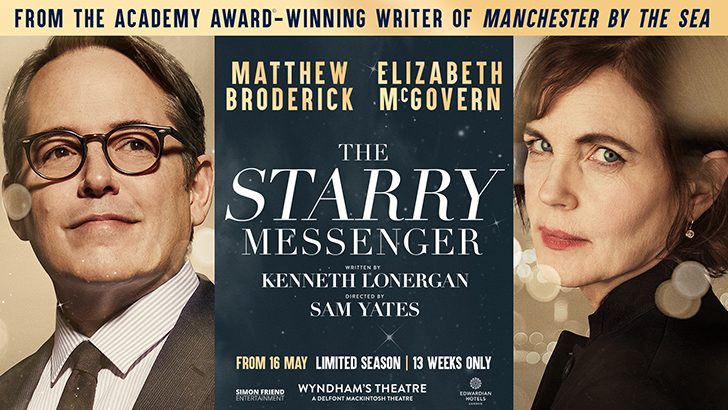
I was working with clients the other day and they noticed one of the icons in the software I was using with them. It was marked as “midlife crisis” and the icon was a sports car. They thought the IT company could do rather better with its icons (no I had not used it in their plan). However perhaps the sports car isn’t that bad an icon – a cliché admittedly. Perhaps I should suggest that they use a star now that a new play (well new to the West End) “The Starry Messenger” is running at Wyndham’s theatre.

The play explores the now recognised normality of a mid-life crisis. 50 something male falls for vivacious female, some 20 years his junior. Like him, she has baggage though I struggled to see how it even vaguely matched. Mark Williams is a teacher at the New York planetarium teaching evening classes of adult education. He loves his subject, but his va-va-voom has long since departed, his career has been side-lined to the extent that he clings to the hope of even a data entry job so that he can at least be associated with a worthy project. He laments that others are simply better at what he does than he himself. He is un-inspiring. He meets Angela, a hard-working single mother, training to be a nurse. Her genuine kindness somehow enables a relationship to develop.

THE STARRY MESENGER - SOLOMONS IFA BLOG

Ordinary Pain

There is something terribly ordinary about the play. By that I mean the ordinariness of real people living a real life. Many of us, have occasion to contend with huge disappointment and trauma. This is the bread and butter, or perhaps blood and tears of author Kenneth Lonergan. You have probably seen or lives a version of this story. The question remains whether Mark and Anne Williams will be able to face and overcome the chasm of a void in their relationship.

Extra-ordinary Plan

As someone that partakes in the new permitted addictions of social media, within my own field I regularly come across claims that lives are changed by a great financial plan. Part of me wants to agree with this, but another part also would wish to make the point that stuff happens, or as John Lennon put it “life is what happens to you while you’re busy making other plans”. We can plan sensibly, even brilliantly, but sometimes life throws up a problem or two. A financial planner can help make allowance for job loss, serious illness, long-term illness, business collapse or even death itself, but all these assume relationships last. Sometimes they don’t. I would urge caution, however detailed, however much room for error has been made, life is not as predictable as we may think. That does not negate the value of a good plan (or a brilliant one) I am simply making the point that we don’t know the future and some people talk as though they do. Beware.

As for Mark, Anne and Angela – you can see their story develop at Wyndham’s. Mark is played by Matthew Broderick, most famous for his role as Ferris Bueller (1986). A casting that seems entirely appropriate, how would 50-something Ferris face the day? I wonder if he would repeat “You’re not dying, you just can’t think of anything good to do”. Elizabeth McGovern (Downton) plays Anne and rising star Rosalind Eleazar plays the luminous Angela.

The play has begun a 3-month run. You can find tickets here. Here is a short video of the cast members discussing the play and the trailer.

Cast Discussion

Trailer

How will your story play out? Get in touch to consider your options.

Dominic Thomas
Solomons IFA

You can read more articles about Pensions, Wealth Management, Retirement, Investments, Financial Planning and Estate Planning on my blog which gets updated every week. If you would like to talk to me about your personal wealth planning and how we can make you stay wealthier for longer then please get in touch by calling 08000 736 273 or email [email protected]

GET IN TOUCH

Solomon’s Independent Financial Advisers
The Old Mill Cobham Park Road, COBHAM Surrey, KT11 3NE

Email – [email protected] 
Call – 020 8542 8084

7 QUESTIONS, NO WAFFLE

Are we a good fit for you?

GET IN TOUCH

Solomon’s Independent Financial Advisers
The Old Mill Cobham Park Road, COBHAM Surrey, KT11 3NE

Email – [email protected]    Call – 020 8542 8084

7 QUESTIONS, NO WAFFLE

Are we a good fit for you?

THE STARRY MESSENGER2025-01-28T10:08:06+00:00

EVERYONE KNOWS, BUT NOTHING IS SAID

TODAY’S BLOG

EVERYONE KNOWS, BUT NOTHING IS SAID

I wonder if you have played Scruples. I haven’t done so for many years, I remember it as one of those ice-breaker/get-to-know-you games that occasionally got wheeled out at a student party. How truthful and how flexible with the truth are we with one another? Perhaps there has been an episode or incident in your life ,or that of a friend, where everyone seems to know something is awry, but nothing is said. To some this is friendship, to others it is dishonesty.

Money is one of those very divisive topics, aside from income and discussions about fairness, how we all spend it and use it tends to be something that is often hidden. We see some degree of opinion exposed in the media, largely chastising both the very wealthy for their luxury spending and those that are poorer – spending money on “non-essentials”. To say that it is a loaded and often heated topic would be an understatement.

All My Sons, London Old Vic Solomons IFA Blog

A Financial Plan based on reality

The problem for you and I is that in order to provide any meaningful financial plan, you have to declare your real-world spending, so that I can build a plan to enable you to continue to maintain your lifestyle, but also attempt to help more of your own money stick to you. What good is it if I build a plan to deliver an income of £30,000 a year when £45,000 is actually needed. This is a precarious aspect of the adviser/client relationship. In the nearly 3 decades that I have been advising clients, I have very rarely met anyone that hasn’t struggled with completing a spending plan. I have been told the experience is difficult, it raises issues of where has the money gone and what have I to show for it?

The intention is not to expose, embarrass or shame, simply to understand and see things for what they are, without value judgement. I cannot see how I can do a proper job for my clients without understanding how much money they have and need each month to support their lifestyle. Honesty about where we are now is vital in order to enable us to reach the future together. Financial denial is no different from any other form of denial. It can feel comforting, but there are consequences to failing to face realities.

Family Secrets 

I was reminded if this as I was watching “All My Sons” by Arthur Miller (1947). A powerful play that I had seen before in 2010. The play is based on a true story. The main characters all know a discomforting truth which is shameful. The neighbourhood also all know of this, perhaps discussing in private, but otherwise ignoring the proverbial elephant in the room. Whilst a son, a missing in action pilot, acts as the delusion in which others share, it is merely representative of a deeper, darker truth, that a great injustice has been done. In many senses exposing this discomforting truth is a patriotic and righteous act. In reality Miller, was called before the House of Un-American Activities (hard to comprehend this today) on 21 June 1956 to explain himself for writing the play, which casts a wary eye over the American Dream.

To have the future you want, we need to understand your goals and the reality of your situation. Everyone is entitled to dream, but my job is to build a path to the future, not prop up ladders to castles in the sky.

If you don’t know the play I will not spoil it for you, but at the heart is the sense of blood money – or at least money earned deceitfully.

“Chris, I want you to use what I made for you … I mean, with joy, Chris, without shame … with joy…. Because sometimes I think you’re … ashamed of the money…. Because it’s good money, there’s nothing wrong with the money.”

It doesn’t have to be like this… 

I’m not implying that clients earn their money deceitfully! – I’ve only had one instance where this was actually the case and we didn’t proceed… well you don’t want to upset a mercenary really do you! We all know that money is loaded with sentiment, assumptions and values – many learned from our families or social structures. Money doesn’t have to be divisive, secretive or delusional. We can talk about it honestly.

As for the play, currently it is being performed at the Old Vic and stars Bill Pullman and Sally Field until the 8th June. In my honest opinion, it is Colin Morgan as Chris Keller that delivers the strongest performance. One definitely to watch. Here is the trailer and click here for tickets.

Dominic Thomas
Solomons IFA

You can read more articles about Pensions, Wealth Management, Retirement, Investments, Financial Planning and Estate Planning on my blog which gets updated every week. If you would like to talk to me about your personal wealth planning and how we can make you stay wealthier for longer then please get in touch by calling 08000 736 273 or email [email protected]

GET IN TOUCH

Solomon’s Independent Financial Advisers
The Old Mill Cobham Park Road, COBHAM Surrey, KT11 3NE

Email – [email protected] 
Call – 020 8542 8084

7 QUESTIONS, NO WAFFLE

Are we a good fit for you?

GET IN TOUCH

Solomon’s Independent Financial Advisers
The Old Mill Cobham Park Road, COBHAM Surrey, KT11 3NE

Email – [email protected]    Call – 020 8542 8084

7 QUESTIONS, NO WAFFLE

Are we a good fit for you?

EVERYONE KNOWS, BUT NOTHING IS SAID2025-01-28T10:08:06+00:00
Go to Top