How long are you investing?

Dominic Thomas
Feb 2023  •  8 min read

How long are you really investing?

As you know, we use a risk profiling tool, indeed if you have been a client for some years you will know that these have evolved over time.  These all tend to test how you feel about investment loss. It’s a bit like throwing a snake into someone’s lap and asking them how they feel about snakes.

In all my time as an adviser I have never met anyone that likes to see the value of their investments reduce. Yet of course they do from time to time – and time is the key word, or perhaps concept.

Investment returns come from companies providing “solutions” to society at large. This results in products and services being sold for a profit and investors in those companies share the rewards of the endeavour. Wherever you are now, take a moment to consider all the things in front of you, to your left and right, including your attire, and perhaps the medication and food you have already ingested today. It’s made, but almost none of it is made by you.

Risky business?

Almost all investment theory works on the assumption that whatever can reduce in value the most is more “risky”. Cash tends not to reduce in value much, except for the impact of inflation or the bank failing. Shares can alter in price dramatically in the course of a few hours. So to simplify, shares are classified as high risk and cash low risk, with Bonds (and there are numerous types) classified as a little higher risk than cash as they provide return of capital and fixed income, much like cash.

Getting the balance between how much you should hold in cash, bonds and shares will dictate your returns (we call this asset allocation). How long you invest for is also a key part of the results. Unfortunately we live in a world obsessed with the short-term and immediate, yet you will almost certainly be investing for the remainder of your life, which I hope is a rather long time.

The interactive chart below shows 1 year returns, 5, 10 and 20 year returns with increased allocation towards shares from Bonds. In this instance the chart uses purely UK data for UK shares and UK Bonds, our portfolios are actually global, but this will hopefully provide some help with long-term thinking and what “risk” really is.

Figures reflect back-tested data for the period 1926-2020. In cases where the minimum return is a positive number, the red bar still portrays the min return but with a positive percentage.

You can draw your own conclusions, using the intelligence bestowed upon you, or you can listen to the the latest ideas about what will happen in the next 12 months, I would advise and suggest taking a much longer-term approach. For the record, the UK stock market is only about 5%-7% of the world stock market, depending on the value of the pound, which is why our clients invest globally.


How long are you investing?2025-01-27T16:24:51+00:00

Tax year ending

Dominic Thomas
Feb 2023  •  12 min read

Tax year ending!

There are not many weeks left of the 22/23 tax year, which ends on Wednesday 5th April. As a brief reminder of the key issues, I have done a quick summary … if you are not sure of what you have used or what you can use, please get in touch with us as soon as you can.

PENSIONS

  • Everyone under the age of 75 can contribute £2,880 into a pension and get basic rate tax relief, irrespective of any income. This is as close as it gets to ‘money for nothing’
  • The annual allowance of £40,000 applies to those with incomes of £3,600 – £240,000. You and an employer may contribute up to 100% of your earned income (capped at £40,000) between you
  • Those earning over £240,000 need to be careful; your allowance reduces by £1 for every £2 of income over £240,000 until it reaches £4,000 – which includes any employer payments

ISAs – INDIVIDUAL SAVINGS ACCOUNTS

  • Any adult can invest up to £20,000 over the course of the tax year into an ISA which grows free of income tax and capital gains tax
  • Those aged 18-40 can use a Lifetime ISA allowance of £4,000 if this is for a deposit on a first ever home. The Government will add £1,000

CAPITAL GAINS

  • If you are selling an asset / investment (which would include rebalancing them) this triggers capital gains. The 22/23 allowance is £12,300 of gains before you pay any tax, but this is falling in 23/24 to just £6,000 and then £3,000 the following tax year. So if you are going to do this anyway, I would encourage you to get on with it – perhaps you have some shares that you don’t really want …
  • Trusts also pay capital gains, but only have half of the personal allowance, so even more incentive to take profits and rebalance
  • You can delay payment of capital gains tax using some investments (ask/see below)

INCOME

  • If your income exceeds £100,000, you begin to have your personal allowance of £12,570 reduced by 50p for every £1 above £100,000. The personal allowance is the amount of income taxed at 0%. So it would be prudent to have bonuses paid into pensions for example
  • Dividends – the first £2,000 of dividends is tax-free in 22/23
  • Interest for non or basic rate taxpayers is 0% on the first £1,000 of interest (savings allowance) and £500 for higher rate taxpayers. Additional rate (45%) taxpayers don’t get the allowance. As some deposit accounts now pay 3% or 4%, you may be drawn into this (a higher rate taxpayer only needs £16,666 in savings earning 3% interest of £499. You need to declare all income to HMRC through self assessment
  • If you really must insist on a cash ISA (please only for ‘short-term parking’ of money) then this would ensure the interest is tax-free, but rates on cash ISAs are much lower than savings accounts now
  • If you are not using your full personal allowance and have investments that provide taxable income, this may be a sensible moment to trigger income that uses your allowance
  • If you rent a room in your home, there is a tax-free rent-a-room allowance of £7,500

ANNUAL GIVING

  • You can gift £3,000 to any individual without recourse to tax by the recipient or your estate. If you do any substantial giving please put a scan of a signed note of this on our portal
  • If you are feeling generous, you are also permitted to gift your newlywed children £5,000 or grandchildren £2,500

SPOUSE ALLOWANCES

  • If you have a spouse who does not earn up to the personal allowance of £12,570, you can elect to have 10% of this (£1,257) added to your own allowance
  • Spouses also can benefit from sharing assets and effectively doubling exemptions and allowances

ALTERNATIVES & HIGH-RISK INVESTING

It is generally thought that VCTs, EIS and SEIS are really for more sophisticated investors, about 3% of the population. All are long term in nature – meaning 6-10 years. Unlike your portfolio elsewhere (which – if we are managing it – will be an enormous portfolio of global equities), these are very small by comparison. Do not do these on your own unless you know your Sharpe ratio from your Beta. Unlike the above, the investments below can experience permanent loss:

Venture Capital Trusts

  • Tax-free income from your investment
  • Tax-free capital gains
  • Tax relief of 30% on your initial investment (tax reducer)

Enterprise Investment Schemes

  • 30% tax relief on your investment
  • The ability to defer owed capital gains tax
  • Loss relief
  • Exempt from inheritance tax

Seed Enterprise Investment Schemes

  • 50% tax relief on your investment
  • Reduce your due capital gains tax bill by 50% immediately
  • Exempt from inheritance tax

DON’T FORGET

Income taxes are tiered. Each slice of your income is taxed at a different rate.

Band Taxable income Tax rate
Personal Allowance Up to £12,570 0%
Basic rate £12,571 to £50,270 20%
Higher rate £50,271 to £150,000 40%
Additional rate over £150,000 45%

Please remember that HMRC will apply penalties for late payment and fines for non-payment which can result in the very worst of punitive measures – a custodial sentence.

As ever, be sure of two things – death and taxes. Neither are terribly welcome.

Tax year ending2025-01-21T16:33:56+00:00

New year, new me and all that

Jemima Thomas
Jan 2023  •  4 min read

New year, new me and all that…

This year I decided to do a ‘semi-dry’ January.  I’m not one for resolutions usually, but after a Christmas spent both in London and Manchester filled with seeing lots of friends and family, there was a fair amount of celebratory gatherings I was a part of, and it would be nice to start the year feeling lighter both mentally and physically (as well as saving a bit of money this month!).

When it comes to changing habits, I’ve learnt that stopping anything abruptly and going ‘cold-turkey’ never works for me.  It always feels like I’m punishing myself when I’m effectively trying to ‘better’ myself, which makes no sense at all.  If I want to cut down on something, weening myself off is the most doable (for me at least).

That being said, by the second half of 2022 I was putting away larger amounts into my savings than usual. I had set myself a realistic goal, and even with all the fun winter festivities going on, I’m proud I kept at it.  I’d be lying however, if I didn’t acknowledge that I did feel some guilt and a little sadness by doing it. I like to splurge on my loved ones, and I’m annoyingly a ‘yes person’ especially when it comes to an event that involves all my friends. But this Christmas … I resisted. I stuck to my budget on how much I’d spend on each person and I didn’t waver, I turned down (a few) more excessive meals or theatre shows, and I prioritised what was most important.

As someone who’s not a great saver, this is all a pretty huge deal, and I have no regrets on sticking to my guns. I won’t hide the fact that compromising my lifestyle can sometimes be harder than I would like.  Of course I could make it easier by putting away less, but knowing that my future self will be in a better position has made the compromises a positive move. I hope I’ll feel the same in February after I’ve had fewer gins and tonic.

I value and respect those who are honest about their experiences when it comes to compromising, as we all do it often in life (in our relationships, our finances, our work etc). It’s making sure that these compromises are worth the long-term goal. If they’re not, a readjustment is needed. This is why here at Solomon’s we strive to ensure that our clients feel comfortable and positive in long-term planning, because the fruits of the compromise can be golden.

You can read more articles about Pensions, Wealth Management, Retirement, Investments, Financial Planning and Estate Planning on my blog which gets updated every week. If you would like to talk to me about your personal wealth planning and how we can make you stay wealthier for longer then please get in touch by calling 08000 736 273 or email [email protected]

New year, new me and all that2023-12-01T12:12:39+00:00

Purpose – how to plan…

Purpose – how to plan…

I have shelves of books about financial planning, investing and anything that helps me to improve how I do what I do and how to simplify, explain and address issues that actually matter to you our clients.

One of the lessons that I have learned over the last three decades is that planning for the future is often too far into the future to be meaningful. We all hope to have a rewarding, purposeful and enjoyable life, but thinking about the next thirty years (2052) often feels too distant from the present.

TIME TRAVEL

As I write, it is November 2022, and looking backwards is easier.  Three decades ago (November 1992) is the same distance backwards as it is forwards to 2052. Back in 1992 we had just had the ERM crisis, unemployment was 2.7m, Charles & Diana were still unhappily married. The same time traveller distance back to November 1962 and 007 premiered Dr No and Z-Cars was first aired. The Cuban Missile Crisis had just happened, and The Beatles had just released their first single ‘Love Me Do’.

Suffice to say thirty years is a long time and much changes, though most of it is barely noticed on a day-to-day basis. As humans we tend to have short memories, often having to relearn the same lessons.

The cashflow modelling that we have been using with you since it was available, suffers from the same problem, projecting decades out into the future. Of course, I remind you that “this is a version of the future that almost certainly will not happen, as life is not linear and stuff happens” or something along those lines.

On the one hand I need to extol the rationale, logic and purpose of having a long-term mindset, and on the other I am aware that we really cannot predict anything. The last five years were probably unthinkable to most of us decade ago.

So we focus on the gradual accumulation of small changes that all add up to a better future. Taking advantage of improvements in technology, lower charges and efficiencies. Yet I still find the daily use of pad and paper something that I am unlikely to give up easily. Even holding a printed document is better than a pdf.

Planning ahead for me means considering the year, quarters, weeks and days. I use a planner and despite all the workflows and tech, the planner is really my personal account and guide. This is really a place for my values and aspirations or goals both personally and for the business. The self-accounting enables me to not simply get things done, but to get the important things done… or at least progressed.

Quarterly planning is nothing to do with investment valuations or market conditions, but ensuring you are taking action to progress towards your goals whilst living out your own values consistently and authentically.  Planning with purpose.

You can read more articles about Pensions, Wealth Management, Retirement, Investments, Financial Planning and Estate Planning on my blog which gets updated every week. If you would like to talk to me about your personal wealth planning and how we can make you stay wealthier for longer then please get in touch by calling 08000 736 273 or email [email protected]

Purpose – how to plan…2023-12-01T12:12:42+00:00

Why long term investing is crucial

TODAY’S BLOG

I came across this article by David Booth, the founder of Dimensional Fund Advisors in the US and I think it fair to say, one of the giants within the investment community. I think he has found a great way of outlining the problem of uncertainty. Whilst the references are American, this doesn’t detract from the message.

WORRIED ABOUT STOCKS? WHY LONG-TERM INVESTING IS CRUCIAL…

We are living in a time of extreme uncertainty and the anxiety that comes along with it. Against the backdrop of war, humanitarian crisis, and economic hardship, it’s natural to wonder what effect these world events will have on our long-term investment performance.

While these challenges certainly warrant our attention and deep concern, they don’t have to be a reason to panic about markets when you’re focused on long-term investing.

Imagine it’s 25 years ago, 1997:

  • J.K. Rowling just published the first Harry Potter book.
  • General Motors is releasing the EV1, an electric car with a range of 60 miles.
  • The internet is in its infancy, Y2K looms, and everyone is worried about the Russian financial crisis.

A stranger offers to tell you what’s going to happen over the course of the next 25 years. Here’s the big question: Would you invest in the stock market knowing the following events were going to happen? And could you stay invested?

  • Asian contagion
  • Russian default
  • Tech collapse
  • 9/11
  • Stocks’ “lost decade”
  • Great Recession
  • Global pandemic
  • Second Russian default

With everything I just mentioned, what would you have done? Gotten into the market? Gotten out? Increased your equity holdings? Decreased them?

Well, let’s look at what happened.

From January of 1997 to December of 2021, the US stock market returned, on average, 9.8% a year.

A dollar invested at the beginning of the period would be worth about $10.25 at the end of the period.

These returns are very much in line with what returns have been over the history of the stock market. How can that be? The market is doing its job. It’s science.

Investing in markets is uncertain. The role of markets is to price in that uncertainty. There were a lot of negative surprises over the past 25 years, but there were a lot of positive ones as well. The net result was a stock market return that seems very reasonable, even generous. It’s a tribute to human ingenuity that when negative forces pop up, people and companies respond and mobilize to get things back on track.

Human ingenuity created incredible innovations over the past 25 years. Plenty of things went wrong, but plenty of things went right. There’s always opportunity out there. Think about how different life is from the way it was in 1997: the way we work, the way we communicate, the way we live. For example, the gross domestic product of the US in 1997 was $8.6 trillion and grew to $23 trillion in 2021.

I am an eternal optimist, because I believe in people. I have an unshakable faith in human beings’ ability to deal with tough times. In 1997, few would have forecast a nearly 10% average return for the stock market. But that remarkable return was available to anyone who could open an investment account, buy a broad-market portfolio, and let the market do its job.

Investing in the stock market is always uncertain. Uncertainty never goes away. If it did, there wouldn’t be a stock market. It’s because of uncertainty that we have a positive premium when investing in stocks vs. relatively riskless assets. In my opinion, reaping the benefits of the stock market requires being a long-term investor.

By investing in a market portfolio, you’re not trying to figure out which stocks are going to thrive, and which aren’t going to be able to recover. You’re betting on human ingenuity to solve problems.

The pandemic was a big blow to the economy. But people, companies and markets adapt. That’s my worldview. Whatever the next blow we face, I have faith that we will meet the challenge in ways we can’t forecast.

I would never try to predict what might happen in the next 25 years. But I do believe the best investment strategy going forward is to keep in mind the lesson learned from that stranger back in 1997: Don’t panic. Invest for the long term.

Footnotes

  1. In US dollars. S&P 500 Index annual returns 1997–2021. S&P data © 2022 S&P Dow Jones Indices LLC, a division of S&P Global. All rights reserved.
  2. Data presented for the growth of $1 are hypothetical and assume reinvestment of income and no transaction costs or taxes. This value is for educational purposes only and is not indicative of any investment.

Dominic Thomas
Solomons IFA

You can read more articles about Pensions, Wealth Management, Retirement, Investments, Financial Planning and Estate Planning on my blog which gets updated every week. If you would like to talk to me about your personal wealth planning and how we can make you stay wealthier for longer then please get in touch by calling 08000 736 273 or email [email protected]

GET IN TOUCH

Solomon’s Independent Financial Advisers
The Old Mill Cobham Park Road, COBHAM Surrey, KT11 3NE

Email – [email protected] 
Call – 020 8542 8084

7 QUESTIONS, NO WAFFLE

Are we a good fit for you?

GET IN TOUCH

Solomon’s Independent Financial Advisers
The Old Mill Cobham Park Road, COBHAM Surrey, KT11 3NE

Email – [email protected]    Call – 020 8542 8084

7 QUESTIONS, NO WAFFLE

Are we a good fit for you?

Why long term investing is crucial2025-02-10T17:07:21+00:00

YOU ARE ALREADY READY – WIMBLEDON AND WINNERS

TODAY’S BLOG

YOU ARE ALREADY READY – WIMBLEDON AND WINNERS

I was watching the local tennis tournament in Wimbledon and for some reason a comment by the BBC commentator, John Inverdale struck a chord. It wasn’t a particularly unusual comment and nothing new, but for some reason it resonated, and I think he was spot on.

He said (and I may paraphrase)

“I was at Roehampton last week for the qualifying, I was interviewing one of the players that got through and asked: at match point, one point away from qualifying, what were you thinking? the answer was I wished I was anywhere but there… which is very different from a Champion who revels in such moments.

If you didn’t know who they were, you wouldn’t be able to tell the difference between most players, but it’s at the key moments, when the match is tantalisingly poised… invariably it’s the It’s the champion that’s been there more often who comes through.

Apologies to Mr. Inverdale if I haven’t transcribed that perfectly. Anyway, if I understood correctly, he was really stating that winners seem to win more frequently because they are better in the tense moments. Something that I suspect we might all agree on.

YOU’VE GOT THIS…

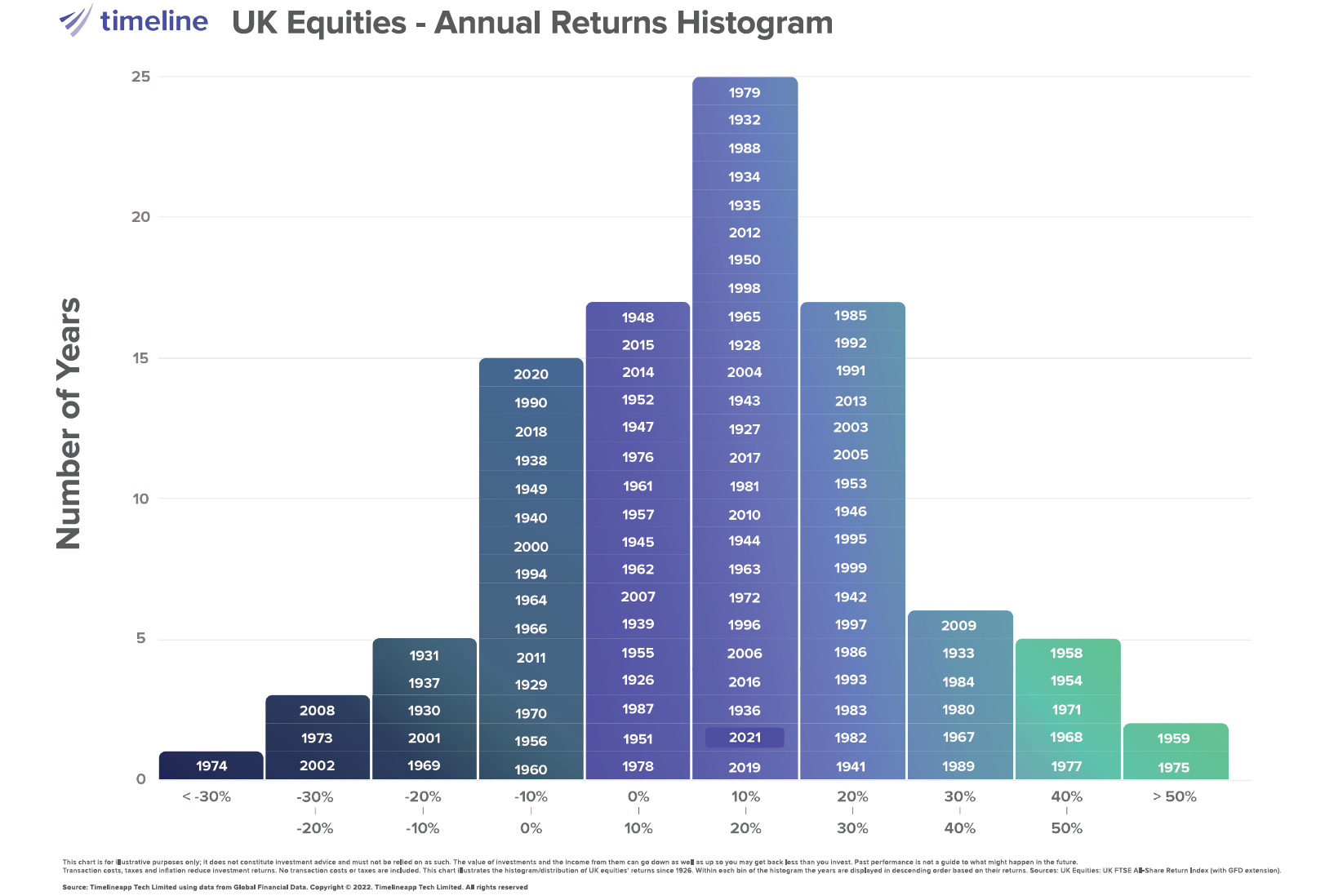
It reminded me of a chart that I have been using with clients recently. We know that markets have been difficult or “volatile” this year. The histogram I have been discussing is this one.

UK Equities 1926-2021

In simple terms it shows the calendar year returns of the UK stock market from 1926 to 2021. Everything right of 0% (column 5) ending the year positively, to the left (the first four columns) – negatively. The good news is that since 1926 there have been rather more years of positive returns (72/96) or 75% of all years.

I’ve been considering how we all handle stock market crashes and I think its right to remind ourselves of the awful investing years that we have lived through… depending on when you became an investor (most of you would not have been investors (aged 18) before 1955). So it seems reasonable to point out that you have lived through more than your fair share of bad investment years… you’d have to be at least 67 to have been an adult investor in 1973 and 1974, two of the worst years, but I suspect most have experienced 1990, 1994, 2000, 2001, 2002, 2008, 2011, 2018, 2020. Returning to the tennis analogy, these were the tense, big moments. You held your nerve and survived. You are still here; you and your portfolio have survived.

The way media and arguably regulation presents investment is to focus on the negative years. We can agree and acknowledge that “bad years” for investors come around regularly – 1 in 4 is a negative year. We are all adults and know this. Whatever is thrown at us over the coming months you have the genuine life experience to fall back on. You have been here before. Hold fast and play the long game, progressing through your own journey to the final.

If you are concerned about your portfolio please get in touch with me. If you know someone that is, why not suggest that they get in touch too. The greats all have coaches, but talent is what you possess already. A coach seeks to maximise yours.

Dominic Thomas
Solomons IFA

You can read more articles about Pensions, Wealth Management, Retirement, Investments, Financial Planning and Estate Planning on my blog which gets updated every week. If you would like to talk to me about your personal wealth planning and how we can make you stay wealthier for longer then please get in touch by calling 08000 736 273 or email [email protected]

GET IN TOUCH

Solomon’s Independent Financial Advisers
The Old Mill Cobham Park Road, COBHAM Surrey, KT11 3NE

Email – [email protected] 
Call – 020 8542 8084

7 QUESTIONS, NO WAFFLE

Are we a good fit for you?

GET IN TOUCH

Solomon’s Independent Financial Advisers
The Old Mill Cobham Park Road, COBHAM Surrey, KT11 3NE

Email – [email protected]    Call – 020 8542 8084

7 QUESTIONS, NO WAFFLE

Are we a good fit for you?

YOU ARE ALREADY READY – WIMBLEDON AND WINNERS2023-12-01T12:12:48+00:00

Money is not a peace of mind, it’s a choice

Jemima Thomas
May 2022  •  5 min read

Money is not peace of mind, it’s a choice

If you are looking for a gritty (anxiety inducing) series to binge, then Ozark on Netflix is for you. The series is about a financial adviser who drags his family from Chicago to the Missouri Ozarks, where he must launder money to appease a drug boss. So basically it’s a show about Solomon’s! (Please note this is very clearly a joke and we are not affiliated to this fictional TV series).

I was very pleased to see how many hits (yes, I stalk this on the regular) my first blog post ‘Slow and Steady’ got a few months ago, and I’m hoping that my youthful (and often under-represented) perspective will be mildly interesting to read again …

Amusing to some I’m sure, but I’ve always used the backdrop of art mediums such as film and TV to understand more about life, and there are a huge amount of personal parallels that resonated with me whilst watching Ozark. For one, the show is filled with financial lessons and quotes that have stuck with me. One of my favourites comes from lead character Marty: “Patience. Frugality. Sacrifice. When you boil it down, what do those three things have in common? Those are choices. Money is not peace of mind. Money is, at its essence that measure of a man’s choices.” For me this completely encompasses why we do what we do here at Solomon’s, and why great financial planning is so important.

Finding a good financial planner is a choice. And I truly believe it’s one of the best and often life-changing decisions you can make. Aside from the obvious differences of what Solomon’s does and what character Marty does (we aren’t laundering money, killing people, or secretly working for drug lords), we are however helping our clients invest their money wisely, something that I have begun to do myself. Perhaps I’m avidly searching for advice more often now both in ‘life’ and when it comes to my own finances, but I am acutely aware of the importance of having a financial plan.

Life isn’t always straightforward and is constantly changing, but some financial lessons are staple and vital in the long-run. Much like what happens to Marty and his family throughout each season, they are constantly having to adapt under severe life or death scenarios, and it’s eye-opening to see (although fictional) what people choose to do to save themselves financially.

Choices are also wrapped up in mistakes – mistakes are wrapped up in choices

Advice isn’t something I take lightly. I used to despise unwarranted advice, especially in my teenage years where I probably had a chip on my shoulder and felt most lost. But as I’m getting older, it’s something I welcome with open arms, and usually ask for. Other people’s mistakes often teach the biggest life lessons, and an open mind allows the space for us to learn from one another.

I get to read and listen to clients’ stories regularly as part of my work on Spotlight (our client magazine), and we often ask ‘’If you could go back and give your 20-year old self advice, what would it be?” and the responses are always helpful and interesting. When people feel comfortable and safe enough to talk about their financial mistakes (or any mistake for that matter), I am reminded that every day is a school day.

Money is not a peace of mind, it’s a choice2023-12-01T12:12:50+00:00

Should you become an investment expert?

DEMANDING ATTENTION

I recently read Oliver Burkeman’s latest book “Four Thousand Weeks”. I thoroughly recommend it. One of the things he reminded me of is that your life is sum of the things you pay attention to.

Whether that’s a deliberate focus or a haphazard collection of experiences. What you pay attention to will define you.

You can choose to spend your time looking after your own investments. There is something about this that seems perfectly reasonable and “grown up” after all, who is more trustworthy with your own money?….

Or perhaps you can let go of the notion that you need to be fully competent in many aspects of adult life. Perhaps the plethora or choices and complexity is nothing like those your parents actually had. When money was generally a lot easier and investment choices were simple. Heck, it’s much more complicated than 10 years ago, let alone your parents generation.

Now we have that time saving device and access to the internet, all possible answers can be considered. But is this how you really want to spend your precious time?

DO IT YOURSELF?

THINGS I PUT DOWN

My parents built our first family home when they were just 25, the house itself is still standing and probably faring better than the faded magazine that reported their story (House Beautiful) from the time. Meanwhile I’m over twice that age and can barely achieve most rudimentary DIY tasks. In truth, they had limited options as a couple of new teachers back in the 60s. They built a house because for them, it got them a home they could afford. A decade later they sold it for five times what it cost them.

I’m not daft enough to attempt a house build, it is an aspiration to do so one day, but what I really mean is have a house built, one that I have “designed” not to actually lay all the bricks!

Perhaps I will never get to “build my own house” it can be added to the very long list of things that I will never get to do, that isn’t going to deflate me, it’s reality and the fact that my choices are always compromises.

If you want to do your own investing, fine, go for it. I can promise it’s not a part-time occupation and experience can be expensive to acquire. I’m serious – go for it. You will have a world of choices and “experts” bombarding you with information. My one tip would be to have an evidence-based Investment philosophy and stick with it for life…. Or at least 2 decades.

Alternatively, why don’t you go out and do something less boring instead…

Dominic Thomas
Solomons IFA

You can read more articles about Pensions, Wealth Management, Retirement, Investments, Financial Planning and Estate Planning on my blog which gets updated every week. If you would like to talk to me about your personal wealth planning and how we can make you stay wealthier for longer then please get in touch by calling 08000 736 273 or email [email protected]

Should you become an investment expert?2023-12-01T12:12:51+00:00

NFT – NEW FAIRYTALE

TODAY’S BLOG

NFT – NEW FAIRYTALE

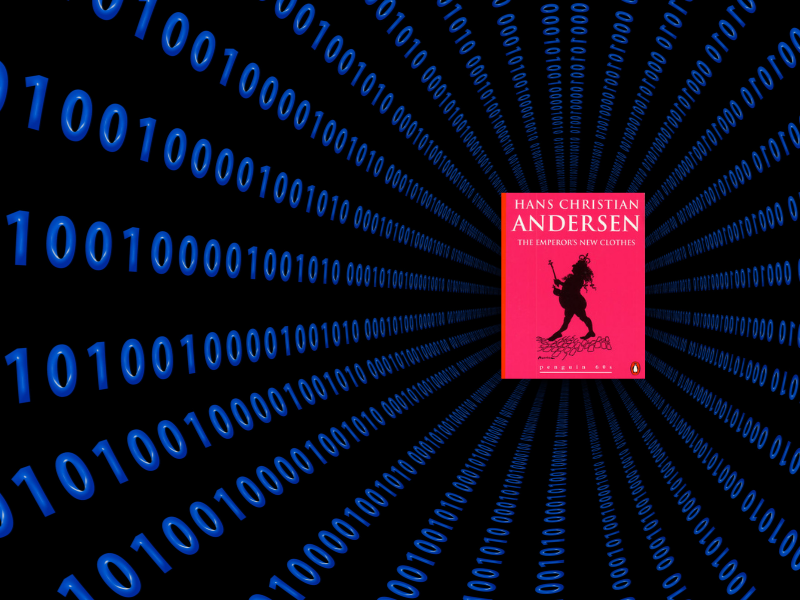
Perhaps you haven’t heard about NFTs, if not give yourself a pat on the back. However, it’s possible that you have seen something online or had a younger person mention it to you and perhaps it left you a little perplexed. I am not a fan. To me this is yet another of “The Emperors’ New Clothes”. I am concerned that a lot of people will say goodbye to their hard earned savings for fear of missing out and not understanding investing, in a culture that appears to tell us not to invest in the stock markets. Give me a moment and I will try to explain why.

One of the main reasons for people being scammed is due to a fear and lack of understanding about the stock markets. The market volatility is regularly reported by what passes as news, keeping you informed about the latest FTSE100 movement. “Billions were wiped off the markets today” is a phrase that regularly rolls off news presenters’ tongues, yet rare is the day (have I ever?) when we hear the “billions wiped on”. We are all kept in a state of anxiety about impending doom and it is quite deliberate. It gets your attention.

SO WHAT… HOW DOES THIS ENCOURAGE SCAMS?

Well, fearing the investment of your money in the most regulated, scrutinised exchange, where data is published and reviewed every day of the year and has been for decades, it seems that the volatility and the anecdotal “I lost money” or “my dad lost money” triggers the big red panic button that most of us have. So many turn to alternative forms of investing in the mistaken belief that they are less ‘risky’ (in fact some seem to be a ‘sure thing’). Oh, and for good measure, we humans are impatient, we love a happy ending and have a tendency to ignore the hard work that went into creating one (if it even is an ending). Or to put it another way, to approve of and want successful investments once they have happened.

NFTs The New Clothes

INVESTING IN REAL COMPANIES

When you invest money into the stock market or funds of equities (as is more likely) you buy shares in companies that trade internationally. They do so by making or providing goods and services that we want, need or require. As markets are generally competitive, they strive to improve what they do to ensure their own sustainability. Where companies often go wrong is cutting corners to reduce costs and increase profit rather than improving what they do and communicating this properly. On occasion, you may have an objection to the company, or its sector or the people that lead it. So you can (we can) screen out some of these based on ethical, environmental, social or governance standards. At the same time, you know that ‘cheap’ is unlikely to be high quality, but you also know that we don’t all need our weekly shopping from Harrods. There is a range; a spectrum. Sometimes we pay more for things because of the feelings that it evokes, sometimes we do so because we instinctively know it to be better.

Your investment appreciates in time as the company you invest in grows. You also receive a share of the profits made (dividends). Quite how much and how well these companies ‘perform’ is largely down to how well they run and… luck. By luck I mean – the right place at the right time, for example being a PPE manufacturer and a pandemic arrives.

You get your money back when you sell your investment. In the interim, you’ve hopefully had some dividends and an improvement in the value of the share. If you hold a handful of companies and one or two fail (such as the Kodaks of the world) then you have a proper loss. If you hold thousands, perhaps an entire market, then the impact of any failure is significantly reduced.

INVESTING IS NOT GAMBLING

Placing a sporting bet or a stake in a casino, you are hoping for a win, or something close to that to get your money back, plus the incentive to make the bet in the first instance. You may get back nothing – which is far more likely. That’s gambling – the risk of complete loss. For some people this is a small bit of fun (I can think of many better things, but I won’t judge), for others it becomes an addictive habit that can destroy families.

When you consider investment in proper companies (shares in them) over time, going back to the start of your lifetime, there is only one direction of travel for the combined value of your investments. Upwards. Yes there are bumps along the way (volatility) but you own real assets (companies) making and providing real products and services.

THE NEW CLOTHES

The digital world and our obsession with it, has given some people the idea that a digital image is worth something. These NFTs (Non-Fungible Tokens) are in my opinion the equivalent of the Emperor’s new clothes. The value is talked up by nefarious online forums and chatrooms and ‘traded’.  I would not touch them with the proverbial barge pole. If in the event I am wrong about this in say three decades time, that’s fine with me as I will be holding assets that provide regular income from actual profits from making real products and services. I can and will happily live with that and until proven otherwise, I will not aid anyone into deliberate folly.

HMRC’s NFT SEIZURE IS A WARNING TO ‘INVESTORS’ AND TAX CHEATS

The UK tax authorities have confirmed their first ever seizure of a non-fungible token (NFT) following a probe into an alleged £1.4million VAT fraud. Her Majesty’s Revenue & Customs (HMRC) said it had confiscated three NFTs, along with £5,000 in other crypto-assets, and arrested three people as part of a fraud investigation concerning around 250 sham companies. It claims the three suspects, who have not been publicly named, used a variety of ‘sophisticated methods’ to try and conceal their identities, such as false invoices, pre-paid unregistered mobile phones and virtual private networks.

NFTs are tokens representing the ownership of a digital asset, which could be an artwork, an image, music, or even a tweet that have their own unique signature and cannot be exchanged for another asset of the same type. But there has been increasing worries that these digital tokens, as well as cryptocurrencies, are being used by criminals to hide their illicit financial gains. Nick Sharp, the Deputy Director of Economic Crime at the HMRC, said: “Our first seizure of a Non-Fungible Token serves as a warning to anyone who thinks they can use crypto-assets to hide money from HMRC.”

Understand the real risk and buy real assets. You have been warned.

Dominic Thomas
Solomons IFA

You can read more articles about Pensions, Wealth Management, Retirement, Investments, Financial Planning and Estate Planning on my blog which gets updated every week. If you would like to talk to me about your personal wealth planning and how we can make you stay wealthier for longer then please get in touch by calling 08000 736 273 or email [email protected]

GET IN TOUCH

Solomon’s Independent Financial Advisers
The Old Mill Cobham Park Road, COBHAM Surrey, KT11 3NE

Email – [email protected] 
Call – 020 8542 8084

7 QUESTIONS, NO WAFFLE

Are we a good fit for you?

GET IN TOUCH

Solomon’s Independent Financial Advisers
The Old Mill Cobham Park Road, COBHAM Surrey, KT11 3NE

Email – [email protected]    Call – 020 8542 8084

7 QUESTIONS, NO WAFFLE

Are we a good fit for you?

NFT – NEW FAIRYTALE2023-12-01T12:12:53+00:00

ARE YOU BEING SCAMMED?

TODAY’S BLOG

ARE YOU BEING SCAMMED?

OK I admit that I am often sceptical about surveys, the sample sizes are often too small to infer anything of significance. However, in this instance, even if the survey is bogus it is certainly worth reminding you about scams – and something that you can and ought to pass on to your friends.

A survey for Liverpool Victoria (LV) found that about 14% of the adult population (about 7.6m adults) have been hit by a pension scam. Double this number were concerned that they might fall prey to a scam (a pension scam to be precise). Half admitted that scams were hard to spot and around 41% wanted help knowing how to do so and how to prevent being scammed.

WHY TARGET A PENSION?

Aside from your home, your pension is probably your largest or most valuable asset. Scammers know this, they also know that the majority of people don’t know much about pensions, find them very dull and full of jargon. They often don’t realise how much they are worth and rarely treat them as though they are the family heirlooms that they are.

As your adviser (if not yet, then get in touch) I have been explaining the importance and value of your pension for many years. You know that we focus on using the most modern pensions to take advantage of pension freedoms and evidence based low-cost investment strategies. It is your future source of income (or a current one) and may well be something you leave to your beneficiaries.

ARE YOU BEING SCAMMED?

BEWARE THE FREE LUNCH (REVIEW)

However, for those that do not want an ongoing relationship with their adviser, minimising costs is a significant appeal, having a “free” pension review – well music to their ears rather than any recognition of alarm bells. For most of my working life financial advice has been generally touted as free. It isn’t, it never has been and that is frankly the biggest source of all the problems.

COLD CALLING

A friend of mine, Darren Cooke started a lobby in 2016 to end cold calling. Most advisers joined the movement which resulted in the banning of cold-calling about pensions from 2019. Yet it still happens. It is banned, but there you are.

PENSION LIBERATION

There is no such thing, unless you consider liberating your pension from you a form of liberation – I call it theft. You cannot access your pension before age 55 except for a very, very rare number of instances. Safer to assume you cannot.

Moving your pension to a SIPP (Self-Invested Personal Pension) is absolutely fine BUT only if you are using properly regulated funds within it. Not offshore weird stuff like teak farms or storage boxes, car parks or some other daft “asset” that I can actually set on fire.

NEW FREEDOMS, NEW TEMPTATIONS

Taking your pension is much easier than it used to be. There are new (2015) pension freedoms which have made pensions much better than they were. However, with greater freedom has come greater choice and increased responsibility – yours (and mine). A crook will exploit some basic knowledge (rules have changed) pander to misinformed opinions about stock markets “they are risky and lose you money” and will offer something that sounds altogether better – guarantees, no stock market involvement, high returns -much better than your cash and sometimes money now…. All for free.

Sadly, many do not remember the adage “if its too good to be true, it probably isn’t”, fewer still seek out a financial adviser and if they do, may well be befuddled by what restricted or independent means (invariably a restricted adviser will not mention it, even though they are meant to do so clearly). When a regulated adviser provides advice, he or she is liable for it. I can assure you that we take this very seriously as the liability rather unreasonably, extends beyond the grave.

HANG UP

If you have a friend that you think is being scammed or you are approached yourself, hang up the phone and get in touch with me. I have seen too many people get scammed for one lifetime. A good site to check out is the FCA SCAM SMART site.

Dominic Thomas
Solomons IFA

You can read more articles about Pensions, Wealth Management, Retirement, Investments, Financial Planning and Estate Planning on my blog which gets updated every week. If you would like to talk to me about your personal wealth planning and how we can make you stay wealthier for longer then please get in touch by calling 08000 736 273 or email [email protected]

GET IN TOUCH

Solomon’s Independent Financial Advisers
The Old Mill Cobham Park Road, COBHAM Surrey, KT11 3NE

Email – [email protected] 
Call – 020 8542 8084

7 QUESTIONS, NO WAFFLE

Are we a good fit for you?

GET IN TOUCH

Solomon’s Independent Financial Advisers
The Old Mill Cobham Park Road, COBHAM Surrey, KT11 3NE

Email – [email protected]    Call – 020 8542 8084

7 QUESTIONS, NO WAFFLE

Are we a good fit for you?

ARE YOU BEING SCAMMED?2023-12-01T12:13:05+00:00
Go to Top