
Who is on your list?

Dominic Thomas
Post written: Aug 2026  •  Published: Aug 2026
3 min read

Who is on your list?

I recently went to see a new(ish) musical of the Japanese manga story “Death Note” at the Barbican, Directed by Stephen Whitson. It’s an imaginative story and a decent new musical, with a high level of energy and a fairly incredible set and large ensemble cast.

The story was originally written by Tsugumi Obha and drawn for the anime manga series by Takeshi Obata. The premise is perhaps one of the oldest struggles that we mortals wrestle with – is there any justice? Since the dawn of time, life has been “unfair” and “unjust”. Myth, religion and story all tend to wrestle with and explain this very fundamental cry of woe in a world that frequently feels unfair. Even Jesus observes in the sermon on the mount:

He causes his sun to rise on the evil and the good, and sends rain on the righteous and the unrighteous” (Matthew 5:45)

I’m not too familiar with Japanese myths or the faiths of Shinto, Buddhism or the general cultural mix, though I do find it intriguing. So quite how old the notion of other worldly gods and demons goes back is somewhat illusive. Obha introduces us to several “death demons” or Shinigami. They carry a book, into which they mercilessly play with humanity, the random writing of a name results in that persons death. Somewhat bored with his existence, one Shinigami called Ryuk, deliberately drops his book before a student with a clear sense of right and wrong called Light, who quickly learns that he can serve justice far faster than his father Soichiro, who is head of Japan’s National Police Agency. His “success” and liberal use leads to inevitable questions about the validity of his own version of “justice”.

It’s an enjoyable musical, with some good songs (music by Frank Wildhorn). I suspect that most of the audience quickly wonder whose name they might write down in the book, to be very candid, my list is very long and easy to produce, an evident flaw in my own character, which is probably the point.

We all want the world to be considerably better and much fairer, each day we are confronted with challenges to our sense of fairness, often in the small details, but invariably in big “news” stories of the day. However much you try, its inescapable, much like death. World culture is full of figures representing death, some are rather more palatable than others. Hades to Azreal. I was quite fond of “Death” in the Sandman, another “graphic novel”. Death was warm, welcoming, caring, compassionate and rather beautiful (played by Kirby Howell-Baptiste in the 2022 television series “The Sandman”).

Anyway, justice, as we know is often in short supply, illusive. As consumers we have the opportunity to exercise a moderate amount of consumer power against companies whose actions and behaviours we oppose. At a political level, we get to vote, as consumers we get to spend (or withhold spending) and perhaps vote at AGMs as many protestors attempt to do. Often the challenge feels enormous, perhaps overwhelming, but we are reminded from history that even small acts of resistance can bring about significant change.

Sadly I do not possess the ability to grant extended life and cure life threatening or life taking conditions. None of us escape death, as ever we are reminded and called to live well, on our own terms and to live justly, fairly – whatever that may mean for you. Your financial plan is best when designed around your values, so be aware that we expect this to be an ongoing discussion between us, without judgement about your views on life and death and the meaning ascribed to them. We can also discuss how your views on social issues like climate, sustainability, governance etc can be applied to your investments. Nothing will be “perfect” because you and I are not, neither is the world.

Here is the trailer for Death Note the Musical showing at The Barbican until 12 September 2026. I think it fair to say, audiences would typically be younger than “normal” which is a good thing to encourage people into theatres.

I’m sorry, but I simply cannot resist sharing this rather beautiful clip from the Netflix series “The Sandman”. Here are Kirby Howell-Baptiste (Death) and Tom Sturridge (Dream).

The Sandman (2022-2025), Created by David Goyer, Neil Gaiman and Allan Heinberg. Starring Tom Sturrige. Produced by Netflix

Your values for your financial plan. It’s your life.

References:

Death Note The Musical: https://deathnotethemusical.com/

Tickets at the Barbican: https://www.barbican.org.uk/whats-on/2026/event/death-note-the-musical

The Sandman: https://www.imdb.com/title/tt1751634/

What we do: https://www.solomonsifa.co.uk/what-we-do/
Have a question or feedback about this article?

Please share this with a friend

Who is on your list?2026-08-21T15:16:34+01:00

NS&I Big Data and the WOPR Problem?

Dominic Thomas 
Post written: March 2026  •  Published: July 2026
3 min read

NS&I Big Data and the WOPR Problem?

Adapting to the new world is far from straight-forward and NS&I are yet another publicly humiliated organisation that has failed to migrate data to a new system, costing billions. These sorts of problems are common and normally don’t come to light in the private sector, unless there has been a GDPR data breach.

Getting your money into someone’s system is easy, getting it out often isn’t as simple as it could be. That’s why when we review who we use to hold your investments we consider what is required. Customer service is something that is overlooked when assessing solutions, yet can become a significant barrier.

In order to provide “better” (cheaper) services to their millions (250m) of customers, NS&I undertook a £2bn Business Transformation Programme in 2020 to modernise their systems. Two years into the project red flags were all over the place, signalling that it would be unachievable, so in 2024 they rebooted the project and over £1.3bn more has been required. It certainly seems that the project is still unlikely to be delivered before 2028 and the Committee of Public Accounts have, I think it fair to conclude, torn the management team of NS&I to shreds, noting weak controls, poor and delayed decisions and frankly a naïve lack of understanding of the complexity of the issues. They are still not of the view that NS&I really are up to the task or owning the scale of the problem.

Most of us have a soft spot for the old Post Office, trusted by many families for generations. Sadly, sentiments are not the way to assess service, which is shaped by experience.  Unfortunately, my experience of NS&I isn’t terribly good. Not too long ago they offered advisers the opportunity to digitally connect with client accounts, we have had minimal success with this, but honestly, it’s been something of a nightmare, with links and passwords not working. Registration processes have been awful.

You probably have seen in the news in late March that NS&I have made so many blunders that they are now in the position of having to pay significant compensation to savers whose accounts seem to be either inaccurate or missing.  At the time of writing, there is nothing on NS&I’s website that even mentions the debacle.

Remember that NS&I are basically a front for HM Treasury to raise funds from the public safely; using the money to fund capital projects in the country. Essentially, you are lending your money to the Government.

If you have NS&I products, Premium Bonds, Savings Certificates, Cash ISA etc, please get in touch and we will attempt to include these in our reports to you and will hopefully provide you with additional support should you experience problems with them.

Here is a reminder of the dramatic warning about data security that many of us received over four decades ago in 1983 when a student (Matthew Broderick) hacked the NORAD defence system WOPR (War Operational Plan Response) in the film War Games. The issue isn’t really the technology, but the lack of good human thinking.

(War Games (1983), Directed by John Badham, Starring Matthew Broderick, Ally Sheedy and John Wood Produced by United Artists)

Let us know about your NS&I Accounts.

References:

Public Accounts Report Feb 2026: https://committees.parliament.uk/publications/51662/documents/286154/default/

NS&I Transformation Programme: https://committees.parliament.uk/work/9280/nsis-transformation-programme/

NS&I Board: https://nsandi-corporate.com/governance/who-we-are

NS&I Prize Checker: https://www.nsandi.com/prize-checker

War Games (1983): https://www.imdb.com/title/tt0086567/

What we do: https://www.solomonsifa.co.uk/what-we-do/

Have a question or feedback about this article?

Please share this with a friend

NS&I Big Data and the WOPR Problem?2026-07-03T11:54:26+01:00

How About Some Actual Intelligence?

Dominic Thomas
Post written: March 2026  •  Published: June 2026
2 min read

How About Some Actual Intelligence?

It’s evident to anyone who has ever read a book without pictures, that the majority of world leaders are some of the most inept and corrupt people available from the 8.3 billion alive. There is a category of small-town fool that used to be the exception rather than the rule. Yet, here we are, all older, wiser, more politically aware of our choice of words and yet the United States is run by some of the most foolish people to self-identify as ‘leaders’. What I am always surprised by is the way that they are believed, followed and adored.

I know a number of you have enjoyed the deliberately slow pace of a barge holiday and some even own one, so I thought I’d share a true story that I learned recently which highlights the condition of blind faith.

A man had planned a family holiday on a barge, he had done some investigation into his route using ChatGPT (software) about the vessel, the route and the locks that he would encounter. He met with Ben, a young man who has been working on barges for some time and despite his youth was skilled in operating, maintaining and repairing a barge and was very familiar with the local canal network.

The man, wishing to display his newfound knowledge, asked about the route to the beautiful Roman city and drew attention to a stretch of five locks along the way. This seemed to make him anxious about the additional “work” and delay that it would cause him. Ben reassured him that it would take far longer, two days longer, to reach the first lock and this would be a small challenge, easily mastered and this would provide him ample confidence to tackle each of the remaining locks which were very similar and actually many hours and in some cases days apart.

He would not accept the young expert’s advice or reassurance, preferring to draw out his mobile phone and asking it for advice to go in the other direction. Ben listened, aghast at the nonsense that ChatGPT provided, listing obstacles and warnings that were in either in the wrong order or completely false. The man would not listen, choosing to rely on and believe the accuracy of his own ‘pocket expert’. Despite protestation and warning, Ben reluctantly bid him and his family farewell as they set off confidently in the wrong direction for their week long barge holiday.

In this age of individualism, it seems that many are happier turning to the ‘expertise’ of artificial intelligence, and placing a high degree of trust and confidence in the output. They fail to appreciate that artificial intelligence is largely pattern recognition software, cobbling together stolen (“scraped”) information from the web. We have begun to see the errors of this within financial planning already. Of misplaced faith in the ‘answers’ and lack of real understanding of the risks involved, creating a disastrous combination of confidence (and fear) in all the wrong elements. This is not simply going to create a minor delay or deviation, but a completely different result from the one intended, both much more expensive and disappointing.

Your financial plan is unique to you, based on your values, resources, skills and desired outcomes. This is what we have trained for, what we do all day long and have gained decades of experience at; meeting and helping countless people all trying to navigate their own financial journey. We may not be physically with you throughout every inch of your journey, but our skill is helping plot it, course correct, maintain and refuel, knowing when to put to harbour and when to set sail, to assess the conditions sensibly to minimise anxiety rather than to watch you head off in the wrong direction because of something you heard on the news, in the paper, online, in the pub or around your dining table or worse, from your phone. Beware of artificial intelligence, embrace and seek actual intelligence, or expertise, in a world that is complex.

References:

The Limitations of ChatGPT with Emily Bender: https://www.radicalai.org/chatgpt-limitations

The AI Con by Emily Bender: https://www.worldofbooks.com/en-gb/products/ai-con-book-emily-m-bender-9781847928610

Canals of Britain: https://canalrivertrust.org.uk/canals-and-rivers

History of Britains Canals: https://www.historic-uk.com/HistoryMagazine/DestinationsUK/The-Canals-of-Britain/

Inland Waterways Charity: https://waterways.org.uk/about-us/the-charity

What is financial planning: https://www.solomonsifa.co.uk/what-we-do/

Refer us: https://www.solomonsifa.co.uk/refer-us/

World Population: https://www.worldometers.info/world-population/

Have a question or feedback about this article?

Please share this with a friend

How About Some Actual Intelligence?2026-06-17T19:02:39+01:00

Has the sales pitch become the prompt?

Dominic Thomas
April 2026  •  3 min read

Has the sales pitch become the prompt?

One of the many criticisms of financial stuff is its inaccessibility – the jargon, terms, mathematics and mountains of tax rules that are embedded in ‘the system’ which seems stacked against the ordinary person. When I started in financial advice in 1991,  it was largely a world of sales people and administrators; some very well paid successful sales people and an awful lot of ‘failed’ salesmen with huge debts unable to make ends meet each month.

Training requirements were initially met within a few days, before you were unleashed on your audience, which for most of them was their personal address book. It was crucial to learn a sales script. Perhaps you met some of them – Milldon, Merchant Investors, Allied Dunbar, Cannon Lincoln, Laurentian and even ‘the man from the Pru’. This culture resulted in a lot of bad advice by commission-hungry salespeople and the result was lasting damage to trust and a massive increase in regulation.

Scroll forward three decades or so and our own training programme is three years (minimum) to become Diploma qualified and potentially a further seven years or so to become Chartered. Technical understanding has rightly brought about knowledge requirements. The number of ‘advisers’ has fallen from about 200,000 to around 27,000 – a reduction of nearly 90%.

It’s 2026 and ‘AI’ (a marketing term, not a thing) is still in its infancy since 1956, but already being used to offer up answers to technical questions. Unfortunately, being able to trust the accuracy of the answers is more than a little problematic (you shouldn’t). As with other forms of media, when your own field of expertise is covered in the news, you appreciate how poorly it is understood by those forming the questions and presenting their findings.

It doesn’t help that our culture celebrates the wealthy like Bill Gates, who offers opinions on any topic which sound authoritative; making unfounded and highly improbable claims about technology – in particular that it will replace doctors and teachers.

The noble intention of helping to democratise information is, it seems, deeply flawed, you really need to understand context and the question you are asking with implications that you aren’t aware need consideration.  We see this all the time, and politicians play the game, presenting baseless easy answers or raising common observations without any real depth of thought or application.

There are times that I wish I had known in 1991 what I know today, but it is the process of hard learning and building experience that are so vital when faced with real life matters. It’s also why our training of new advisers isn’t ‘high speed’. The temptation of AI is the speed of ‘learning’.  I have even been encouraged to offer you a better looking digital clone of myself to interact with you rather than build a team of people.

As the number of advisers has reduced and complexity increased (created by the sector, regulation and Government policy), the cost of advice and running an advisory firm has risen enormously. The salaries, software and tools have replaced self-employed advisers with a desk, phone and dictation machine.

‘Free’ AI tools and DIY services all, understandably, have appeal to many.  In fact as some will argue, the real goal of AI is to remove wages. However the thing that has been forgotten in this transition to adviser expertise is that money is deeply personal and financial planning is not about transactions, but about helping draw out deeply held beliefs, values, baggage, myth and aspiration and navigating the deliberately crafted landscape of a world filled with fear and greed.

It is the soft skills and critical thinking that have been largely ignored by regulation and a sector obsessed with numbers and speed. My concern with AI being widely used is that it is not designed to serve the interests of the individual posing the ‘prompt’. It largely is designed to remove as much human reflection as possible, whilst feigning understanding and nuance, whilst being steeped in bias. The real beneficiary of the AI answers are the owners of the technology, which is built on theft (data scraping) of other people’s work.

The pattern recognition system is ‘alive and well’ in flattering your ego with what you want to hear rather than what you need to hear. The problem is that we don’t appreciate how important this is until it’s too late.

It is the questions that we don’t know to ask, that we need to ask. This is where the human experience, actual reality, is so alive and necessary.

To be crystal clear, technology brings lots of helpful advantages, but it is a tool not a replacement for humans. It is not ‘better than nothing’; its far worse than nothing, particularly when ‘nothing’ is often an inexpensive book (or a free one in a library).

References:

The AI Con by Alex Hanna and Emily Bender. https://thecon.ai/ (don’t buy it from Amazon, that’s another story).

The history of AI and Eliza https://liacademy.co.uk/the-story-of-eliza-the-ai-that-fooled-the-world/

Bill Gates comments on AI: https://www.cnbc.com/2025/03/26/bill-gates-on-ai-humans-wont-be-needed-for-most-things.html

Retail Distribution Review: https://publications.parliament.uk/pa/cm201011/cmselect/cmtreasy/writev/rdr/m188.htm

50 Years of Regulation: FT Adviser (2016 David Severn): https://www.ftadviser.com/content/9de58b26-925f-522d-9bf7-faaf7feba22d

FSA Review of Polarisation (July 2000) https://londoneconomics.co.uk/wp-content/uploads/2011/09/106-Polarisation-and-Financial-Services-Intermediary-Regulation.pdf

HM Treasury FCA Financial Advice Market Review March 2016 https://www.fca.org.uk/publication/corporate/famr-final-report.pdf

How commission worked – Money Marketing (April 2001) https://www.moneymarketing.co.uk/news/out-with-the-old-in-with-the-new-style/

Money Marketing – The future of regulation (Simon Collins June 2022) https://www.moneymarketing.co.uk/opinion/financial-services-regulation/

FCA sector RMAR data 2024 (November 2025) https://www.fca.org.uk/data/retail-intermediary-market-data-2024  and data about adviser numbers: https://www.fca.org.uk/data/retail-intermediary-market-data-2024/retail-intermediary-market-interactive-analysis-2024#staff

FCA – The Mills Review The Impact of AI on financial services markets, a research initiative closing on 26 February 2026. https://www.fca.org.uk/publications/calls-input/review-long-term-impact-ai-retail-financial-services-mills-review#lf-chapter-id-your-thoughts-on-the-longer-term-impact-of-ai-on-retail-financial-services-

Solomons set up in 1999 without commission. https://www.solomonsifa.co.uk/financial-services-sector/


Has the sales pitch become the prompt?2026-04-21T15:09:30+01:00

What are the Twenty Lessons?

Dominic Thomas
April 2026  •  3 min read

What are the Twenty Lessons?

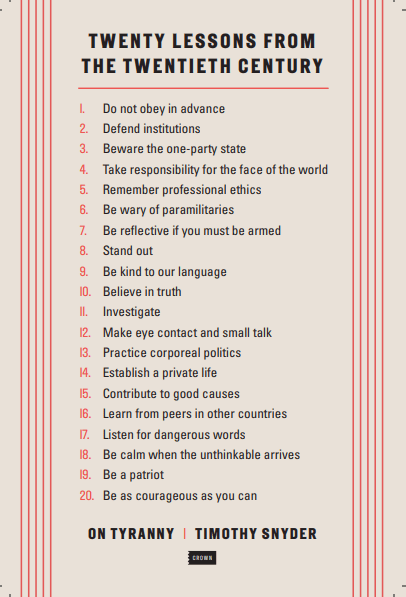
Most marketing people will advocate using a number as a way to increase engagement – seven ways to improve your marketing, five things you need to know about… and so on, as humans we seem to love a list, preferably a short one that’s a prime number. Timothy Snyder’s book On Tyranny has the subtitle “Twenty Lessons from the Twentieth Century” which caught my eye as worth my attention.

There is no denying that we live in challenging times, where truth has become harder to reach and there are so many powerful vested interests determined to treat us like mushrooms, kept in the dark and fed on…

Truth is a big deal in financial planning. It’s the partner of trust, without both – any advice provided needs some considerable investigation. My sector is not known for its transparency, trust or grasp of truth. We have powerful regulation which attempts to ensure that we are. Yet, over the last two decades in particular, I can attest to the fact that many of the advisers I meet are decent people, who are keen to share best practice, have a degree of vulnerability about their need to improve knowledge and admit that they don’t know everything. Most of those I meet, I believe to be trustworthy and genuinely want to help both advisers and clients to make money and investing better understood.

There is even a software package called “Truth” that aims to reveal the truth of your ambitions for your financial decisions.

Sadly, not all are truthful, many will claim to provide financial planning, but are really selling investments, building the engine before even knowing what is required. It’s not easy to tell from a website or indeed when you meet them. There are still a few who are only interested in extracting your wealth for their own benefit and they are occasionally caught.

Aside from the charlatans, who I can do little about, other than pay my regulatory fees which cover their failings and deal with the consequences of mistrust, my main concern is a lack of thinking. Not about products and tax legislation, or indeed sensible solutions, but the eagerness to embrace anything that appears to save time. It is easy not to think, to simply accept narratives of large, powerful players or persona’s and what they say from their platform.

It seems to me that good financial planning is all about helping uncover your values and helping you to achieve and maintain your lifestyle. The one you really want, not the one that vacuous individuals display for you to envy and strive for. All choices come with a consequence and there is a price for every decision – who you love, where you work, live, what you eat, how you exercise, what you read and so on. To pretend that political decisions have no bearing on these things is to fail to appreciate the fragility of the freedoms you currently enjoy, which are certainly under siege. The belief that taxes are always bad, that there are those who don’t deserve help, that we are all ‘self-made’ and need a heavy shot of ‘resilience’, is to miss the point and purpose of what it is to live as a human in a thriving, peaceful community, To be critical is not the same as to criticise.

We can all point to problems, but the real skill is to address root causes, invariably this is envy and greed. Something that is on constant display in our scrolling. Add in a dose of fear and mistrust, a sprinkling of inflammatory words and the rabbit hole opens up to swallow, perhaps consume.

In the context of a ‘good life’, we need a good society and a functioning democracy; something that it seems many advisers forget as they chastise yet another Chancellor whilst failing to pause to consider the source of their information. None of us get it right all the time, but an attitude of thoughtful reflection about vested interests is one that I encourage.

In this book, Snyder draws some uncomfortable lessons from history which have a very current application. He is under no illusions about the problems, but offers some thoughtful hope for facing what needs to be confronted. Snyder is a man who has committed his life to understanding the context of why we tend to war, how to spot the signs and what to do about it. Here are his twenty lessons.


What are the Twenty Lessons?2026-04-10T18:01:22+01:00
Go to Top