Can you identify Traitors?

Dominic Thomas
Oct 2025  •  3 min read

Can you identify Traitors?

In an age of terms like “patriot” being used in that very reductive American way, the idea of a traitor is repackaged as someone who opposes such a narrow definition. The ‘othering’ of people who hold different beliefs or values is currently rife throughout much of the world. It seems that reasonable discussion, debate and democracy are all under significant attack. I’m sure you know who and what I am referring to.

The idea of trust is being challenged and what we see and hear isn’t as trustworthy or reliable as it once was, in part due to quite deliberate manipulation and misinformation, but also due to the fabrication of our visual world. The falsification of information is possible due to technology that is so good, and it is now very difficult to tell if the family member or friend you are seeing or hearing on your digital device is actually who you think. The dystopian vision of 1980s movies like The Running Man are now our reality.

You probably haven’t avoided the BBC show Traitors. I hadn’t seen the previous shows and agreed to watch the ‘celebrity’ version. It was and is intriguing. On the one hand it seems a bit like a childhood game of murder in the dark crossed with hide and seek with a bit of Cluedo and the Krypton Factor thrown in for good measure.

What I hadn’t expected to witness was the way people are persuaded as readily as they are, to see (albeit via a BBC edit) how people assess each other for honesty, integrity and trust. The results are not good. We aren’t very good at assessing characters, at least – not as good as we would wish to believe.

On the political stage this helps explain a little why some people seem willing to believe what many of us would recognise as an obvious liar or fraud. I suspect that deep down many of us are aware that perhaps our ability to discern isn’t as good as it might be.

In the context of financial services, trust is vital, but of course is the one element that is so frequently abused or lost. The media is awash with stories and information of fraud, abuse and corruption. Regulation helps but is often too little too late. I regularly come across people who have experienced ‘advisers’ who sell them expensive funds or products and who (to my mind) clearly fail to sit on the side of the client – which is our role.

It’s obviously not a problem unique to finance, but where money is involved, integrity and character will either surface or disappear. This week I heard yet another story about siblings squabbling over the redistribution of their father’s estate. The same parents but clearly the children have different moral compasses.

How we assess people as trustworthy is an important skill and none of us have a flawless ability. We all make errors of judgement, the hardest being those we repeat.

Transparency helps of course, by which I mean clearly revealing information showing how the trusted person benefits from any action taken. I remember that prior to 1995 we didn’t even have to disclose how much commission we earned. So when

I set up Solomon’s four years later in 1999, I did so by having a clear pricing model (without commission). It was innovative at the time, but woefully naive. It took the regulator a further 13 years to make all advisers agree fees properly with clients (as we had been doing since 1999).

Being ahead, or being first, or being thoughtfully objective, didn’t really help the business to expand or thrive, in fact it was a very hard time convincing people of our approach. I was reminded of this whilst watching Traitors, being right (identifying the traitor) often backfires, with an unwillingness for some to disbelieve the narratives set by those with most to lose (the actual traitors). However good, rational or clear the argument, many were persuaded by their gut instinct or unwillingness to suspect foul play by those they thought ‘trustworthy’. We also have a tendency to avoid conflict or change, accepting the truth, sadly, isn’t as easy as it should be.

As a viewer, we feel exasperated by the folly and lack of good thinking, when it is exhibited and ignored we may feel despair, but of course we have the unfair and enormous advantage of knowing who the traitor is! In our real world it is much harder to tell.

Our values are aligned with yours, as you win, we win. As you lose, we lose.

It’s not a perfect system or model, it’s not cheap, but it’s the best I’ve been able to come up with over last three decades. We will remain faithful to your best plans.

References:

  • PIA – commission disclosure 1995
  • FSA – RDR 2012

Can you identify Traitors?2025-10-30T10:13:58+00:00

The FA of Fantasy Funds for Footballers

Dominic Thomas
Sept 2025  • 3 min read

The FA of Fantasy Funds for Footballers

I wonder if you know a professional footballer? Or perhaps you are one.  Our offices are located opposite the Chelsea training ground in Cobham. As the season starts and the all important transfer window closes, a lot of money has changed hands (we have seen a new British record payment for a player – £125m for Alexander Isak) with over £3bn spent by the Premier League.

Professional footballers tend to be young, and with the odd exception like James Milner, most end their playing careers by age 35. Some go on to become pundits and coaches, occasionally a Manager.

Sadly, where there is money, there is corruption and I am sorry to report that football is no different. There are a significant number of Agents and villains all set to relieve the player of his money and of course there is plenty of pressure on players off the pitch to simply keep up the appearance of success.

Just like anyone else, young players (and old ones) are not sure who to trust when it comes their finances. Many have been ruined by bad advice or downright fraud. There are advisers who ‘specialise’ in providing advice to players, but this guarantees nothing, and if anything is probably a red flag. Many have lost millions of pounds in investment schemes that they didn’t understand and should never have been exposed to. They were young and not sophisticated investors (most people aren’t) and they have been scammed time and time again.

This isn’t new information, it’s been going on for years, but there is a new documentary on the BBC – which you can see on iPlayer as well – called The Story of the V11. Players get all sorts of abuse from the stands and in the media, but there is and has been a great deal of financial abuse. It is utterly disgraceful and inexcusable. Many of the players involved have lost everything (including their lives due to the perceived shame and resulting suicide). It is desperately sad and could have been avoided.

The main problem that most professional players face is a high income (which is taxed at 45%) and a celebrity lifestyle alongside little if any financial knowledge. So when you see vast sums of tax being taken from your payslip, it’s entirely understandable to ask the question: what can I do to reduce it? (as we all do). Footballers have a short career but usually a very normal life expectancy. However, there are firms of financial advisers that will always attempt to carve out a niche market and claim that they know what makes everyone in that niche tick … then they seek endorsement from others who are well known in the niche and who (by virtue of experience) imply that their recommendations can be trusted.

The reality is of course that everyone is different, we may share lots of similarities, but we are all different. The common ground we share is attempting to secure our own future for when we get sick and are unable to work or decide to retire and stop earning.

The only thing these players did wrong was to trust the wrong person, who financially abused them and sold them investments that were and are… a load of rubbish. The advisers concerned sold utterly awful ‘investments’ (honestly, they cannot really be called investments). The advisers earned huge commissions and pretended that the tax-incentivised schemes (film partnerships) were backed by the Government and were risk-free.

It is a desperately sad tale and I hope that they get justice and the ‘advisers’ concerned all go to prison. They have caused misery and hardship and all the ingredients for a painful existence. When people are victim to these sorts of fraud they often feel stupid; they are not; they were ripped off and taken advantage of by criminals and fraudsters under the guise of being a qualified financial adviser.

Your financial plan does not need to involve complex investments, irrespective of your level of wealth. Investing doesn’t need to be complicated; it’s about owning a diversified portfolio of real businesses that produce income from the profits they make. Some businesses fail, but owning them all in the way our clients do, means the risk is minimal – barring a world ending catastrophic event (at which point none of us will be worried about money).

A good financial plan reflects your aspirations; a great one expresses your values and is reviewed regularly and importantly, you should be able to see the valuation of your portfolio and have it verified by various properly regulated entities.

So, you may not be a footballer, but the issues are the same – trusting the person that is advising you about your money, which is your future. If you know a footballer (I spot many in the Cobham area) or someone who needs our help in providing impartial, transparent advice with clear fees and clear communications, by spreading the word about us you may not be simply saving them money, but perhaps saving their life.

It is my opinion that currently, the legal system, tax system and regulatory framework have all failed to help these players and it is a disgrace – another one.

Get in touch to find out more, share this with a friend.

Here is the link to the BBC documentary: Footballs Financial Shame

The FA of Fantasy Funds for Footballers2025-09-05T11:27:28+01:00

Traitors and behaviours…

Jemima Thomas
Jan 2023  •  5 min read

Traitors and behaviours…

I love binge-watching a TV series and a good murder mystery is my favourite, so naturally it’s no surprise I tuned into the BBC’s latest reality TV series, The Traitors. Two months on, and the show has been streamed more than 28 million times on BBC iPlayer. To say it has been a success is an understatement, and there is now a US version (yes I have also eaten my way through this too!), which has also been a brilliant watch.

The basic ‘plot’ is that 22 strangers are moved into a castle in the Scottish Highlands to complete a series of challenges and missions together as a team, to add to a pot of money that they might win at the end of the game. The game consists of three secretly-assigned ‘traitors’ and the rest being ‘faithfuls’.  The goal of the game is for the faithfuls to collectively reach the final, where they’ll be able to split the winnings. However, if a traitor (or traitors) manage to reach the final, they get to take the pot of money for themselves. Throughout the game, the three traitors are secretly lurking, sabotaging the efforts of the others and picking off contestants one by one. Each evening, contestants gather around a table to ‘banish’ someone they suspect of treachery.  It’s the ultimate game of detection, backstabbing and trust, the faithfuls must root out the traitors amongst their ranks to win; or risk losing everything.

On paper I’m not sure this sounds quite as thrilling as it was to watch play out, but I can assure you (if you haven’t already watched) that it’s incredibly gripping and shocking to see the lengths to which people will go to defend themselves under pressure. With everyone feeling confused, sketchy (or not!) behaviours become magnified and analysed, and emotions quickly run high as the days pass.  It’s safe to say that they all seem to become a little mad as a result of not knowing who to trust. Morals are thrown all over the place, and each person quickly becomes defensive (and sometimes aggressive) in order to convince other team members that they are in fact a faithful.

I’m very aware that trust and money are two of the most important aspects of financial planning.  You have to trust that although the stock market will dip, it will inevitably rise again (albeit very slowly at times), you have to trust that your money is in the safest hands, and that your long term goals will be possible.  Our behaviour around how we manage our feelings on this is vital.

This brings me to the book I was reading a few months back, Psychology of Money by Morgan Housel. It’s a brilliant easy read on how money isn’t necessarily ‘what you know’, but ‘how you behave’.  Housel says “behaviour is hard to teach, even to really smart people”. He shares a number of short stories exploring the strange ways people think about money, and how people tend to make financial decisions as a result of their background, marketing, and intuitive knee-jerk decisions.

We have a few copies of Morgan’s book available, so do contact us if you would like to receive a copy and we will send one out to you. I highly recommend watching Traitors (and the US version if you enjoy the UK one!) and to set some time aside to read Morgan’s book if you can.

Traitors and behaviours…2023-12-01T12:12:38+00:00

YOU ARE ALREADY READY – WIMBLEDON AND WINNERS

TODAY’S BLOG

YOU ARE ALREADY READY – WIMBLEDON AND WINNERS

I was watching the local tennis tournament in Wimbledon and for some reason a comment by the BBC commentator, John Inverdale struck a chord. It wasn’t a particularly unusual comment and nothing new, but for some reason it resonated, and I think he was spot on.

He said (and I may paraphrase)

“I was at Roehampton last week for the qualifying, I was interviewing one of the players that got through and asked: at match point, one point away from qualifying, what were you thinking? the answer was I wished I was anywhere but there… which is very different from a Champion who revels in such moments.

If you didn’t know who they were, you wouldn’t be able to tell the difference between most players, but it’s at the key moments, when the match is tantalisingly poised… invariably it’s the It’s the champion that’s been there more often who comes through.

Apologies to Mr. Inverdale if I haven’t transcribed that perfectly. Anyway, if I understood correctly, he was really stating that winners seem to win more frequently because they are better in the tense moments. Something that I suspect we might all agree on.

YOU’VE GOT THIS…

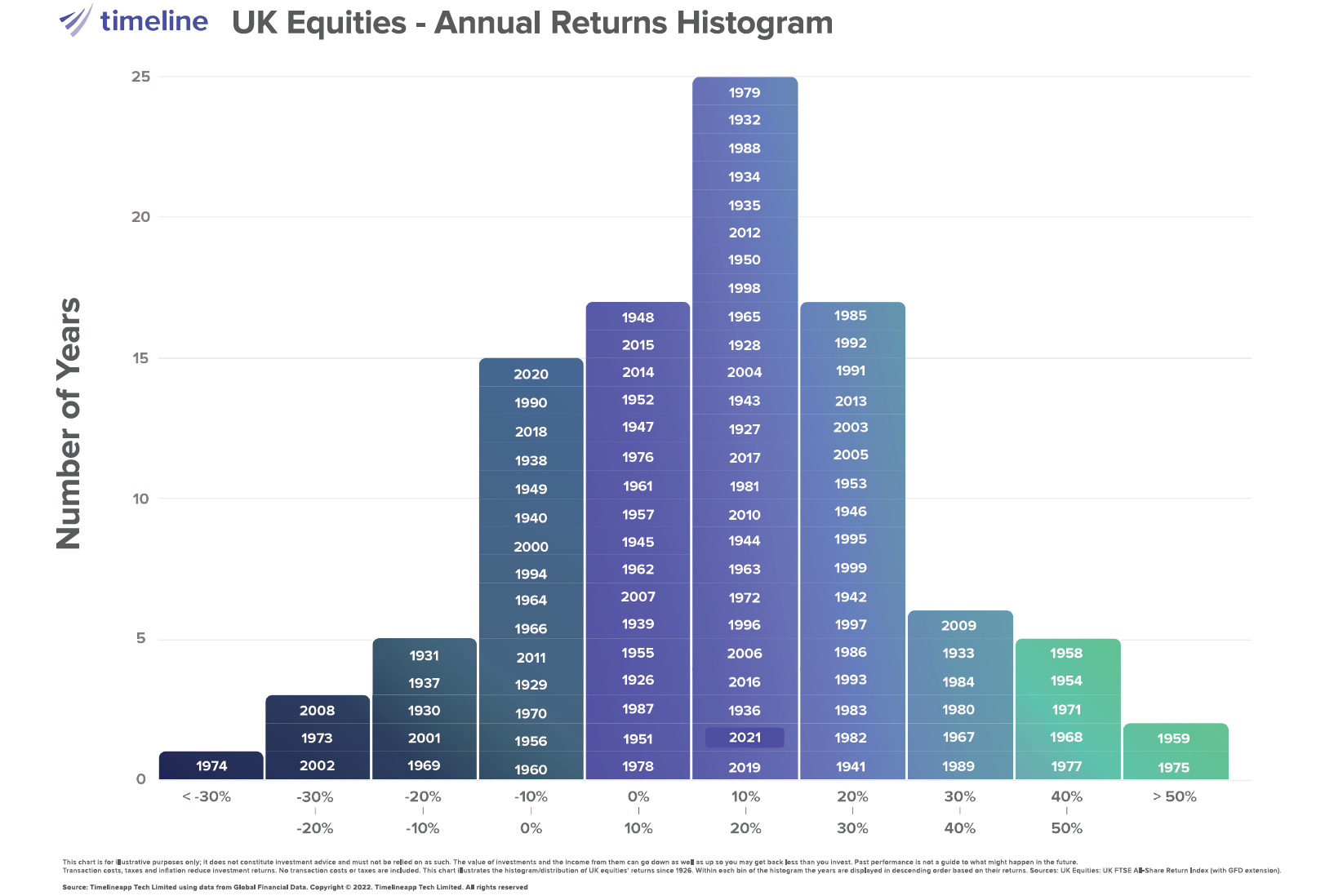
It reminded me of a chart that I have been using with clients recently. We know that markets have been difficult or “volatile” this year. The histogram I have been discussing is this one.

UK Equities 1926-2021

In simple terms it shows the calendar year returns of the UK stock market from 1926 to 2021. Everything right of 0% (column 5) ending the year positively, to the left (the first four columns) – negatively. The good news is that since 1926 there have been rather more years of positive returns (72/96) or 75% of all years.

I’ve been considering how we all handle stock market crashes and I think its right to remind ourselves of the awful investing years that we have lived through… depending on when you became an investor (most of you would not have been investors (aged 18) before 1955). So it seems reasonable to point out that you have lived through more than your fair share of bad investment years… you’d have to be at least 67 to have been an adult investor in 1973 and 1974, two of the worst years, but I suspect most have experienced 1990, 1994, 2000, 2001, 2002, 2008, 2011, 2018, 2020. Returning to the tennis analogy, these were the tense, big moments. You held your nerve and survived. You are still here; you and your portfolio have survived.

The way media and arguably regulation presents investment is to focus on the negative years. We can agree and acknowledge that “bad years” for investors come around regularly – 1 in 4 is a negative year. We are all adults and know this. Whatever is thrown at us over the coming months you have the genuine life experience to fall back on. You have been here before. Hold fast and play the long game, progressing through your own journey to the final.

If you are concerned about your portfolio please get in touch with me. If you know someone that is, why not suggest that they get in touch too. The greats all have coaches, but talent is what you possess already. A coach seeks to maximise yours.

Dominic Thomas
Solomons IFA

You can read more articles about Pensions, Wealth Management, Retirement, Investments, Financial Planning and Estate Planning on my blog which gets updated every week. If you would like to talk to me about your personal wealth planning and how we can make you stay wealthier for longer then please get in touch by calling 08000 736 273 or email info@solomonsifa.co.uk

GET IN TOUCH

Solomon’s Independent Financial Advisers
The Old Mill Cobham Park Road, COBHAM Surrey, KT11 3NE

Email – info@solomonsifa.co.uk 
Call – 020 8542 8084

7 QUESTIONS, NO WAFFLE

Are we a good fit for you?

GET IN TOUCH

Solomon’s Independent Financial Advisers
The Old Mill Cobham Park Road, COBHAM Surrey, KT11 3NE

Email – info@solomonsifa.co.uk    Call – 020 8542 8084

7 QUESTIONS, NO WAFFLE

Are we a good fit for you?

YOU ARE ALREADY READY – WIMBLEDON AND WINNERS2023-12-01T12:12:48+00:00

A VERY BRITISH SCANDAL

TODAY’S BLOG

A VERY BRITISH SCANDAL

There is no Downton Abbey Christmas special, but if you enjoy a period drama vaguely based on events then Boxing Day offers up A Very British Scandal. Obviously, I have not seen the production, it has some top-drawer stars and is likely to be a hit for the BBC. So what has a period drama got to do with your financial planning? Well, it’s a story that has some useful messages. If I were a betting man (I’m not) I imagine that the focus will be on sex and power with a nod to things that have changed and some that have not.

I’m curious to learn if we ever witness the end of the story, or more accurately the end of Margaret Campbell, Duchess of Argyll who died in 1993 at the age of 80 and buried not many miles away in Brookwood Cemetery, Surrey. She would have been 109 this month!

Foy & Bettany - BBC A Very British Scandal

HIGH SOCIETY SCANDALS

However the story is retold by Sarah Phelps, it would be fair to say that the Duchess was a very wealthy individual, one whose life was full of high society life and celebrity. She was born to Scottish millionaire George Wigham who was Chairman of Celanese Corporation, still listed on the NYSE and possibly held in your portfolio (a tiny fraction). Her first marriage at the age of twenty was to American Investment Banker Charles Sweeny (23) whose family had a home locally in Wimbledon. Sweeny later went on to form the Eagle Squadrons of American pilots volunteering to fight in the RAF. It is alleged that the wedding dress designed by Streatham born Norman Hartnell caused such a stir in Knightsbridge that the traffic of the day was gridlocked for 3 hours. The couple divorced in 1947.

Her second and last marriage in 1951, aged 38 was to twice divorced Ian Douglas Campbell, the 10th Duke of Argyll and 9 years her senior (casting improved its actor age gap to 13 years).  Suspicious of her infidelity the story unfolds in a scandalous divorce in 1963.

It will be interesting to see how the story is retold given its previous framing by men in power, many of whom it is alleged knew the Duchess very intimately. A decade or so later her memoirs “Forget Not” were published. Quite what happened thereafter is significant as the Duchess mismanaged her investments and finances (or someone did) and in 1978 at the age of 65 she had to sell her Mayfair home and elected to move into a suite at the Grosvenor House Suites. Unable to pay her bills, aged 78 she was evicted in 1990.

PENURY – CASHFLOW EXHAUSTED

Whatever one’s view of the Duchess and the blatant hypocrisy of various powerful men, there are obvious lessons about choices and financial management that need to be remembered. Appearance is often not reality. How people say they live and how they actually live are often rather different. This is a familiar story, as old as storytelling itself. Your financial plan needs to be robust enough for changes in your circumstances, but a great financial plan has considered and will continue to address the issue of an affordable lifestyle.

Claire Foy and Paul Bettany star in the BBC’s “A Very British Scandal” a 3-part drama starting on Boxing Day 2021 at 9pm. It will be shown on consecutive nights, but all three as a “box set” are also available via the BBC i-player from 9pm on Boxing Day. Here is the official BBC trailer.

Dominic Thomas
Solomons IFA

You can read more articles about Pensions, Wealth Management, Retirement, Investments, Financial Planning and Estate Planning on my blog which gets updated every week. If you would like to talk to me about your personal wealth planning and how we can make you stay wealthier for longer then please get in touch by calling 08000 736 273 or email info@solomonsifa.co.uk

GET IN TOUCH

Solomon’s Independent Financial Advisers
The Old Mill Cobham Park Road, COBHAM Surrey, KT11 3NE

Email – info@solomonsifa.co.uk 
Call – 020 8542 8084

7 QUESTIONS, NO WAFFLE

Are we a good fit for you?


GET IN TOUCH

Solomon’s Independent Financial Advisers
The Old Mill Cobham Park Road, COBHAM Surrey, KT11 3NE

Email – info@solomonsifa.co.uk    Call – 020 8542 8084

7 QUESTIONS, NO WAFFLE

Are we a good fit for you?

A VERY BRITISH SCANDAL2023-12-01T12:12:58+00:00

TOMORROW’S WORLD

TODAY’S BLOG

PLANNING A FUTURE

The more I read or hear about the impact of the pandemic on real people I am reminded of how important it is to have a sense of the future. There is little doubt that many of us have been struggling with the practicalities of living detached from friends and family, or frankly anyone that we may not know, but form a part of our ordinary lives.

Monty Don made the point that having something to look forward to is ever so important, which is part of the reason why so many people love and enjoy gardening. Those of us with gardens have benefitted this year from fairly good weather and the ability to take more time to enjoy our open spaces. Many have remarked that during the Spring when were in the full lockdown phase, they observed the natural world in way that seemed to be a glimpse into a bygone time, of no cars or aeroplanes – to see and hear nature, as may have been observed centuries ago.

TOMORROW’S WORLD

You will probably remember the BBC1 programme “Tomorrow’s World”. It was something of a TV fixture for many people, irrespective of age. When I grew up there were only three TV channels and “Children’s television” officially ended just before the news, but programmes really didn’t stop appealing to children. Perhaps you will remember James Burke, Michael Rodd, William Woollard, Judith Hann and Maggie Philbin all explaining various inventions which would perhaps become commonplace lifestyle improving solutions. Many of the “predictions” turned out to be some way off the reality, others were quite clearly an early prototype.

Anyhow, it got me wondering about the importance of having a vision for the future. We have seen some welcome reassessment of the past, we cannot change it, but we can at least learn to understand it differently, specifically its impact on the present.

SOLOMONS IFA - TOMORROW'S WORLD

A PLACE IN TIME

Without a grasp of history and a hope for the future, I would argue that it is easier to become overwhelmed by the present. Today I could probably find shows like Tomorrow’s World, but I’d really have to hunt them down from not simply hundreds of channels but different media sources and they certainly would not be what the majority watched, all experiencing the occasion at the same time, which I also believe to be pertinent to our sense of time.

THE IMPORTANCE OF HOPE

The book of Proverbs has an interesting phrase “without vision the people perish”. That’s a pretty bold statement and of course, has been interpreted in all sorts of ways and probably used to justify all sorts of ideas. If I may, can I simply offer it as an acknowledgement of the value of having a sense of tomorrow. Having hope.

Many of us, (perhaps all of us) have had moments of despair at the current circumstances. Whether that is concern about health, family, friends, loneliness, financial pressure, worrying if your business (or your friend’s) will survive, if you will ever get to enjoy the things you did before… Then there is a very deep despair that overwhelms and leads to some believing that they have no future and so end the pain.

DON’T UNDERVALUE YOUR FUTURE

The future is something I discuss all the time with clients, but I have to admit that simply having a sense of a future itself (whatever that looks like) is rather more important than having no vision at all. Please get in touch if you need to talk or simply want me to listen. Perhaps your plans have altered, maybe some priorities have changed. Alternatively, maybe you know someone that I may be able to help to get their plan for their future into shape.

And for your amusement… here’s the team at Tomorrow’s World looking back at the 1970s as the new decade was about to begin from roughly 4 decades ago – which is typically how long people “work” for a living and increasingly how long retirement may last…

Dominic Thomas
Solomons IFA

You can read more articles about Pensions, Wealth Management, Retirement, Investments, Financial Planning and Estate Planning on my blog which gets updated every week. If you would like to talk to me about your personal wealth planning and how we can make you stay wealthier for longer then please get in touch by calling 08000 736 273 or email info@solomonsifa.co.uk

GET IN TOUCH

Solomon’s Independent Financial Advisers
The Old Mill Cobham Park Road, COBHAM Surrey, KT11 3NE

Email – info@solomonsifa.co.uk 
Call – 020 8542 8084

7 QUESTIONS, NO WAFFLE

Are we a good fit for you?

GET IN TOUCH

Solomon’s Independent Financial Advisers
The Old Mill Cobham Park Road, COBHAM Surrey, KT11 3NE

Email – info@solomonsifa.co.uk    Call – 020 8542 8084

7 QUESTIONS, NO WAFFLE

Are we a good fit for you?

TOMORROW’S WORLD2025-01-28T10:06:34+00:00

On Chesil Beach

On Chesil Beach

The new film On Chesil Beach of the book by Ian McEwan is now in cinemas. It will perhaps bring back some memories for anyone that married in the 1960s, with the period captured wonderfully. Set primarily in 1962, it is the story of a newly-wed couple Edward (Billy Howle) and Florence (Saoirse Ronan) who discover that they are unprepared for the intimacy of marriage.

At the time of the story, the “sexual revolution” of the 1960s had barely begun, indeed Penguin Books had only recently (November 1960) won their case to publish Lady Chatterley’s Lover. Despite the reality of millions of daily lives, Britain was generally rather poor at sex education. Edward and Florence lack any real understanding of each other intimately. The church would of course argue that a lifetime of marriage would gradually facilitate intimacy, whilst such an answer for many is workable, where trauma and intimacy collide, there is little comfort in glib answers. Florence offers a different option, one that Edward simply cannot face.

Sweet Sorrow?

Spoiler alert – the marriage does not last the day and is annulled. Unlike the book, we do not follow the characters much beyond the moment of decision on Chesil Beach. Decisions are made, tempers are lost, and parting was not a sweet sorrow.

In our contemporary society, relationships now take various forms, it was not until 1973 that the Matrimonial Causes Act made the case for divorce clear (beyond annulment). This despite all our somewhat hypocritical history about personal conduct in aspects of sexual intimacy and marriage. Henry VIII managed to get what he wanted and created the Church of England as a consequence. The law is flexible for those with power, as perhaps you noticed in the recent BBC dramatization about Jeremy Thorpe (A Very English Scandal).

Life can be Messy

The problem with most financial planning is that real life tends to get in the way and muck things up. Life is not nice, neat straight lines, well not for most. We might wish that everything was very each to model, but the truth is that it is of course complex, nuanced and on occasion vexing. One of the most significant aspects that will impact your financial planning will be your marital status. Any change in this will create an obvious need to review your plans, yet many don’t see past the Form E (financial statement required for a divorce) and to be blunt, I’m always surprised that lawyers do not wish all sides to undergo some basic (or complex) financial assessment with proper cashflow modelling for their new scenarios. Perhaps few have experienced the benefit of this.

In any event, life is messy. Sometimes we all need to make changes that we did not expect. This might be marriage, divorce, redundancy, addictions, debt… and so on, a plethora of possibilities that were not expected. So, I tend to get a little, well, dismissive of advisers who think that a cashflow plan is the done deal – the future is mapped out, life is now a beach…. I would be quick to point out the massive advantage of cashflow planning, we use it for all our clients, but it does have its short-comings and like anything else, garbage in, garbage out, but reading a forecasted future as anything other than an option would be unwise at best. We may all crave certainty, but there is none when it comes to living life. I advise all clients that the plan is not set in stone, it will be wrong, but it is today a very good guess about he future, based upon sensible assumptions that need regular reviewing.

The Unvarnished Truth

It is not a crime to admit things need to be changed. That your plans must alter, that is normal. What is a crime (in a sense) is pretending that everything is ok when it isn’t. You may never have a Chesil Beach moment, but may I propose that a relationship with a financial planner, requires honesty and the ability to listen, discuss and think together.

On Chesil Beach is now in cinemas, here is the trailer. I enjoyed the film, beautifully shot and poignant storytelling 7/10.

Dominic Thomas
Solomons IFA

You can read more articles about Pensions, Wealth Management, Retirement, Investments, Financial Planning and Estate Planning on my blog which gets updated every week. If you would like to talk to me about your personal wealth planning and how we can make you stay wealthier for longer then please get in touch by calling 08000 736 273 or email info@solomonsifa.co.uk

On Chesil Beach2025-02-03T10:37:20+00:00

Loving and not so loving

Loving

Yet another example of how times have changed – thankfully. The new film “Loving” is the true story of Richard (Joel Edgerton) and Mildred Loving (Ruth Negga). White man falls in love with black woman and marry in 1958, but not recognised within their own state of Virginia. Hard to believe that it was not even 60 years ago, yet thankfully seems a lifetime and world away from where we are today.

Or not so loving…

This is an ordinary couple, with an ordinary story, except for their determination to fight for what they believe to be right. Their surname is, of course, perfect for their story and perfect backdrop for its opponent, the State of Virginia.

A lifetime ago

60 Years ago, not that long ago really is it. Of course it’s a lifetime ago. Certainly, in lifetime financial planning terms these days that would be the rough timeframe we use for clients in their 40’s. Lots of people will be celebrating their sixtieth birthdays this year, people like Jo Brand, Robin Cousins, Steve Davis, Fern Britton, Paul Merton, Jayne Torvill, Dawn French, Billy Bragg and Stephen Fry to name just a few. It may interest you to recall the BBC TV news programme called Nationwide, which aired its infamous April Fool joke about Spaghetti growing on trees… was aired in 1957. Fake news is clearly not new.

Tempus Fugit

In short, time passes quickly. You cannot really put your financial planning on pause. Life moves on, rules change, economically, socially and environmentally. Change is our constant and whilst often feared, is generally our friend – except when it comes to deteriorating health.

Not always happy, shiny people…

The problem I have with some financial planners and supposed gurus within our field is that whilst they mean well, the future is uncertain. However adept they are at cashflow planning and deep-diving on your personal values and goals, life isn’t always a neat straight-line. Sometimes, horrible stuff happens, like an uninvited thug turning up in your bedroom in the dead of night. Health can fade, as can memory and the real problem is if everything is as it is today. Now. It is in the darker moments that a great financial plan will be tested. Your concern is unlikely to be about your next holiday or where to moor your yacht.

A New Rising Star

At 35, Ruth Negga, was nominated at the BAFTAs for the 2017 Rising Star Award and is nominated for an OSCAR as leading actress for this film “Loving”. She is great in the movie, though will have tough competition with Isabelle Huppert, Emma Stone, Meryl Streep and Natalie Portman. Anyhow, if Ruth Negga were a client (do get in touch if you are keen), then we would likely consider a 65-year time horizon for her financial plan. That is a long time. So much can change. She’s a talented actress and I hope that she has plenty of opportunity to get some good roles (there are woefully few for women). Yet her future is no more or less certain than anyone else’s. This is precisely why it is vital to review your financial planning regularly – and clients know we do this annually. Checking our assumptions and progress towards the future you are creating. Little remains unchanged, which based on history, is a rather good thing.

Anyway, here is the trailer for Loving. I gave it 7/10, shot and acted beautifully, some great lines, but it felt a little slow.

Dominic Thomas
Solomons IFA

You can read more articles about Pensions, Wealth Management, Retirement, Investments, Financial Planning and Estate Planning on my blog which gets updated every week. If you would like to talk to me about your personal wealth planning and how we can make you stay wealthier for longer then please get in touch by calling 08000 736 273 or email info@solomonsifa.co.uk

Loving and not so loving2025-01-28T13:29:11+00:00

Money Box – Interest Only Mortgages

Money Box- Interest only mortgages

If you follow me on twitter you may be aware that I was raising some concerns about the reporting of an item on BBC Radio 4 Money Box and BBC1 Breakfast about interest-only mortgages. Let me be clear I do not provide mortgage advice – we refer this to someone that does – should anyone require it, we encourage clients to clear off debt and mortgages as quickly as possible.

Paul Lewis relates the story of Christine, a woman now 70 years old, bought her flat in Liverpool in August 2004 at the age (I assume) of 58 with a ten-year mortgage of £151,774. It was an interest only mortgage, meaning that she was only paying interest, not the loan which would need repaying at the end of 10 years. Having had 2 years extra time to repay the money, her lender (Santander) has now given her until 24th November 2016 to do so or face legal proceedings.

There is not enough information (as ever) in the story presented to be able to provide any solid advice. We are told that there is no equity in the property (the value of the flat less the mortgage). This could be because the flat has not increased in value at all since 2004 (which whilst possible seems a little unlikely) or it could be that she has amassed other debt which has wiped out any equity that built up over the last 12 years. The reality is we don’t know and in any event, this is the situation she is now in.

We are told that Christine now (in 2016) has an income from pensions of £1,100 a month and her mortgage costs her £600 a month. It is unclear if she has any other savings. The story is clearly upsetting to Christine, but I am suspicious of what is being reported.

What is missing?

If the angle for Money Box is the possible miss-selling of the mortgage then some better factual information is really required. As I have said I don’t arrange mortgages, but it would be unusual for someone to borrow £151,744 without an income to justify this (typically 3.25x income, which would mean requiring an income of about £46,700. Being 58 at the time she was only 2 years away from receiving her State pension. So what income did she declare? And was the lender really offering a 58-year old a 100% mortgage within 2 years of retirement? Now that would have some grounds for complaint about bad advice. She cannot “recall” being offered a repayment mortgage or anyone asking her how it would be repaid.

But there was a foreign property…

Christine is certainly very unclear about what an interest-only mortgage is, thinking (for a some reason that it would continue) when she knows it wouldn’t (not outstanding until she dies) and of course would be clearly stated on the annual statements and original mortgage offer. Christine provides what appears to be conflicting information, recalling when asked how she expected the mortgage to be repaid, she mentions an intention to sell a foreign property to help do so. Sadly this “crashed” but again merely demonstrates that rather more (and better) questions need to be asked. More information is needed, but is woefully lacking.

Clarity or Charity?

When Christine was asked a direct question “Did you not understand what interest only meant?” she replies “Yes, you were just paying off interest that they were charging on the house itself and not off the property. That is how it was sold to me”. The reporter does not challenge her statement which makes no sense at all unless by “house” and “property” she really means mortgage/loan or capital (read it back to yourself).

The Coming Mortgage Apocalypse….

The only clear thing is that she appears confused, not fully understanding how mortgages work and is certainly distressed. Money Box seem concerned that lots of people are in a similar position, reporting that over 160,000 interest-only mortgages are due for repayment within the next 2 years. Money Box report that about 2million people have interest-only mortgages and that 1 in 8 (12.5%) of them appear to be like Christine, not realising that the money needs to be repaid (though presumably having been asked the question they do now know). Importantly 40% claim that they will struggle to repay the mortgage in full.

This of course is probably the real scare story or anxiety that Money Box wishes to convey and the implication being that this is the fault of unsafe products and a bad industry of bad lenders and bad mortgage advisers…. which will lead to are creating more homelessness. Well as with all things, there are likely to be some, (bad ones) but such generalisations and calling for yet more regulation is a far stretch, when in practice this has more to do with some people not understanding the commitment that they are making or claiming not to understand.

There are more options than you think

Christine is very worried, understandably, she has my sympathy, yet it seems that the only options she has discussed (remember there is a financial adviser “on hand”) is going into an old peoples home or a hostel. It sounds to me as though her adviser is pretty useless if this is the case. A quick search of properties to rent in Liverpool for £600 or less reveals over 2,000 listed as available.

The Power of Denial

It’s a terrible thing that’s happened, that I never thought it would come to this”. Well it is certainly hard, but Christine has £1100 a month of income and can chose how to use it. Renting is a viable option. So I am left feeling that this is more a report on the power of denial – denial of reality. Something has clearly gone very wrong, with poor budgeting and planning. This does not make Christine innumerate, frankly successive Governments fail far more spectacularly and one wouldn’t really accuse them of innumeracy or financial illiteracy, as tempting as it may be.

I’m left with the impression that this is a story of not wanting to understand, rather than not being able to understand, which is perhaps true of Money Box as well. Accusing lenders or advisers of mis-selling is a very lazy approach, when actually Santander has been providing information and already extended the deadline by 2 years.

Paul Lewis ends the piece with a nod to the debt-counselling charity Step Change, which implies an awareness that there is rather more here than simply clearing the mortgage by selling the flat and what is actually missing is a fundamental grasp of a budget and the reality of consequences. Getting out of depth financially is not a sin, it can easily happen to anyone, (and I do mean anyone… even billionaires!) the key is facing the truth and exploring options carefully.

Dominic Thomas
Solomons IFA

You can read more articles about Pensions, Wealth Management, Retirement, Investments, Financial Planning and Estate Planning on my blog which gets updated every week. If you would like to talk to me about your personal wealth planning and how we can make you stay wealthier for longer then please get in touch by calling 08000 736 273 or email info@solomonsifa.co.uk

Money Box – Interest Only Mortgages2023-12-01T12:19:03+00:00

Business Owners Beware

Business Owners and Employees Beware

Business Owners and Employees need to be aware of fraud that could cost a business its existence. Technology is fantastic, it enables us all to do things much more quickly and also opens up so many new opportunities. However, we all know it is a double-edged sword which can work against us. I imagine that everyone with an email address has had some form of email scam or fraud – everything from the rather obvious “I need you to help part $X million in your account and will pay you a share” to much more sophisticated scams.

The real problem is that in a world where you make purchases all the time from people and businesses that you have never “met” invariably this reduces your ability to spot a scam. There is an interesting story on the BBC website about how the Accountant to a business was pressured into sending €500,000 from one of their clients’ accounts. On the surface it seemed legitimate, but thankfully was caught.

Time Pressure

Often fraudsters will use the pressure of time for a deal or lost opportunity (increasingly common in many marketing campaigns as it is). However, some firms produce lots of information – for example online diaries, showing when people are available (capitalising on times when they are unavailable). So a sense check is often the first thing you should do. Where money is concerned, a good financial planner is someone that you will have a trusted relationship with. So he or she should have a pretty good idea about your plans – assuming that you provide information honestly and that suitable questions have been asked.

In the case the BBC highlight, the Accountant was informed that the money was to be used to buy a business in Cyprus. One would hope that the business would have discussed such a plan with the Accountant in advance (if true) so it would not be something out of the blue. Similarly, a financial planner, really should have a good idea of when you might need money – for school fees, a wedding, a property purchase and so on. In practice few expenses should be a “surprise”. This relationship is likely to mean that fraud can be spotted more easily, but in no way guarantees it.

Anyway, be mindful that anyone that has access to any of your accounts – business or personal might unknowingly sign off something believing it to be true. You are responsible for your accounts and need to ensure that you have a process to sense check financial transactions. Here is the BBC item. Click here to see.

Dominic Thomas
Solomons IFA

You can read more articles about Pensions, Wealth Management, Retirement, Investments, Financial Planning and Estate Planning on my blog which gets updated every week. If you would like to talk to me about your personal wealth planning and how we can make you stay wealthier for longer then please get in touch by calling 08000 736 273 or email info@solomonsifa.co.uk

Business Owners Beware2025-01-28T09:55:27+00:00
Go to Top