
Julie – a matter of trust

Julie

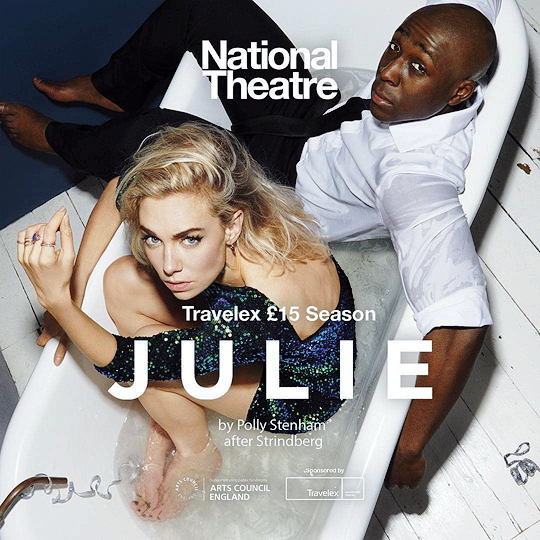
I noted in social media last week that a fight broke out in the balcony of the Lyttleton Theatre between two male members of the audience at the end of a performance of Julie. I already had a ticket booked, but of course wondered, whether it was something about the play…

I can report that the acting was rather good, (Vanessa Kirby and Eric Kofi Abrefa to name two key performances) but to be blunt, this was a play that I simply did not care for. The dialogue was awful and reminded me of various unpleasant characters. It was meant to be reworking of August Strindberg’s play Miss Julie, but it felt dated and done before, many times before, but rather better.

The basic background premise is one of a sense of being trapped by circumstance. In this case rich it-girl with the traumatic experience of being the first to find her mother following her suicide. We can only guess why, but mine is that the mother also felt trapped in a life of luxury, lacking any meaning or any significant connection with her obviously wealthy, materially successful but invariably absent husband. The resulting wealth used as the justification for a lack of presence. The price of “success” and the excesses are its ongoing punishment.
Held in Trust

Julie, who has no money of her own, because it is held in Trust “because she is irresponsible with it”. She certainly is irresponsible, but whether this came before or after the Trust fund is one of the few talking points. I’m not a fan of Trusts (a bit odd for a financial planner to admit) but living from someone else’s money rarely has a good outcome and to put it bluntly, those that do best are the legal advisors, all (mainly) to avoid the clutches of a divorcing spouse, which from my point of view merely sets up the prospect of not living with the consequences of actions. A Trust might be a suitable metaphor for many elements of the play, the lack of trust between parent and adult child, the lack of trust between a self-serving man and a woman. The lack of real trust between a socialite and her maid… I could go on. Trust is quickly sacrificed for pleasure, or perhaps relief from the trappings of situation.

Do You Trust the Trustee Savings Bank?

So, who to trust? What is the price of trust and should you ever trust anyone? The truth is that we all must, being human we will be failed, but not trusting makes for miserable existence, albeit possibly right in a few instances.  Trusting any adviser is hard, trusting someone else with your money is one of the most difficult realities. Consider the recent muck up at TSB – Trustee Savings Bank, an utter fiasco. Advisers and the financial services industry must do an awful lot to shift the default setting of “mistrust”. Yet when it comes to your financial planning, this is what you need to remove. Any decent adviser will build trust over the years, by keeping promises, doing what they said they would do, looking after all your financial “stuff” and communicating in plain words.

A Problem of Wealth

One of the natural problems of having a significant amount of wealth, is that it tends to attract the wrong people, like bees to a honeypot. The opening scene of Julie reveals a birthday party composed of people that she neither knows nor likes, friends they are not. We can all probably think of people that have been parted from their money by their acquaintances.

Never underestimate the positive power of a proper financial fiduciary. Its not simply what we do, its also what we do not do, which includes not putting a hand in the till – or in this case the blender.

Here’s a promotional video from the National Theatre for Julie.

Dominic Thomas
Solomons IFA

You can read more articles about Pensions, Wealth Management, Retirement, Investments, Financial Planning and Estate Planning on my blog which gets updated every week. If you would like to talk to me about your personal wealth planning and how we can make you stay wealthier for longer then please get in touch by calling 08000 736 273 or email [email protected]

Julie – a matter of trust2025-01-21T15:48:30+00:00

What We Cannot Measure

What We Cannot Measure

Financial scams are sadly all too common, we cannot measure how much we save clients by helping them to avoid the many thieves, scammers and general loathsome low-lifes that are keen to part you from your money. Yet that is arguably one of the most significant aspects of my work – helping clients to avoid making mistakes, or at the very least, making fewer of them.

I had to admit to living in a bit of bubble within my sector. When I started as an adviser (1991) I thought most of them were crooks and little of my early experience of helping people get out of rubbish rip-off arrangements altered my opinion. Admittedly for a more complex set of reasons, I was acutely aware that when I turned up to events, my car was one of the “worst” in the car park. Others were doing much better… and frankly I thought I knew why.

Skip forward quite a few years and my opinion changed dramatically as a result of being part of the institute of Financial Planning (IFP) who are now the CISI. The people I met there were open, genuinely keen to help each other do a better job for our clients and were adamant that clients must be put first. This is the bubble that I have been in for quite a long time now. I forget, (because I tend not to come across them) that there are still a lot of horrid individuals who would raffle their family.

The Ark Scam

I have followed the Ark scam with some exasperation, these scams impact our regulatory fees (which rise as a result). In many senses they feel like rewarding failure, but I do appreciate that it’s not an easy job to stop every scam. However this morning I saw a tweet from a decent-minded adviser I know about a post from another. It is the very shocking and desperately disappointing story of Sue Flood’s experience with Ark and her pension. She has been failed miserably.

I would encourage you to read the item on Henry Tapper’s blog page. It is a verbatim script of her account of things from a meeting yesterday. I wish it were very different.

All I can say is that it is about time that some justice was provided to these 500 or so victims. The authorities responsible should wake up and get on with resolutions and bringing the crooks into the safety of prison.

It is this sort of stuff that we help clients avoid. There is a lot of it out there. Frankly Bitcoin is another and most of the rubbish that is covered in the press is decidedly bad for your wealth. Sue did just about as much as anyone could be reasonably expected to do, she checked out her adviser and everything seemed fine. As an industry (we still are) we have collectively failed many, many people like this.

Here is the link to the article.

Dominic Thomas
Solomons IFA

You can read more articles about Pensions, Wealth Management, Retirement, Investments, Financial Planning and Estate Planning on my blog which gets updated every week. If you would like to talk to me about your personal wealth planning and how we can make you stay wealthier for longer then please get in touch by calling 08000 736 273 or email [email protected]
What We Cannot Measure2023-12-01T12:18:06+00:00

The Leisure Seeker

The Leisure Seeker

Those that are not retired have many rather cliched ideas about retirement. Invariably these involve lots of leisure, cruises, golf and gardening. Most of the retired people I work with often voice that they are busier than ever, its simply that they don’t have to turn up for paid work.

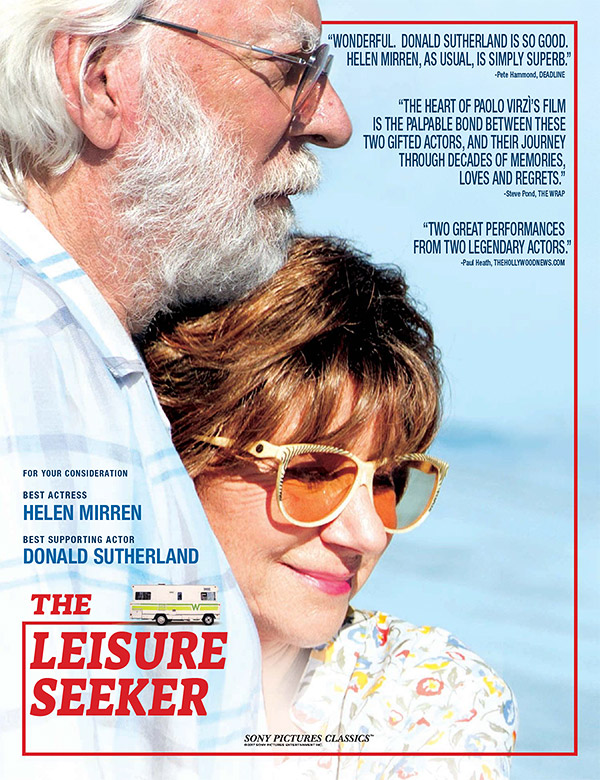
The Leisure Seeker is a gentle movie about the Spencer’s, John (Donald Sutherland) and Ella (Helen Mirren) who decide to take one last once in a lifetime trip together in their recreational vehicle, a leisure cruiser. Their adult children are left confounded at what they perceive to be irresponsibility, given that John is clearly suffering from signs of dementia.

Memory Lane

The couple take a trip down memory lane, with mixed results. Johns dementia creates a scenario where his confusion about who, where and when he is, leads him to expose some deeply buried secrets. He is also paranoid that Ella is having an affair with Dan Coleman, who he believes is the secret motivation for their trip together.

The cruel irony of John’s dementia means that he is not even aware of the loving nature of their trip, a special excursion to Hemingway’s house in Key West, John’s literary hero, of whom he has recounted many insights to his English students throughout his career.

How does it End?

Any good financial planner will inevitably address the question of your life expectancy. All planners work on the basis of attempting to ensure that your money lasts just a little longer than you do. Naturally, this is educated guesswork and requires regular reviews. However, we also need to be mindful of the difficulty of an ending of a life. Simplifying arrangements where sensible to do so, without ruining years of sensible investment strategies and estate planning.

The film exposes the need to discuss these issues with someone trusted, certainly it would make sense for your planner to have an idea or awareness of your intentions, as it would be for your family, though the emotional dynamic of family relationships makes such a conversation problematic and rich material for drama.

The truth is that all of us face an ending, it’s simply a question of how, why and when. Here is the trailer for the film, which being small, is now reaching the end of its run in selective cinemas.

Dominic Thomas
Solomons IFA

You can read more articles about Pensions, Wealth Management, Retirement, Investments, Financial Planning and Estate Planning on my blog which gets updated every week. If you would like to talk to me about your personal wealth planning and how we can make you stay wealthier for longer then please get in touch by calling 08000 736 273 or email [email protected]

The Leisure Seeker2025-01-27T16:07:36+00:00

Good news for Equitable

Good News for Equitable Life

There is finally some good news for anyone that is still alive and has an Equitable Life policy. The company that came under serious financial and legal pressure some years ago having attempted to reverse its promises, is now planning to provide an additional payment to policyholders.  The Equitable has built up some reserves and now intends to distribute these to policyholders, all to be approved at the AGM on 31 May.

There is no news about how much, simply that there will be some payment, which is nothing to do with compensation (for which there was a report in 2008 for it to be “speedy”). The company closed to new business in December 2000, so your policy will be at least 17 years old. Equitable will be writing to policyholders in due course. It would seem likely that this only relates to people with holdings in their “with-profits” fund.

Good news for Equitable2023-12-01T12:18:13+00:00

Power of Attorney – Are you due a Refund?

News from Alex Truesdale today in relation to possible refunds for recent Power of Attorney.

Power of Attorney – are you due a refund?

OPG LPA/EPA REFUND PROCESS: FEBRUARY 2018

WHY HAS A REFUND BEEN OFFERED?

When LPAs/EPAs are registered, a fee is payable to the Office of the Public Guardian, of £120 or £110 per LPA/EPA, which in some circumstances was reduced by 50%.

In an announcement made by the Ministry of Justice yesterday, partial refunds are being offered to those who applied to register for powers of attorney between 1 April 2013 and 31 March 2017 (you don’t need to know precisely when you applied).

According to the MoJ, the process to register LPA/EPAs became more efficient during this period (probably because the volume of LPA registrations submitted has climbed so markedly as the general public become aware of the advantages of having LPAs in place)  and as a result, operating costs for the Office of the Public Guardian came down. However, the fee charged for the application did not reduce in line with this. The fee was subsequently lowered by the MoJ to £82 per LPA, a change which came into effect on 1 April 2017. This announcement stops short of an automatic refund being sent out to all donors, so do please spread the word if you have friends, neighbours or relatives who may also have applied

WHAT DOES THIS MEAN FOR ME?

This applies to lasting powers of attorney (LPA) and enduring powers of attorney (EPA) made in England and Wales.  You can make a claim if you’re the ‘donor’ – the person who made the power of attorney, or an ‘attorney’ – appointed by the donor in an LPA or EPA.

The refund must be paid to the donor – or to his/her estate if the donor has since died and may take up to 12 weeks to appear. You only need to make one claim per donor, even if you made more than one power of attorney.

WHAT IS THIS WORTH TO ME?
How much you get depends on when you paid the fees – see table below. You’ll also get 0.5% interest. You’ll get half the refund if you paid a reduced fee (‘remission’).

When you paid the fee Refund for each Power of Attorney
April 2013 – September 2013

October 2013 – March 2014

April 2014 – March 2015

April 2015 – March 2016

April 2016 – March 2017

£54

£34

£37

£38

£45

HOW DO I CLAIM?

If the donor is still alive, start here:  https://claim-power-of-attorney-refund.service.gov.uk/when-were-fees-paid

You’ll need the donor’s UK bank account number and sort code.

You must claim by phone ( 0300 456 0300 (choose option 6))  if:

the donor doesn’t have a UK bank account
the donor has died
you’re a court-appointed deputy

CAN ALEX TRUESDALE WILLS LIMITED APPLY FOR THE REFUND FOR ME?

Unfortunately no – only the donor or the attorney is able to apply.

I HAVE FURTHER QUESTIONS – WHO CAN I CALL?

Just phone 0300 456 0300 (option 6) or email the OPG on [email protected]

Dominic Thomas
Solomons IFA

You can read more articles about Pensions, Wealth Management, Retirement, Investments, Financial Planning and Estate Planning on my blog which gets updated every week. If you would like to talk to me about your personal wealth planning and how we can make you stay wealthier for longer then please get in touch by calling 08000 736 273 or email [email protected]

Power of Attorney – Are you due a Refund?2025-01-21T15:48:30+00:00

Some Good News

Some Good News

There is some good news today about pensions. A recent court case (23 January 2018) has concluded that 245 victims of a pension scam should be reimbursed by those that stole money from their pensions, to the tune of a whopping £13.7m. The High Court Judge Mark Pelling has ruled that 4 pension scammers must make redress to those that they scammed. Those four people being David Austin, Susan Dalton, Alan Barrett and Julian Hanson. These were all connected to a company called “Friendly Pensions” (as if!). You can google their accounts online to see who is who or see more detail here.

I say good news, because it often seems that my particular world if full of stories about people who are scammed and the culprits invariably get away with it. Thankfully the regulator and the Police are all having much more success in Court. Apart from being odious examples of human beings, the scammers simply break all rules, take money that is not theirs, blow it on an excessive lifestyle and pay no taxes, hopping from one financial jurisdiction to another. Thankfully this lot of reprobates were caught.

Usual Trick

These scammers all profited from cold calling and offering to move pensions but providing the investor with the incentive of a tax-free rebate from given up commission. I think the thing that distresses me most is the way that they hide lies amongst truths. Up until 2013 it was possible to give up commission (but only to improve – by reducing investment charges). As of 2013 commission was finally banned by the regulator and advisers had to agree fees with their clients for the work conducted. This can appear very similar to a commission (because the fee can be paid from the pension or investment), but it is very different in practice – in that it is determined and agreed between you and the adviser, not set by the product provider (manufacturer) of the pension (or investment).

Another thing to watch out for is the investments themselves – invariably unregulated investments are used due to the high charges that traditional (mainstream) funds do not have by comparison. In many instances, unregulated investments may as well be a bank account that a crook simply empties into their own account, usually via a network of other accounts.

Why I am particularly delighted is because usually the compensation bill is picked up and shared between the remaining adviser firms in the UK. Though not involved and most unlikely to ever recommend an unregulated investment, all are obligated to pay as demanded within 28 days by the FSCS – the Financial Services Compensation Scheme. So it’s a bill that in theory I won’t be having to pay, though I suspect that these crooks have managed to spend most if not all of the money, so we will probably have to anyway – such is life.

In short, take great care. I know its an industry full of jargon and a plethora of tables and charts, many of which are unhelpful, but get a sense of the adviser you are using and why he or she might be suggesting you change things that you have. There aren’t that many good reasons to move a pension – but reducing your investment costs would be one of them, perhaps better control and reporting if they are all in the same place, or access to some sensible investments, but frankly thats about it unless your old scheme is an utter rip off and isn’t delivering anything of value. Some old pensions do have valuable benefits and some have hefty penalties (still in 2018!).

Anyhow, at least 245 people are now legally entitled to compensation from those that defrauded them, which in my book is a good result.

Dominic Thomas
Solomons IFA

You can read more articles about Pensions, Wealth Management, Retirement, Investments, Financial Planning and Estate Planning on my blog which gets updated every week. If you would like to talk to me about your personal wealth planning and how we can make you stay wealthier for longer then please get in touch by calling 08000 736 273 or email [email protected]

Some Good News2023-12-01T12:18:15+00:00

Are Annuity Rates on the Rise?

Are Annuity Rates on the Rise?

Annuities may be starting to improve again. Why is this relevant to you? Well, if you plan to retire you would be wise to consider an annuity as an option for all or part of your retirement income. If you are already retired and using a Drawdown arrangement, improvement in rates may also be worth your attention.

New Rates

I recently received an email from one of the UKs largest insurance companies advising of change to their annuity rates. In general rates have begun to increase upwards. As an example, a 65 year-old with the maximum single life annuity from £100,000 would now receive £4,944 a year rather than £4,896 a year, an increase of about 1%.

How long is a lifetime of income?

Anyone wanting to build in a spouse’s pension of 50% (i.e. once the “owner” (annuitant) of the annuity dies, income would reduce to 50% for the remainder of the spouse’s life) can expect the same fund to buy an annuity of £4,420 up from £4,375. These are for level annuities (the income remains the same). You could build in a degree of inflation-linking, doing so would reduce the initial income for a joint life annuity £2,818 a year increasing by 3% each year.

The crossover point

The alarming detail is that it would take 17 years (in my example) for the inflation (rising) annuity to match the annual income of the level annuity, at which point it continues to pay out more each year (i.e. a 65-year-old would be 82). It takes a total of 30 years before the total income paid out would exceed that of the level annuity. Remember that this is for someone that started their annuity at age 65.

In truth, there are better annuity rates out in the market. You should also note that if you have any form of health problems, or smoke, you would probably qualify for an enhanced annuity. However most people would look at a pot of £100,000 and think an income of £4,420 is not terribly much and any “bells and whistles” added just make it worse. Hence pension freedoms and the abolition of the requirement to buy an annuity.

However, despite appearances annuities offer a guaranteed lifetime income, no other alternative really does that, but instead relies upon investment returns, which obviously means risk. Since pension freedoms (April 2015) many people have chosen not to buy an annuity and have taken their income from a drawdown pension instead. Unfortunately, according to recent research, many will run their pension pot dry within 12 years. Most people take too much it would seem, or at least an unsustainable amount. Almost everyone under-estimates their life expectancy, which is a crucial discussion to have and one that needs regular reassessment.

So now you know that:

  • There are different and better (higher) annuities available in the market
  • Health issues might provide a better (enhanced) annuity
  • Drawdown pensions carry risk
  • Life expectancy is a key factor
  • Most people are expected to run out of money
  • Review, review, review – especially if you have a Drawdown pension

Dominic Thomas
Solomons IFA

You can read more articles about Pensions, Wealth Management, Retirement, Investments, Financial Planning and Estate Planning on my blog which gets updated every week. If you would like to talk to me about your personal wealth planning and how we can make you stay wealthier for longer then please get in touch by calling 08000 736 273 or email [email protected]

Are Annuity Rates on the Rise?2025-01-21T15:50:47+00:00

The Hurdles We Face

Like most advisers, I regularly have enquiries as a result of the new pension freedoms. In essence, someone wants to move money out of a pension and the Pension company have told them that they cannot do so unless an adviser signs the forms, by which they really mean, takes responsibility for the advice if or when it all goes wrong. So after attempting to explain why I will not do this for the umpteenth time, I thought that perhaps a post about it would be easier… its lengthy, but provides context. If you are in this position and cannot find the time or energy to read 4 pages, then you really should not be messing around with your pension.

The Hurdles We Face

In the past, most people received a poor service from their financial adviser. As advisers were paid based on selling products, some of which were good, some of which were awful. The majority were unlikely to see “their” financial adviser (assuming s/he stuck around) unless the adviser believed that there was another chance to sell a product and thus earn some money.

Free Advice Illusion

The illusion of “free advice” was perpetuated by the product providers (the big life assurance and pension companies). They made it worse by having incredibly complex charging structures. They competed for business based on spurious data about past performance coupled with extra commission, above the agreed standard LAUTRO rate. Unhelpfully each product had a different rate of commission anyway so it was always likely that you would end up with a product that suited the adviser rather more than it suited the investor. In the late 1980s there was also the added problem of Independent Advisers being forced to disclose commission whereas Tied Agents didn’t (and couldn’t) Tied Agents were paid much more commission in any event. It was Tied Agents that were largely responsible for mis-selling of pensions. The collective advising legacy of Tied Agents is now shaped in the form of the largest financial advice company in Britain.

Suits you sir…

As an example, £200 into a pension typically paid commission to the adviser of around £2,300 and then about £5 a month after 4 years until payments stopped. The same amount invested into a PEP or ISA would pay typically £6 a month for as long as the payments were made (£72 a year). PEPs and ISAs did also include a fund based commission of 0.5% as well, so on a fund worth £2400 this would generate another £12 a year (plus growth) – £2,300 now or £84 over the year? (not hard maths).

This invariably resulted in bad selling practices and inappropriate advice. The result was marginally better regulation, improved qualification requirements for advisers and a ban on commission for investments from 2013. All advisers had to charge fees and agree these with their clients.

Unfortunately, this has not prevented criminals being criminals. The digital revolution which has helped on many levels is now under constant threat from fraud. Standards have had to be raised. What most people don’t appreciate is that the advice provided by financial advisers needs to be suitable, it sounds rather obvious but has implications. The most significant being that the adviser is liable for his or her advice not simply at the time, or their working career or indeed their lifetime, but for eternity. We are the only group on earth that can be sued posthumously (our estates).

Tongue-tied about risk

As a direct consequence of the historic mis-selling, any insurer providing professional indemnity insurance (a mandatory requirement to hold) takes a fairly negative view of bad practice and particularly “risky” products – which don’t necessarily mean investor risk, but those that invariably have been used to scam people. This has resulted in fewer insurers, higher premiums to the point that many advisers consider this a tax on good practice rather than an insurance against unlikely complaints.

Common Sense Revolution

A good adviser will always want to look after their clients well, forming a long-term relationship where a good service is provided and is financially rewarding to both the adviser and the client. Most advisers now look after their clients much better, adding significant value over time. There is much documented evidence for this (google adviser alpha).

The risk to the adviser is now more likely to be a bad relationship with a client, that results in a complaint, so service is vital and actually serves both client and adviser much better anyway. So very few advisers are now willing to take on a “one off” piece of work. The risk of things going wrong is too great.

Getting to know you

In a typical process an adviser must demonstrate that s/he knows their client before offering advice. This means sufficiently understanding the clients existing arrangements, circumstances and plans for the future, all within the context of the current real world. Here’s a brief list of the sort of things we require.

·         Evidence of your identity and residency (are you a potential fraudster?)

·         Family circumstances, context (who else is impacted?)

·         Income and tax information (to reduce but also to avoid fraud and evasion)

·         Assets (on a global basis)

·         Liabilities (on a global basis)

·         Existing arrangements (old employer pensions etc)

·         Giving (historic, present and planned)

·         Current spending levels (where does it go? How much does life cost you?)

·         Goals (why, when, who, what, how?)

·         Attitude to risk and capacity for loss

·         The content of your Will (where will all the above go?)

I could go on, but you probably get the point. Obtaining all of this isn’t as straight-forward as you may imagine either. Whilst you may loathe insurance companies, I can assure you that tracking down and obtaining the right information from them about you is enough to test the frustration boundaries of anyone.  Additionally, some people are simply not good at facing difficult truths – such as their own lack of financial control and an unwillingness to confront the basics of something that reveals where it all goes (like an expenses statement).

Trust me, I’m a…

So we’ve now gathered the above, we need to assess it and analyse it properly. Then in light of your aims, what’s realistic given your resources, appetite for risk and ability to cope with loss, we can put together solutions from everything that is “out there”…. Which to remind you is an ever evolving, changing, competitive marketplace, so what’s “best” last week may not be so today.

Committed to paper

We then provide a suitability report, which is meant to be read. Most are long because a lot needs to be said, but we also operate in a climate of complaint and many complaints are won based on what was not said by the adviser than what was done or even whether the adviser was “right”. The client is a human and wants to simply get on with life and not read a very long document about financial stuff.

Then there is the issue of fees and investment costs. We have evolved from the delusion that advice is free, but most people still believe that it is cheap. Even with very good technology (none of it joins up) completing the list earlier and creating a “file” takes about 2 days for the typical person, that assumes the information has arrived.

Fees

Anyway, fees – most charge to look after your money, so will take a percentage of this. The more you have the more you pay (as with most things in life). However in our unnecessarily complex tax system, the more you have invariably means the greater your options and the greater the complexity. Just for a benchmark, complexity probably starts at income of £80,000, but could be a lot lower depending on your age.

Fees come in all forms, but in essence I see six  

1.       The first is to implement or arrange something (i.e.. ISA). Some call this an initial charge. In essence, it is the result of a recommendation to use XYZ investing in a portfolio of funds with ABC, which is suitable because…. Charges are typically 1%-5%

2.       Ongoing management and looking after of the arrangement – the idea being that stuff changes, you need to make adjustments to keep within the parameters that were established. Perhaps switching funds within the portfolio, rebalancing or changing the “shell” of the investment to something now better. Charges are typically 1%

Both of these rely on you having money to invest and look after. Its not that different from commission, invariably taken from the investment rather than your bank account. It works but its not perfect. We know that it isn’t perfect as well, but its how most of us work.

3.       The service fee, this is often paid as a retainer and provides for the cost of meetings and keeping all your stuff (old style and new style) up to date and keeping you in the loop, charges are typically £50 – £500 a month

4.       Ad hoc fees – for specific, often complex pieces of work but of course nobody does this unless they are fully furnished with all the facts about you (as per my list). Charges typically a minimum of £300

5.       The financial planning fee – this is really where the best advisers are heading. In theory you don’t need any money to be invested with your adviser, they design a financial plan, which will take account of all you have and reveal a version of the future so that you can actually know how much is enough, what you need to do and so on, irrespective of who ends up investing the money. A financial plan can be a mammoth document covering the reasons for each assumption made, or it can be reduced to the headline charts, showing you the what and why with a list of action points. A financial plan will cost at least £1500, some ten times this (remember complexity and options). Some advisers recognise that this is often “new” for their clients and discount it heavily to £500-£750 be warned that this also indicates their lack of confidence in the value that they are offering. Financial planning is a real skill, not simply a new label.

6.       The no strings fee. This is the latest attempt to separate financial planning and perhaps behavioural coaching from your money. You pay all fees directly from your bank account, irrespective of how much you have. Naturally there will be some expectation of a correlation between how much value is added or work done, but payment is separate. As a result, there will be no adviser charge shown on any illustrations as the adviser is paid separately. This of course, makes the illustrative projections look much better. The adviser will be paid what was agreed irrespective of results. To be blunt most of us would prefer to work this way, but don’t have clients wealthy enough to do so. Those that do, successfully tend to charge £5,000 – £30,000 a year for their services.  Note that the fee is not necessarily related to time, but more likely value. Consider a tax planning saving of £800,000 what is that worth?

Show me the money

In the attempt to protect and help consumers the regulator has ensured that fees and costs are reflected in all illustrations (evolving since 1995 with “commission disclosure requirements”). Illustrations now show the impact of investment charges and adviser charges. These are significant and appear to cannibalise your investments. When coupled with low rates of growth used for illustrations and a well-intended “remember the impact of inflation” the resulting illustration far from helps consumers, but puts them off ever bothering to move money out of their bank account, (which if run by the same illustrative rules, would have you spitting blood).

Full circle…. Back to affordability and making it appear cheap

The truth, as uncomfortable as it may be, is that financial planning and good financial advice are now largely out of reach (price wise) to most people, due to our operational costs and the need to make a profit so that we can come back next year and do this all again so that our clients are looked after properly within the context of accurate information. It is an exhausting process. Most advisers I know (and I know a lot) would all want everyone to have better financial advice and are actively seeking ways to help through new media (podcasts, blogs, Vlogs, books, seminars, free downloads etc). Naturally, we hope to attract some new good clients, but we are also keen to help educate and improve financial literacy. We call it the savings gap. It’s in all our interests to help Britain become a nation of financially independent adults….the alternative is really rather frightening.

In conclusion (finally!) I cannot do a one-off piece of work for you. It isn’t in my long-term interests to do so (and probably not yours) without doing a proper job. Any adviser that offers to do so is at best deluded and perhaps desperate for money; at worst somewhat economical with the truth and likely running the risk of taking cash for forms, aiding scammers, knowingly or foolishly. This will result in further complaint, the inevitable failing of his or her business, and a compensation bill that the remaining good firms have to split between them (known as FSCS levies). Such a system has numbered days and is currently being reviewed in a fairly timid fashion. This really infuriates most advisers, many of whom vent in online sector forums and can easily be found on topics like Unregulated Collective Investment Schemes (UCIS) or Defined Benefit Pension Transfers or any recent receipt of a regulatory invoice from the FCA or FSCS, despite this there has been little appetite for opposition to a regulator that appears powerful yet out of touch.

When all is said and done, nobody can guarantee anything in financial services. Trust needs to be earned, I believe that this is done by being transparent and keeping promises. Quite how or even how much advisers are paid becomes largely irrelevant under such conditions. Any good financial planner or adviser wants a good long-term relationship with clients.

I genuinely wish you good luck in your endeavour to find a trustworthy, ethical adviser that has possesses business acumen. At one point there were over 250,000 people selling pensions and insurance products, there are now about 25,000 registered individuals who are licensed to do so across 5,720 firms, the vast majority of which are not yet financial planners. You could search my social media account to find some, but in general those are the elite advisers. Beware that search engines or directories are also paid-for marketing tools.

Think I’m wrong? today a report about pension transfers from final salary (“gold-plated pensions”) continues to press the point that advisers cannot be trusted. Nobody appears to have any notion of the cost or risk involved, everything is assessed in terms of a price for filling out forms. See Professional Adviser item by Hannah Godfrey.

Dominic Thomas
Solomons IFA

You can read more articles about Pensions, Wealth Management, Retirement, Investments, Financial Planning and Estate Planning on my blog which gets updated every week. If you would like to talk to me about your personal wealth planning and how we can make you stay wealthier for longer then please get in touch by calling 08000 736 273 or email [email protected]
The Hurdles We Face2025-01-27T16:07:36+00:00

An Act of Trust? My Cousin Rachel

An Act of Trust? My cousin Rachel

There’s a new reworking of Daphne Du Maurier’s 1951 story “My Cousin Rachel” that is currently in cinema’s. A romantic throw-back to a time when men wore britches and women had little to call their own, thank heaven we have moved on. This is perhaps a timely reworking of the story, visiting the issue of inherited wealth with a passing nod to the patronage of the landed gentry, whilst their labourers gather the proverbial scraps from under their table.

Philip Ashley (Sam Claflin) is an orphan, taken in by his Cornish, landowning bachelor cousin Ambrose. Sadly for Mr Ambrose, he becomes unwell and heads to Florence, where he is initially restored by the sun and charms of Rachel, who he elects to marry. His illness shortly returns, resulting in his mysterious death, leaving a widow and Philip to face the prospect of an early inheritance. Suspicious of foul play, due to letters from his dying cousin, Philip is determined to punish Rachel for what he believes she has done. “Whatever it cost my cousin in pain and suffering before he died I will return with full measure upon the woman that caused it.”

Under a Spell

As a somewhat naïve and hot-headed young man, he is mesmerized by his cousin’s widow when she arrives at the estate. All plans to punish are swiftly reversed and forgotten, because he “likes to look at Rachel”…. who is played rather brilliantly by Rachel Weisz.

I will not reveal any more of this thoroughly enjoyable tale, which will perhaps get you reflecting on whether women are viewed any differently today than they were then. In fact to say any more would not help your own reflections.

The thing about inheritance

However, I can say that the story is an example of why you need to have a Will and that it is reviewed regularly. Moreover (a word I use knowing the angst caused for my old French teacher, who swore it was redundant) it also displays some of the pitfalls of a Trust, or at least a Trust that reverts to a beneficiary who is only 25 and is unhelpfully naïve and besotted.

This is a common financial planning problem – at what age should someone inherit wealth? particularly a life-defining amount. For all the planning that can be done, this will inevitably boil down to how the Trust was established and who the Trustees are and to be blunt, how responsible the beneficiaries are.

In the story, Philip can rely on the steady hand of family friend and Trustee Nick Kendall, (Iain Glen) who whilst being a voice of reason, is also compromised by his hope that his daughter Louise, (Holliday Grainger) will marry Philip and thus be financially secure.  The Kendall’s suspicions are alert for conflicted reasons. Often selecting a Trustee can be a difficult task, the basics are that they must be at least 18 years of age and of sound mind, and not held at her Majesty’s pleasure.

Selecting Your Trustees or Executors

Many clients will of course naturally wish to select family members or friends, there is nothing wrong with this, except that most families have at times, strained relations. Friends may change. The responsibility of being a Trustee or Executor is no small matter – just ask anyone that has been one (or is). This is why these important legal documents, which assure your beneficiaries of your provision, are reviewed regularly. In our post-modern society, people move around the world, not simply the county. Death at a distance (a fate that befell Ambrose) is rather more complex than that wedding you have been invited to abroad.  So when selecting Trustees, always use your head which may well conclude that those that share your surname are indeed the right people, but do think about this carefully.

Anyway, here is the trailer.

Dominic Thomas
Solomons IFA

You can read more articles about Pensions, Wealth Management, Retirement, Investments, Financial Planning and Estate Planning on my blog which gets updated every week. If you would like to talk to me about your personal wealth planning and how we can make you stay wealthier for longer then please get in touch by calling 08000 736 273 or email [email protected]

An Act of Trust? My Cousin Rachel2025-01-21T15:48:30+00:00

The Eye of Truth – Mindhorn

The Eye of Truth – Mindhorn

It seems that we are living in a time of “alternative facts” of course we aren’t it is merely that certain politicians and business leaders wish us to believe their point of view rather than reality. So perhaps there is a certain sense of good timing for a bionic eye that enables truth to be seen. However, as with most things, the irony in this instance, is that the possessor of the bionic eye, (Mindhorn) is blind to his own shortcomings.

Mindhorn is a new comedy about a TV actor “Richard Thorncroft” (Julian Barratt) playing a detective “Mindhorn” in the 1980s. Now many years later, the type cast, washed up actor is struggling to maintain his dignity in a world that has forgotten him. He is rescued by a serial killer; whose own delusions mean that he believes that Mindhorn is real. As a result, reluctantly the local Police call in Mindhorn for one last performance to entrap the villain.

Bodie & Doyle meet Steve Austin and Knight Rider

Being comedic, this has the potential to be a rip take of any and every TV detective since Bodie and Doyle at CI5 with references as broad as the lapels. How one man is stuck in the past of his glory days and failing to embrace the present, or indeed the uncomfortable truth of reality. Sadly, the film, like many, has all of its best bits in the trailer. There are some funny moments, but this is a fairly tame affair which could have been so much better, despite being rammed with an impressive collection of actors, who all must have also thought that the concept was good, but the final delivery…. Hmm. Take comfort in the fact that there are as many twists as there are in a straight piece of wood, which certainly could not describe the acting, but recycled pulp is probably not far off the truth about the script.

Former Glories

On occasion, we all meet people that are an echo of their former greatness. Whilst I can accept that with age limitations do apply, particularly the laws of physics! It seems such a missed opportunity to not live fully irrespective of age. I’m sure that like me, you meet many that do. Retirement can seem like a fairly scary subject for some people. What on earth will they do with their time? Just endless rounds of golf and bridge? Well, I can assure you that the retirees that I advise all have very active lives, in fact most are more active than ever before. I’d argue that retirement is nothing to fear at all – infirmity however, well, that’s a different thing entirely.

A Vibrant Retirement

So any financial plan, should really be set up for a full and vibrant retirement, one that reflects what you wish to do and how you intend to spend your time. Of course things may change over time and for some, infirmity may become an unwelcome compatriot, so some thought also needs to be given to the “what if?” of this prospect…. Which may or may not occur.After all, even the Duke of Edinburgh has only just annoucned that he will “retire” later this year – and he’s 96 in a few weeks time! Financial planning is very much about taking a look into the future and making some changes now, if you don’t like what you see (albeit with loads of assumptions). It is never a sense of constantly trying to restart the glory days like Mindhorn. There are some things that need to grow, some that need to die and some that simply need to be tried.

Here’s the trailer for Mindhorn. It makes a compelling pitch as a comedy, but sadly lacked the final punchline.

Dominic Thomas
Solomons IFA

You can read more articles about Pensions, Wealth Management, Retirement, Investments, Financial Planning and Estate Planning on my blog which gets updated every week. If you would like to talk to me about your personal wealth planning and how we can make you stay wealthier for longer then please get in touch by calling 08000 736 273 or email [email protected]

The Eye of Truth – Mindhorn2025-01-27T17:01:51+00:00
Go to Top