ESHER AND SURREY TOP TAX PAYERS

TODAY’S BLOG

ESHER AND SURREY TOP THE TAX PAYERS

Don’t worry, I’m not going to get into my opinions about politics and the upcoming general election. I am merely going to draw your attention to some data that makes the point that taxation probably determines your politics.

579 TOWNS RANKED IN THE UK

A new study by UHY Hacker Young Accountants found did some sums on average incomes and average amounts of income tax paid across 579 towns of the UK. I might take issue with the idea of an average income; I would much prefer “median” which is the actual mid-point of income. I’m sure you know this, but let’s just make the point.

THE THING ABOUT AVERAGES

10 people, 9 have an income of £10,000 and one has an income of £100,000. The average income is £19,000 (total income divided by 10). The median income (the mid-point in the total range is £10,000). The average is distorted by incomes at either end of the scale.

ESHER AND WALTON

Given the above, it would therefore probably not surprise you that the stockbroker belt has a much higher average income tax. The most expensive area being Esher and Walton, where the average income per person is £68,600 and the average income tax paid is £18,900. London has an average income of £46,900 with income tax of £10,400. Compare this to Nottingham North which came 579th (last) with an average income of £21,700 and tax paid of £2,080. By way of note the national average income tax paid is £4,617 with an average income of £30,780.

WHAT ABOUT HOUSE PRICES?

So just doing a quick check of house prices in Bulwell, NG6 – the average value of property is £139,792 whilst in Esher it is £1,039,615 (according to Zoopla). Again, be warned about averages! Let’s pretend that to buy a property in either you can do so with a multiple of your income. In Bulwell you would still need 6.44x the average income for the area, in Esher you would need 15.15x the average income for Esher. House prices and incomes are related. High incomes are needed to buy higher priced homes.

LIFE IN ESHER COSTS IN TRIPLICATE

The average person in Esher pays income tax of triple the national average. I regularly drive through Esher, it is a pretty little “town” with a flourishing high street, which includes a stockbroker and lots of kitchen companies. Its the home of many celebrities and football stars (its is very close to the Chelsea FC training ground). It has one of my favourite cinemas – the Everyman, (which isn’t obviously more expensive than most others). The give away is the large houses with equally large gates, in fact there are communities of them.

Despite what some might say, the higher earners have had many tax rises. The personal allowance tapered from £100,000 (abolished by £125,000). Inheritances tax nil rate band frozen at £325,000 for a decade. Yes this might be increased to possiblly £500,000 with the additional Main Residence Nil Rate Band, but in practice, if the estate is worth more than £2m, it is lost. Child benefit withdrawn for those earning £50,000. Annual pension allowance cut hugely to an annual allowance of £40,000 but probably £10,000 for anyone with income or relevant earnings of £210,000.

You can draw your own conclusions from why people with more money might vote for tax cuts and why those with less want more tax from those that seem to have more. The regional bias for work and pay does not help with solutions. There are some suggestions here from the ONS.

For the record, according to the ONS, the average pay for employees in September this year (2019) was £26,416.

Dominic Thomas
Solomons IFA

You can read more articles about Pensions, Wealth Management, Retirement, Investments, Financial Planning and Estate Planning on my blog which gets updated every week. If you would like to talk to me about your personal wealth planning and how we can make you stay wealthier for longer then please get in touch by calling 08000 736 273 or email [email protected]

GET IN TOUCH

Solomon’s Independent Financial Advisers
The Old Mill Cobham Park Road, COBHAM Surrey, KT11 3NE

Email – [email protected] 
Call – 020 8542 8084
7 QUESTIONS, NO WAFFLE

Are we a good fit for you?

GET IN TOUCH

Solomon’s Independent Financial Advisers
The Old Mill Cobham Park Road, COBHAM Surrey, KT11 3NE

Email – [email protected]    Call – 020 8542 8084
7 QUESTIONS, NO WAFFLE

Are we a good fit for you?

ESHER AND SURREY TOP TAX PAYERS2025-01-21T16:34:23+00:00

THE TAX YEAR

TODAY’S BLOG

THE TAX YEAR

The new Tax Year is now well under way. Those of you that are employed will be receiving your first payslip of the new tax year and will also shortly have a P60. For those that are self-employed, many will now be starting to collate information for the tax year that has now ended, ready for submission of your self assessment accounts to HMRC.

I’m often, ok, sometimes… asked why does that tax year begin on 6th April rather than 1st January. This is a good example of “recency bias” in assuming that things have always been as they are now. In practice it wasn’t until 1751 that England adopted 1st January as the opening day of the new year. The Scottish were considerably ahead adopting 1st January from about 1600. It would not surprise most Scottish that they have been out-partying the English on new years eve.

Why? well as is often the case, our calendar and practices stem from religious beliefs and events. England, being Protestant didn’t adopt the Gregorian calendar when it was introduced in 1582 by the Pope. You may recall that the 16th century had somewhat sanguine relationships with Rome and the Catholic Church, so following the lead from Vatican City about when to set the date wasn’t likely to hold a great sense of importance. The Scottish naturally took a rather different approach.

A New Dawn

The Solstice or Spring Equinox really marks the new year, which in England dates back as far as Stonehenge, which I am told is about 2500BC and recent DNA discoveries suggest that those that built Stonehenge were from Anatolia (modern Turkey). March 25th was the equivalent of January 1st.  As Christianity spread and Easter took the place of Spring Equinox, the minor problems of the calendar drift began to materialise over centuries. By 1584 the then Pope Gregory decreed the changes required, making the adjustments. It wasn’t until the Calendar Act in 1750 that the calendar correction was applied to England (and the Empire) in 1751.

In Time with Europe

The English calendar needed to add 11 days to catch up with the Gregorian Calendar. So September 2nd was followed by September 14th. This made for a short year (25 March to 31 December) and tax collectors basically didnt like it, so simply shifed 25 March by adding 11 days and allowing for the Leap Year of 1800, so the new tax year began on 6th April. Not even time can truly bend the two great certainties of life… death and taxes.

Here is a short video we made about this.

Dominic Thomas
Solomons IFA

You can read more articles about Pensions, Wealth Management, Retirement, Investments, Financial Planning and Estate Planning on my blog which gets updated every week. If you would like to talk to me about your personal wealth planning and how we can make you stay wealthier for longer then please get in touch by calling 08000 736 273 or email [email protected]

GET IN TOUCH

Solomon’s Independent Financial Advisers
The Old Mill Cobham Park Road, COBHAM Surrey, KT11 3NE

Email – [email protected] 
Call – 020 8542 8084
7 QUESTIONS, NO WAFFLE

Are we a good fit for you?

GET IN TOUCH

Solomon’s Independent Financial Advisers
The Old Mill Cobham Park Road, COBHAM Surrey, KT11 3NE

Email – [email protected]    Call – 020 8542 8084

7 QUESTIONS, NO WAFFLE

Are we a good fit for you?

THE TAX YEAR2025-01-21T16:34:23+00:00

NOW WE’RE TALKING

TODAY’S BLOG

NOW WE’RE TALKING

The end of the tax year is only a few weeks away, the latest online edition of Talking Money is available for you to read and we think you should download our app. Its a really useful bit of kit to hold on your smartphone or tablet. You can access it for free from your usual app shop (apple or android) simply search for “My IFA” and when you locate a rather dull grey icon of  of a fella that looks like he may be an outline from the mafia, download and use the password SOLOMONS.

We have created a short video which explains a few of the many features, one I use quite a lot is the mileage tracker which helps me accurately record business miles, but there are loads of features and calculators.

Here is the video of our app

Have a quick look at this video, let me know what you think.

Dominic Thomas
Solomons IFA

You can read more articles about Pensions, Wealth Management, Retirement, Investments, Financial Planning and Estate Planning on my blog which gets updated every week. If you would like to talk to me about your personal wealth planning and how we can make you stay wealthier for longer then please get in touch by calling 08000 736 273 or email [email protected]

GET IN TOUCH

Solomon’s Independent Financial Advisers
The Old Mill Cobham Park Road, COBHAM Surrey, KT11 3NE

Email – [email protected] 
Call – 020 8542 8084

7 QUESTIONS, NO WAFFLE

Are we a good fit for you?

GET IN TOUCH

Solomon’s Independent Financial Advisers
The Old Mill Cobham Park Road, COBHAM Surrey, KT11 3NE

Email – [email protected]    Call – 020 8542 8084

7 QUESTIONS, NO WAFFLE

Are we a good fit for you?

NOW WE’RE TALKING2025-01-21T16:34:23+00:00

Conference Season

Conference Season

It is conference season and I my diary is suitably full of my selection of those that I believe merit attention. I’m not attending any of the political conferences and have recently returned from what might be best described as the Premier League of Financial Planners Conference – the annual CISI conference at Celtic Manor.

Yes Minister

Whilst being a non-political conference, clearly insight from the occasional politician or a former one can be valuable. Step forward Steve Webb, who was a LibDem MP and the Minister for Pensions in the Coalition Government, back in the day when politics offered some semblance of common sense.

The Autumn Budget – 22 November 2017

Whilst understandably providing various caveats to his talk, Mr Webb made clear that given the Queen’s Speech, the current Government have essentially given themselves a 2-year timeframe.


Not Enough Hours in the Day

He explained that due to the workings of Parliament, this means about 40 weeks in the year that is given over to Parliamentary work. However, 1 day a week is set aside for the Opposition to make their case and another is for MPs to actually work with their own constituents. Given the amount of time that Brexit will consume, there is precious little likelihood that anything significant will change, unless it is populist, garnering all-party support within the available 120 days a year.

Why Tax Rules Are Daft

Aas tax legislation does not have to go via the House of Lords, unlike other acts (for approval or sense check) much can be altered quickly, even with a tiny majority. He made the point that it is precisely because tax legislation bypasses the House of Lords, that so much of it is so complex and poorly thought through. So that in mind, what could the Government possibly muck around with?

What you can pay in

The Annual Allowance – could be reduced further from the current £40,000, despite acknowledging the complexity of the Tapered Annual Allowance, he thought it more likely that this would be extended rather than abolished, perhaps bringing it in for those earning £100,000 rather than £150,000.

What you can get out

Whilst the Lifetime Allowance has already been thrashed to £1m and is meant to now be linked to inflationary increases, he said that cutting it further is an option as “it passes the Daily Mail test – where people think a £1m pension fund is a lot”. He made the point that the Treasury appears to hate pensions (see all recent changes over the last 15 years) but love ISAs, for which they attempt to invent a new one almost each year now.

Employer’s beware

Whilst he thought it unlikely, he also proposed that the Government could apply employers National Insurance contributions to their pension contributions, which would effectively end salary sacrifice arrangements. He also felt it improbable that the tax-free cash lump sum from pensions would end or be reduced, due to the complexity it would create for those that have had, are having or due to have it and rules are difficult to apply retrospectively.

No F-Bombs

Without a single interruption from anyone handing in a P45 or the stage falling apart, the room of delegates was impressed with his delivery and rationale, but sanguine about the prospect of further pension meddling. Everyone I spoke with conceded that ISAs certainly seem to be the favoured investment vehicle for the Treasury as they only give up future tax revenue, rather than current tax revenues. However, reliance on any future Government to maintain promises about ISAs seems probably unwise.

Dominic Thomas
Solomons IFA

You can read more articles about Pensions, Wealth Management, Retirement, Investments, Financial Planning and Estate Planning on my blog which gets updated every week. If you would like to talk to me about your personal wealth planning and how we can make you stay wealthier for longer then please get in touch by calling 08000 736 273 or email [email protected]

Conference Season2025-01-27T17:01:45+00:00

Warning to Landlords (and others)

Warning to Landlords (and others)

The Government has made it very clear that tax evasion (not paying due taxes) is illegal and will be prosecuted. Whilst we may all have an opinion about the fairness of the law, failing to pay taxes invariably carries with it the real prospect of prison.

Richard Fuller found this to the cost of his liberty. As a landlord with various properties he failed to properly declare and pay the capital gains tax that was due on those he sold between 2006 and 2013. As a result, he evaded £157,725 of capital gains tax. As of last Friday, he has now begun a 27-month prison sentence and of course assets are being taken to pay the correct tax.

Hidden costs but not hidden taxes

Whilst there will always be people that do well from property investments, the reality is that property is not very liquid. There are also many forgotten or hidden costs – such as purchase and sale costs, insurance, lost rent, improvements, accountancy costs and of course tax on the gains.

It is never worth evading tax. It is illegal and anyone doing so will still find plenty of room at her Majesty’s prison service, despite reports of overcrowding. Mr Fuller was found guilty of cheating the public revenue and fraud by false representation by a jury at Winchester Crown Court.

What the Taxman said..

Richard Wilkinson, Assistant Director, Fraud Investigation Service, HMRC, said:

“Fuller thought he was above the law and decided not to declare or pay the tax due from the sale of some of his property portfolio. It is simply not acceptable to steal from UK taxpayers.

“HMRC will continue to pursue those who attempt to hide their gains on assets, their income, and investigate those who attack the tax system. We ask anyone with information about suspected tax fraud to contact our Fraud Hotline on 0800 788 887.”

Evasion is not Avoidance

In short, don’t mess with HMRC. It is never worth it. Tax evasion is illegal, tax avoidance (which is using legitimate arrangements within the tax laws – such as ISAs, pensions etc) is something that the Government encourage to help reduce reliance upon the State and invest in the UK economy.

Dominic Thomas
Solomons IFA

You can read more articles about Pensions, Wealth Management, Retirement, Investments, Financial Planning and Estate Planning on my blog which gets updated every week. If you would like to talk to me about your personal wealth planning and how we can make you stay wealthier for longer then please get in touch by calling 08000 736 273 or email [email protected]

Warning to Landlords (and others)2025-01-21T16:34:24+00:00

The UK General Election

The UK General Election

Over the long run, the market has provided substantial returns regardless of who lives at Number 10. This is not a piece that I wrote, but it is worth sharing as it makes a very useful point. Think and act long term.

Next month’s snap election is the first national vote in the UK since the EU referendum. While the election’s outcome and overall impact are unknown, there is no shortage of speculation about how the election will impact the stock market. Below, we explain why investors would be well-served avoiding the temptation to make significant changes to a long-term investment plan based upon these sorts of predictions.

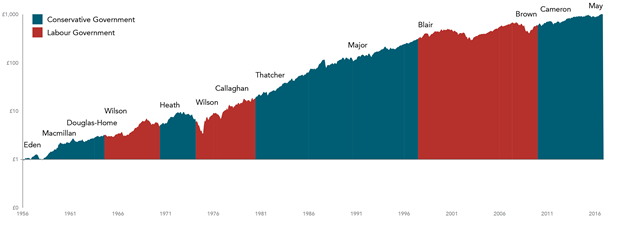
Here’s a chart to consider – Growth of £1 invested into the Dimensional UK Market Index between January 1956 – December 2016…. some 60 years, which is rather like investing at 30 and living until 90.

Note smallprint:

For illustrative purposes only. Past performance is not a guarantee of future results. Index is not available for direct investment, therefore, their performance does not reflect the expenses associated with the management of an actual fund. Dimensional indices use CRSP and Compustat data. See “Index Descriptions” in the appendix for descriptions of index data.

In plain English – this is really an example to demonstrate the wisdom of long-term thinking (and investing) rather than the constant short-term anxiety and to be blunt “mucking about”.

Investing is not meant to be gambling

Trying to outguess the market is often a losing game. Current market prices offer an up-to-the-minute snapshot of the aggregate expectations of market participants— including expectations about the outcome and impact of elections. While unanticipated future events (genuine surprises) may trigger price changes in the future, the nature of these events cannot be known by investors today. As a result, it is difficult, if not impossible, to systematically benefit from trying to identify mispriced securities. So it is unlikely that investors can gain an edge by attempting to predict what will happen to the stock market after a general election.

The focus of this election is Britain’s exit from the EU. But, as is often the case, predictions about the outcome and its effect on the stock market focus on which party will be “better for the market” over the long run. Exhibit 1 shows the growth of £ 1 invested in the UK market over more than 60 years and 12 prime ministers (from Anthony Eden to Theresa May).

Markets and 10 Downing Street

This exhibit does not suggest an obvious pattern of long-term stock market performance based upon which party has the majority in the Commons. What it shows is that over the long run, the market has provided substantial returns regardless of who lives at Number 10.

Equity markets can help investors grow their assets, but investing is a long-term endeavour. Trying to make investment decisions based upon the outcome of elections is unlikely to result in reliable excess returns for investors. At best, any positive outcome based on such a strategy will likely result from random luck. At worst, such a strategy can lead to costly mistakes. Accordingly, there is a strong case for investors to rely on patience and portfolio structure, rather than trying to outguess the market, in order to pursue investment returns.

INDEX DESCRIPTIONS

Dimensional UK Market Index: Compiled by Dimensional from Bloomberg securities data. Market capitalisation-weighted index of all securities in the United Kingdom. Exclusions: REITs and investment companies. The index has been retroactively calculated by Dimensional and did not exist prior to April 2008.

Investments involve risks. The investment return and principal value of an investment will fluctuate so that an investor’s shares, when redeemed, may be worth more or less than their original cost.

Past performance is not a guarantee of future results. There is no guarantee strategies will be successful. The information in this material is provided for background information only.  It does not constitute investment advice, recommendation or an offer of any services or products for sale and is not intended to provide a sufficient basis on which to make an investment decision.

Dominic Thomas
Solomons IFA

You can read more articles about Pensions, Wealth Management, Retirement, Investments, Financial Planning and Estate Planning on my blog which gets updated every week. If you would like to talk to me about your personal wealth planning and how we can make you stay wealthier for longer then please get in touch by calling 08000 736 273 or email [email protected]

The UK General Election2025-01-23T10:55:22+00:00

Talking Money…. again

Talking Money… again

As you will have gathered from the plethora of adverts in the weekend papers and advertising hoardings everywhere, the tax year is coming to a close. This means it is your last chance to use up your 2016/17 ISA allowance of £15,240 or perhaps a Junior ISA for those young enough.

This tax year has had many unwelcome changes, most significantly the pension tapered annual allowance, which has reduced the annual allowance (normally capped at £40,000) to a £10,000. This applies to anyone with “adjusted income” over £150,000. But that doesn’t make you “safe” if you don’ earn £150,000. As the annual allowance is £40,000, the maths starts at £110,000 of income. Pension contributions paid are added to income, indeed any income, be it rent, dividends or interest are all counted. So many may well find that they have exceeded the annual allowance.

Deliberate Complexity

Yes, the Government could have made things easier, but why bother when there are so many willing voters who will forget the hassle at the ballot box. In fact, Mr Hammond, the Chancellor has had two opportunities to abolish this utterly ludicrous rule in either in his Autumn Statement or his Budget last week. There are tax penalties and charges if this is exceeded and you don’t have any unused relief from any of the three previous tax years 2015/16, 2014/15 and 2013/14. Pensions have the ability to go back 3 tax years if you exceed your annual allowance.

Shrinking heads?

To provide a little more context – ten years ago, the annual allowance was £215,000 in 2006/17, it rose each tax year to £255,000 by 2010/11. It was then slashed to £50,000 for 2011/12 and remained at that level until 2014/15 when it became £40,000. Today in 2016/17 it is likely to be £10,000 for many high earners.

Of course the Government knows what they are doing, by encouraging us all to save for our retirement and financial independence…. I expect that we will soon hear “lessons will be learned”. Oh and no, this is not fake news, its just unwelcome news.

Clients will be receiving a printed copy of Talking money this week, which has some more facts.

Dominic Thomas
Solomons IFA

You can read more articles about Pensions, Wealth Management, Retirement, Investments, Financial Planning and Estate Planning on my blog which gets updated every week. If you would like to talk to me about your personal wealth planning and how we can make you stay wealthier for longer then please get in touch by calling 08000 736 273 or email [email protected]

Talking Money…. again2025-01-27T16:08:19+00:00

Is HMRC watching you?

Is HMRC watching you?

In an ever connected world, it should come as no surprise that HMRC are using technology to catch those that do not properly declare their income. In essence they are watching you (and me). I am informed that a new “snooper computer” is being rolled out this month, in time for those that are submitting information about their income for 2015/16. Whilst Government departments have rarely bought or invested wisely in computers (I guess suppliers see them coming… in fact I know they do)… this represents a £100m project.

Why is this important? well…. failing to accurately report and pay your taxes is one of those crimes for which you can expect a custodial sentence. Indeed HMRC powers have increased so much over the last 10 years that they can take money from your bank account until you can demonstrate that you don’t owe it to them (I kid you not).

Declaring Your Income

Under self-assessment we are all responsible for reporting and declaring our income. As everyone has observed, the UK, like most countries, has rather a lot of debt and is currently living beyond its means. The basic reality of maths is that either more income (taxes) has to be generated or less has to be spent and debts renegotiated. So as 31st January 2017 looms as the deadline for declaring and paying income from the 2015/16 tax year (ended April 5th 2016) expect little sympathy from the Government, HMRC or indeed most voters.

The new computer system is a way for HMRC to focus attention on those that appear to declare modest income, whilst also having involvement with organisations where money is clearly involved. So if you’ve bought a house (as I did in 2016) then you had to pay stamp duty… where did this come from? (data triggered from the Land Registry) or you are fairly active on e-bay, do some Airbnb, or rent a property, perhaps sold some things at a car boot sale, or have a Paypal account, bought a car… and, and, and… in short they are looking proactively for various sources of income that you are not declaring.

So what income have you forgotten about?

Income is paid on dividends from shares, invariably these are taxed at 10% automatically, but higher rate taxpayers will need to pay more. Have you declared all the income from those privatisation shares you’ve had for years? how about from non-ISA accounts? Auto enrolment (or workplace pensions) has begun for most firms, so this is yet another opportunity to see data about income. Interest from savings (don’t laugh!) is also income and taxable – except for the first £1,000 – which means most people will not pay tax on it.

For what its worth, you are likely to be the sort of person that is worried about not paying your tax properly. The threat or fear of possibly going to prison is more than sufficient to keep most people “on the straight and narrow” yet there will be some, for whom prison is no real “threat” – frankly that’s probably the very rich, who can afford to live outside of the country and legally avoid UK laws… such as top sportstars, business people that you’ve actually heard of or those that are the beneficiaries of mega Trust Funds (so dont own the assets – the Trust does) such as the Duke of Westminster. Perhaps I’m being a little cynical, but doubt that my remark is far off the mark.

Of course our app (which is free to download) has a load of calculators and tools, loads of tax tables and useful information which is designed to help you to not forget to report your income properly. You can get it on either the Android or itunes platforms, just search for Solomons Financial Planning.

Dominic Thomas
Solomons IFA

You can read more articles about Pensions, Wealth Management, Retirement, Investments, Financial Planning and Estate Planning on my blog which gets updated every week. If you would like to talk to me about your personal wealth planning and how we can make you stay wealthier for longer then please get in touch by calling 08000 736 273 or email [email protected]

Is HMRC watching you?2025-01-27T16:08:37+00:00

The Autumn Statement 2016

The Autumn Statement 2016

With a few hours to go Philip Hammond will be delivering his first Autumn statement, perhaps his last too if reports are to be believed that he will scrap them… who knows. In any event here is my quick wish list for the Autumn Statement

My Autumn Statement Wish List

(from a financial services perspective)

Abolish the Lifetime Allowance, which is currently £1m – if you hold more than this in pensions and you haven’t already “protected it” you will suffer an excess charge. Utterly pointless and discourages people from saving for their financial independence. This would also imply scrapping all previous protections.

Abolish Taper Relief – the new rule that has caused a raft of problems for those earning over £150,000 who can end up able to pay less into a pension (and still may suffer a penalty) than can be invested into an ISA. Utter lunacy, creating enormous headache for some.

Abolish Higher Rate Tax Relief – not what you might expect me to say and on the caveat that the two previous points are met. This saves the UK considerable sums, yet continues to offer an incentive to save for a pension.

Abolish Tapered Personal Allowance – either everyone gets one or nobody gets one. At the moment if you earn over £100,000 your personal allowance reduces by 50p for every £1 over £100,000.

Scrap the new Main Residence IHT allowance – just give everyone an allowance of £500,000 and have done with it. What former Chancellor George Osborne created is a shambles of smoke and mirrors.

Re-establish the different systems for Final Salary (Defined Benefits) pension schemes without any annual allowance, restricting total contributions to any pension to a fixed % of income by the employee (it used to be 15%). Vast sums and energy is used by departments in the NHS, Teachers, Local Government etc all creating utterly pointless, time sucking reports about the Annual Allowance and Lifetime Allowance. This is completely unnecessary.

Abolish LISA – another attempt to hit pensions with the high exit charges and daft array of decisions. Scrap this and other utterly pointless versions of an ISA. Have the single ISA allowance of £20,000 invest it however you like.

Stamp Duty – introduced to calm the property market which is now largely locked up with anxiety about Brexit etc. Huge tax take by Government and feels like a mugging. This needs reduced dramatically.

Fair Taxation

Earn it and tax it here. If you or your business generate income here in the UK it should be taxed at UK Corporation tax rates. Take note Google, Starbucks and Mr Green (et al). So all that nonsense for cross transfer pricing must end.

Genuinely Seeking Transparency and Tax Simplification? Have three rates of personal tax 0%, 20%, 40%. Whatever the source (dividends, capital gains, income etc). Huge sums are wasted on preparing numbers for a system that is designed to confuse. People break the rules deliberately or without knowing.

Corporations

Businesses pay corporation tax, this could be the same rates, with different allowances as personal taxation… this might mean busineses would use their revenue to reduce profits, either through inward innovative investments, expenses, employing people or redistributing to shareholders. More innovation creates more value, wealth, jobs….more tax take.

Means-Testing

If you are retired and have an income in excess of say £100,000 you forefeit your State Pension. You also forfeit free travel on public services and also the Winter fuel allowance…. come on, if you have a £100,000 income and don’t work any more, you aren’t going to need it or miss it and a relatively small number of retired people have £100,000 pension.. but really if you are a celeb you can give up your State pension and bus pass.

Landlords

Being a landlord is just like being a business. You have power over where people live. Some vetting is clearly needed (obviously not all landlords are bad). Landlords should have to apply to be a landlord license and register properties and all those living in them. Property has to be inspected every 3 years to ensure it is suitable for real people to live in. The new rules introduced about CGT, Stamp Duty and interest relief need reviewing, fair rents and fair offsets.

Ok, highly unlikely these will happen, but I really think some better ideas from Chancellors are required…

Our APP will be updated by the end of the day with all the relevant changes. It is FREE to have simply search for Solomons Financial Planning on either APP platform. There are loads of free tools and calculators to try out including an expenses tracker.


Dominic Thomas
Solomons IFA

You can read more articles about Pensions, Wealth Management, Retirement, Investments, Financial Planning and Estate Planning on my blog which gets updated every week. If you would like to talk to me about your personal wealth planning and how we can make you stay wealthier for longer then please get in touch by calling 08000 736 273 or email [email protected]

The Autumn Statement 20162025-01-21T16:34:24+00:00

Panama Papers

Panama Papers

I imagine that you will have picked up on the current big story – the Panama Papers. I imagine that this will rumble on for some time. There are lots of issues to discuss, the ability for the very wealthy to hide their wealth, those that facilitate this to happen, laws about secrecy, laws about laws, political corruption, money laundering, what is ethical, the difference between tax avoidance and tax evasion… not to mention data security.

I don’t know if my thoughts will add much to the discussion, suffice to say that “the system” (by which I mean global tax system) is so complicated that it is little wonder that it is exploited, or some may say “used to advantage”.

It is a sad state of affairs when the wealthy believe that they require such secrecy and the better questions will ask why it is really required. As for the tax system – nobody really likes paying tax, but of course if we want any sort of welfare state or viable social system, we need to combine resources collectively. I don’t know if the debate can be reduced to a matter of “vast wasted taxes spent by bureaucrats” or perhaps “we pay too much tax”.

The other Black List

Fairness is very difficult to define. The vast majority of people in the UK pay very little in direct taxes. The reality is that we are all, quite obviously, interconnected. Billionaires paying less tax than their staff simply does not seem fair in any form. I’m reminded of a line from “The Black List” in which the main character, Raymond Reddington, says “if I paid any tax I’d be furious at how it is wasted” or words to that effect.

Tax is one of those deeply divisive issues and of course is enmeshed with political ideology. Part of my job is to help clients minimise tax payments and use tax allowances properly. So I’m acutely aware that I’m part of the problem… essentially taking tax receipts off the table, so that more needs to be found. Nobody likes to see public money wasted, which merely compounds feelings of frustration. The Panama papers imply that those in charge of deciding how public finances are spent, don’t like the way they do it for their own nations.

Daring to think simply?

Does life have to be so complicated? If there was one rate of tax, would there be any need to hide money? (currently taxed at very different rates). If the very rich could declare their wealth properly, would more tax be collected? Is anyone immune from financial corruption as the numbers get larger and larger? Does the reality that the Offshore market exists confirm the suggestion that the very rich would leave, if tax rates are increased? Or have they effectively already left? Is it possible to have fair taxes when certain countries exist purely to defy such reasoning (Monaco). Certainly rather more is to be revealed by the #PanamaPapers and one thing that is certain to me…. this is not new news.

Dominic Thomas
Solomons IFA

You can read more articles about Pensions, Wealth Management, Retirement, Investments, Financial Planning and Estate Planning on my blog which gets updated every week. If you would like to talk to me about your personal wealth planning and how we can make you stay wealthier for longer then please get in touch by calling 08000 736 273 or email [email protected]

Panama Papers2025-01-21T16:34:25+00:00
Go to Top