
Has the sales pitch become the prompt?

Dominic Thomas
April 2026  •  3 min read

Has the sales pitch become the prompt?

One of the many criticisms of financial stuff is its inaccessibility – the jargon, terms, mathematics and mountains of tax rules that are embedded in ‘the system’ which seems stacked against the ordinary person. When I started in financial advice in 1991,  it was largely a world of sales people and administrators; some very well paid successful sales people and an awful lot of ‘failed’ salesmen with huge debts unable to make ends meet each month.

Training requirements were initially met within a few days, before you were unleashed on your audience, which for most of them was their personal address book. It was crucial to learn a sales script. Perhaps you met some of them – Milldon, Merchant Investors, Allied Dunbar, Cannon Lincoln, Laurentian and even ‘the man from the Pru’. This culture resulted in a lot of bad advice by commission-hungry salespeople and the result was lasting damage to trust and a massive increase in regulation.

Scroll forward three decades or so and our own training programme is three years (minimum) to become Diploma qualified and potentially a further seven years or so to become Chartered. Technical understanding has rightly brought about knowledge requirements. The number of ‘advisers’ has fallen from about 200,000 to around 27,000 – a reduction of nearly 90%.

It’s 2026 and ‘AI’ (a marketing term, not a thing) is still in its infancy since 1956, but already being used to offer up answers to technical questions. Unfortunately, being able to trust the accuracy of the answers is more than a little problematic (you shouldn’t). As with other forms of media, when your own field of expertise is covered in the news, you appreciate how poorly it is understood by those forming the questions and presenting their findings.

It doesn’t help that our culture celebrates the wealthy like Bill Gates, who offers opinions on any topic which sound authoritative; making unfounded and highly improbable claims about technology – in particular that it will replace doctors and teachers.

The noble intention of helping to democratise information is, it seems, deeply flawed, you really need to understand context and the question you are asking with implications that you aren’t aware need consideration.  We see this all the time, and politicians play the game, presenting baseless easy answers or raising common observations without any real depth of thought or application.

There are times that I wish I had known in 1991 what I know today, but it is the process of hard learning and building experience that are so vital when faced with real life matters. It’s also why our training of new advisers isn’t ‘high speed’. The temptation of AI is the speed of ‘learning’.  I have even been encouraged to offer you a better looking digital clone of myself to interact with you rather than build a team of people.

As the number of advisers has reduced and complexity increased (created by the sector, regulation and Government policy), the cost of advice and running an advisory firm has risen enormously. The salaries, software and tools have replaced self-employed advisers with a desk, phone and dictation machine.

‘Free’ AI tools and DIY services all, understandably, have appeal to many.  In fact as some will argue, the real goal of AI is to remove wages. However the thing that has been forgotten in this transition to adviser expertise is that money is deeply personal and financial planning is not about transactions, but about helping draw out deeply held beliefs, values, baggage, myth and aspiration and navigating the deliberately crafted landscape of a world filled with fear and greed.

It is the soft skills and critical thinking that have been largely ignored by regulation and a sector obsessed with numbers and speed. My concern with AI being widely used is that it is not designed to serve the interests of the individual posing the ‘prompt’. It largely is designed to remove as much human reflection as possible, whilst feigning understanding and nuance, whilst being steeped in bias. The real beneficiary of the AI answers are the owners of the technology, which is built on theft (data scraping) of other people’s work.

The pattern recognition system is ‘alive and well’ in flattering your ego with what you want to hear rather than what you need to hear. The problem is that we don’t appreciate how important this is until it’s too late.

It is the questions that we don’t know to ask, that we need to ask. This is where the human experience, actual reality, is so alive and necessary.

To be crystal clear, technology brings lots of helpful advantages, but it is a tool not a replacement for humans. It is not ‘better than nothing’; its far worse than nothing, particularly when ‘nothing’ is often an inexpensive book (or a free one in a library).

References:

The AI Con by Alex Hanna and Emily Bender. https://thecon.ai/ (don’t buy it from Amazon, that’s another story).

The history of AI and Eliza https://liacademy.co.uk/the-story-of-eliza-the-ai-that-fooled-the-world/

Bill Gates comments on AI: https://www.cnbc.com/2025/03/26/bill-gates-on-ai-humans-wont-be-needed-for-most-things.html

Retail Distribution Review: https://publications.parliament.uk/pa/cm201011/cmselect/cmtreasy/writev/rdr/m188.htm

50 Years of Regulation: FT Adviser (2016 David Severn): https://www.ftadviser.com/content/9de58b26-925f-522d-9bf7-faaf7feba22d

FSA Review of Polarisation (July 2000) https://londoneconomics.co.uk/wp-content/uploads/2011/09/106-Polarisation-and-Financial-Services-Intermediary-Regulation.pdf

HM Treasury FCA Financial Advice Market Review March 2016 https://www.fca.org.uk/publication/corporate/famr-final-report.pdf

How commission worked – Money Marketing (April 2001) https://www.moneymarketing.co.uk/news/out-with-the-old-in-with-the-new-style/

Money Marketing – The future of regulation (Simon Collins June 2022) https://www.moneymarketing.co.uk/opinion/financial-services-regulation/

FCA sector RMAR data 2024 (November 2025) https://www.fca.org.uk/data/retail-intermediary-market-data-2024  and data about adviser numbers: https://www.fca.org.uk/data/retail-intermediary-market-data-2024/retail-intermediary-market-interactive-analysis-2024#staff

FCA – The Mills Review The Impact of AI on financial services markets, a research initiative closing on 26 February 2026. https://www.fca.org.uk/publications/calls-input/review-long-term-impact-ai-retail-financial-services-mills-review#lf-chapter-id-your-thoughts-on-the-longer-term-impact-of-ai-on-retail-financial-services-

Solomons set up in 1999 without commission. https://www.solomonsifa.co.uk/financial-services-sector/
 

Has the sales pitch become the prompt?2026-04-21T15:09:30+01:00

What are the Twenty Lessons?

Dominic Thomas
April 2026  •  3 min read

What are the Twenty Lessons?

Most marketing people will advocate using a number as a way to increase engagement – seven ways to improve your marketing, five things you need to know about… and so on, as humans we seem to love a list, preferably a short one that’s a prime number. Timothy Snyder’s book On Tyranny has the subtitle “Twenty Lessons from the Twentieth Century” which caught my eye as worth my attention.

There is no denying that we live in challenging times, where truth has become harder to reach and there are so many powerful vested interests determined to treat us like mushrooms, kept in the dark and fed on…

Truth is a big deal in financial planning. It’s the partner of trust, without both – any advice provided needs some considerable investigation. My sector is not known for its transparency, trust or grasp of truth. We have powerful regulation which attempts to ensure that we are. Yet, over the last two decades in particular, I can attest to the fact that many of the advisers I meet are decent people, who are keen to share best practice, have a degree of vulnerability about their need to improve knowledge and admit that they don’t know everything. Most of those I meet, I believe to be trustworthy and genuinely want to help both advisers and clients to make money and investing better understood.

There is even a software package called “Truth” that aims to reveal the truth of your ambitions for your financial decisions.

Sadly, not all are truthful, many will claim to provide financial planning, but are really selling investments, building the engine before even knowing what is required. It’s not easy to tell from a website or indeed when you meet them. There are still a few who are only interested in extracting your wealth for their own benefit and they are occasionally caught.

Aside from the charlatans, who I can do little about, other than pay my regulatory fees which cover their failings and deal with the consequences of mistrust, my main concern is a lack of thinking. Not about products and tax legislation, or indeed sensible solutions, but the eagerness to embrace anything that appears to save time. It is easy not to think, to simply accept narratives of large, powerful players or persona’s and what they say from their platform.

It seems to me that good financial planning is all about helping uncover your values and helping you to achieve and maintain your lifestyle. The one you really want, not the one that vacuous individuals display for you to envy and strive for. All choices come with a consequence and there is a price for every decision – who you love, where you work, live, what you eat, how you exercise, what you read and so on. To pretend that political decisions have no bearing on these things is to fail to appreciate the fragility of the freedoms you currently enjoy, which are certainly under siege. The belief that taxes are always bad, that there are those who don’t deserve help, that we are all ‘self-made’ and need a heavy shot of ‘resilience’, is to miss the point and purpose of what it is to live as a human in a thriving, peaceful community, To be critical is not the same as to criticise.

We can all point to problems, but the real skill is to address root causes, invariably this is envy and greed. Something that is on constant display in our scrolling. Add in a dose of fear and mistrust, a sprinkling of inflammatory words and the rabbit hole opens up to swallow, perhaps consume.

In the context of a ‘good life’, we need a good society and a functioning democracy; something that it seems many advisers forget as they chastise yet another Chancellor whilst failing to pause to consider the source of their information. None of us get it right all the time, but an attitude of thoughtful reflection about vested interests is one that I encourage.

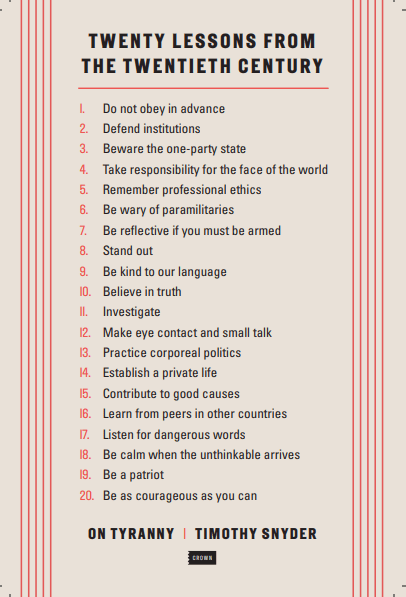
In this book, Snyder draws some uncomfortable lessons from history which have a very current application. He is under no illusions about the problems, but offers some thoughtful hope for facing what needs to be confronted. Snyder is a man who has committed his life to understanding the context of why we tend to war, how to spot the signs and what to do about it. Here are his twenty lessons.


What are the Twenty Lessons?2026-04-10T18:01:22+01:00

Have You Found Reasons to be Cheerful?

Dominic Thomas
April 2026  •  3 min read

Have You Found Reasons to be Cheerful?

It was a wet, cold March evening as I parked up in Hammersmith and walked across the bridge to the Apollo. A now familiar route that I enjoy with my wife since the closure of the bridge in 2019. This evening we were to see David Byrne in concert, an evening of songs that in truth, we weren’t that familiar with. A missing older brother meant that our first exposure to Talking Heads was the whacky, off-piste videos from their 1985 album Little Creatures and tunes that quickly became ear-worms like And She Was and Road to Nowhere, which introduced us to earlier songs Once in A Lifetime (1981) and Burning Down The House (1983).

The oddity of David Byrne amused me at the time, but I wasn’t in a place to be intrigued enough by his messages at the time; fun tunes but little else. As I’ve aged, read more and become more engaged with difference as a way of making sense of the world, Byrne has come to be a rather engaging subversive optimist, someone who points to the absurd and causes us to think again.

Optimism is needed by all investors, there is little point in investing in future growth if you don’t really believe in much of a future and at the moment, that sense of optimism is being severely challenged by the lunatics and sycophants in the White House. Our once reliable, thoughtful, intelligent allies have reverted to the very worst of failing school bullies. The Trump administration and the couldn’t-care-less way in which they brutally treat people and the planet is deeply depressing. I wake most days hoping for news of his arrest or end, and within the week he has managed to dig even deeper into the depths of depravity.

So I seek out stories of hope, taking minor actions (reading, discussing, writing and protesting) to counteract the mainstream narratives. To make a stand for decency and our sole inhabitable planet. Some days it is harder to do than others. When I meet with clients, the sentiments expressed are of the same exasperation. I have come to rediscover people like Byrne who provide some respite and relief and of course a genuine sense that most people are actually decent, not complicit in a march towards fascism, but struggling to cope with the overwhelming amount of chaos and stupidity on display not simply in the US, but here in the UK and around the world.

Byrne also gives me hope as he turns 74 in May and whilst having some breaks from public attention, has been relentless in his creativity. Byrne took inspiration from Ian Dury (yes the hit me with your rhythm stick, Dury) title Reasons to Be Cheerful (1979) and founded an organisation of the same name which provides stories from around the world that most people would find hopeful. He attempts to counteract the mainstream narratives of division and hatred, building a sense of togetherness and an appreciation for the beauty of life and our planet. So whilst the media and the US regime probably makes many of us feel both despair and disbelief, there are, thankfully many billions of us who have reasons to be cheerful. As you may have read or heard me say, I encourage clients to “tune out the noise” by which I mean – try not to listen to the news which leans towards pessimism and strife and gets you living in a state of permanent anxiety about the future and your portfolio. We never hear news like “billions wiped ON to the market this week”. Of course we all need to be informed, but I think careful selection of our choice of media is important, and sadly the traditional forms appear to be considerably compromised under any substantive inspection. Indeed, we have witnessed the Trump administration threaten, cancel and mock journalists, actual news stations, comedians and frankly anyone who challenges their lies.

So you may find it helpful to have a look at Byrne’s organisation and perhaps put some music on and dance. He danced and performed on the very large Hammersmith stage for a solid two hours – no small feat for a man of 73.

Have You Found Reasons to be Cheerful?2026-04-02T10:07:35+01:00
Go to Top