
Who is on your list?

Dominic Thomas
Post written: Aug 2026  •  Published: Aug 2026
3 min read

Who is on your list?

I recently went to see a new(ish) musical of the Japanese manga story “Death Note” at the Barbican, Directed by Stephen Whitson. It’s an imaginative story and a decent new musical, with a high level of energy and a fairly incredible set and large ensemble cast.

The story was originally written by Tsugumi Obha and drawn for the anime manga series by Takeshi Obata. The premise is perhaps one of the oldest struggles that we mortals wrestle with – is there any justice? Since the dawn of time, life has been “unfair” and “unjust”. Myth, religion and story all tend to wrestle with and explain this very fundamental cry of woe in a world that frequently feels unfair. Even Jesus observes in the sermon on the mount:

“He causes his sun to rise on the evil and the good, and sends rain on the righteous and the unrighteous” (Matthew 5:45)

I’m not too familiar with Japanese myths or the faiths of Shinto, Buddhism or the general cultural mix, though I do find it intriguing. So quite how old the notion of other worldly gods and demons goes back is somewhat illusive. Obha introduces us to several “death demons” or Shinigami. They carry a book, into which they mercilessly play with humanity, the random writing of a name results in that persons death. Somewhat bored with his existence, one Shinigami called Ryuk, deliberately drops his book before a student with a clear sense of right and wrong called Light, who quickly learns that he can serve justice far faster than his father Soichiro, who is head of Japan’s National Police Agency. His “success” and liberal use leads to inevitable questions about the validity of his own version of “justice”.

It’s an enjoyable musical, with some good songs (music by Frank Wildhorn). I suspect that most of the audience quickly wonder whose name they might write down in the book, to be very candid, my list is very long and easy to produce, an evident flaw in my own character, which is probably the point.

We all want the world to be considerably better and much fairer, each day we are confronted with challenges to our sense of fairness, often in the small details, but invariably in big “news” stories of the day. However much you try, its inescapable, much like death. World culture is full of figures representing death, some are rather more palatable than others. Hades to Azreal. I was quite fond of “Death” in the Sandman, another “graphic novel”. Death was warm, welcoming, caring, compassionate and rather beautiful (played by Kirby Howell-Baptiste in the 2022 television series “The Sandman”).

Anyway, justice, as we know is often in short supply, illusive. As consumers we have the opportunity to exercise a moderate amount of consumer power against companies whose actions and behaviours we oppose. At a political level, we get to vote, as consumers we get to spend (or withhold spending) and perhaps vote at AGMs as many protestors attempt to do. Often the challenge feels enormous, perhaps overwhelming, but we are reminded from history that even small acts of resistance can bring about significant change.

Sadly I do not possess the ability to grant extended life and cure life threatening or life taking conditions. None of us escape death, as ever we are reminded and called to live well, on our own terms and to live justly, fairly – whatever that may mean for you. Your financial plan is best when designed around your values, so be aware that we expect this to be an ongoing discussion between us, without judgement about your views on life and death and the meaning ascribed to them. We can also discuss how your views on social issues like climate, sustainability, governance etc can be applied to your investments. Nothing will be “perfect” because you and I are not, neither is the world.

Here is the trailer for Death Note the Musical showing at The Barbican until 12 September 2026. I think it fair to say, audiences would typically be younger than “normal” which is a good thing to encourage people into theatres.

I’m sorry, but I simply cannot resist sharing this rather beautiful clip from the Netflix series “The Sandman”. Here are Kirby Howell-Baptiste (Death) and Tom Sturridge (Dream).

The Sandman (2022-2025), Created by David Goyer, Neil Gaiman and Allan Heinberg. Starring Tom Sturrige. Produced by Netflix

Your values for your financial plan. It’s your life.

References:

Death Note The Musical: https://deathnotethemusical.com/

Tickets at the Barbican: https://www.barbican.org.uk/whats-on/2026/event/death-note-the-musical

The Sandman: https://www.imdb.com/title/tt1751634/

What we do: https://www.solomonsifa.co.uk/what-we-do/
Have a question or feedback about this article?

Please share this with a friend

Who is on your list?2026-08-21T15:16:34+01:00

What is it to be known?

Dominic Thomas
Post written: March 2026  •  Published: July 2026
3 min read

What is it to be known?

Most of us wish to live in harmony with our neighbours, as we all know there are various politicians and political parties who clearly attempt to find reasons to instil a sense of difference and division. The aim is not to harmonise, but to homogenise. What is disappointing (understatement) is the way in which media outlets, once respectable and respectful now collude to promote outrage and hatred. The coverage of the by-election won by Hannah Spencer both before and after the actual local vote is an appalling display of ignorance.

Story is important, it’s how we reflect who we are and how we hope to be. I was at the preview of the opening of Our Town at the wonderful local Rose Theatre in Kingston. The American play by Thornton Wilder (1938) has been described as a great American play. The central theme is that life is brief and we all fail to appreciate the joy of the mundane or ordinary.

Set in a fictional town Grovers Corners in the north eastern US State of New Hampshire touching the Canadian border, the region was home to natives like the Abenaki, until the Europeans arrived in the 1600s. The area renamed as New Hampshire in 1629. It is 1901 and only 35 years since the end of slavery, but of course not segregation. As I hadn’t read the programme notes prior to the performance I found Director Francesca Goodridge’s choice to set it in Wales yet to retain all the American names, terms and social icons whilst delivered as though set in the Rhonda valley to be an odd one.

It caused me to wonder how the Welsh might consider an affinity with New Hampshire. We can acknowledge the wars between the “English” and “Welsh” or at least Saxons since records began in the 5th century, a vast amount history and fighting over the control of land, with the first war of Welsh independence in 1277.

You may think I’m projecting more than is there, but surely we are all living through a period when misplaced nostalgia and a sense of historic cultural identity are very much being used to divide people around who truly ‘belongs’. So this seems like an odd and deliberate choice, to once again extol virtues that didn’t exist and the cultural norms based on little of substance, sharing the commonality of a lack of thoughtfulness.

Wilder exposes us to the competing churches, of essentially the same religion, division already calcified and formalised, which is certainly a Welsh experience. The socially approved singular pathway to happiness of marriage, children and death. These are currently politicised, with Reform and misogynists contemplating taxing childless women (all a part of the eugenics and replacement theory nonsense) and a vile toxic male culture fostered online by some dreadful examples of ‘men’ who seem eager to tell women how to be and what families are, whilst never having one or abandoning those that they have.

Central characters George and Emily marry, but with a sense of forced urgency passed off as nerves, seeming to lack time for a thoughtful discussion about what each might want from life, but to simply follow the path set down by their ancestors, with George taking over his uncle’s farm rather than heading off to further education (How Green is My Valley? anyone…) So I’m not sure if Goodridge was merely pointing to a smalltown mentality and the commonly shared experiences of life – but why not change the terms? Isn’t the point of a common experience to relate rather than replicate? There is a sense in which Wilder seems to bemoan the changes ushered by progress, the arrival of the motor car and locking doors, the growth of the town yet the sense of familiarity as those who leave return and almost everyone stays. The newsworthy gossip and the suggestion that Policing was once friendly and amenable and newspapers were fair.  It is these nostalgic notions that politicians attempt to exploit.

Wilder, like all of us, a product of his time, doesn’t appear to have anyone in his fictional town of any other ethnicity. There is an ability to witness depression, hardship and struggle, dress it up as stoicism and resilience whilst ignoring any attempt to engage, remedy and repair; failing to encourage thoughtful different approaches. To my mind this isn’t a very Welsh approach, a nation that has protested and fought hard for positive, inclusive social change. The community of Grovers Corners seems to be pretending that everyone is happy, as Mrs Soames exclaims, “I’m sure they’ll be happy. I always say: happiness, that’s the great thing! The important thing is to be happy.”

A Director makes choices, the cast all worked extremely hard on their execution of a precise and energetic living set, but I found the play to be reductionist and overly simplistic. Michael Sheen plays the Stage Manager, a role that’s been performed by Henry Fonda, Paul Newman and Alan Alda and he is a wonderful actor (and a very decent human).  I’m just not convinced that the play is really terribly worthy.

Your financial plan is a reflection of your values and is arguably a record of your story, full of major and minor events, but any good plan starting with the end in mind – the goal to make your own meaningful life, rather than meaning made from it by others. Context is everything, adapting to circumstance and reality whilst holding firm to values that actually matter to you rather than social expectations. Whilst Wilder reminds us of the brevity of life and to appreciate the time we have, I think he fails to convey the complexity, the nuance of the struggle of living in the present whilst having a mind for the future. In my opinion, It’s a Wonderful Life (1946) is a far better take on the same ideas.

Anyway, as ever, make up your own mind. Here is the promotional trailer.

Have a question or feedback about this article?

Please share this with a friend

What is it to be known?2026-07-24T16:54:25+01:00

What are the Twenty Lessons?

Dominic Thomas
April 2026  •  3 min read

What are the Twenty Lessons?

Most marketing people will advocate using a number as a way to increase engagement – seven ways to improve your marketing, five things you need to know about… and so on, as humans we seem to love a list, preferably a short one that’s a prime number. Timothy Snyder’s book On Tyranny has the subtitle “Twenty Lessons from the Twentieth Century” which caught my eye as worth my attention.

There is no denying that we live in challenging times, where truth has become harder to reach and there are so many powerful vested interests determined to treat us like mushrooms, kept in the dark and fed on…

Truth is a big deal in financial planning. It’s the partner of trust, without both – any advice provided needs some considerable investigation. My sector is not known for its transparency, trust or grasp of truth. We have powerful regulation which attempts to ensure that we are. Yet, over the last two decades in particular, I can attest to the fact that many of the advisers I meet are decent people, who are keen to share best practice, have a degree of vulnerability about their need to improve knowledge and admit that they don’t know everything. Most of those I meet, I believe to be trustworthy and genuinely want to help both advisers and clients to make money and investing better understood.

There is even a software package called “Truth” that aims to reveal the truth of your ambitions for your financial decisions.

Sadly, not all are truthful, many will claim to provide financial planning, but are really selling investments, building the engine before even knowing what is required. It’s not easy to tell from a website or indeed when you meet them. There are still a few who are only interested in extracting your wealth for their own benefit and they are occasionally caught.

Aside from the charlatans, who I can do little about, other than pay my regulatory fees which cover their failings and deal with the consequences of mistrust, my main concern is a lack of thinking. Not about products and tax legislation, or indeed sensible solutions, but the eagerness to embrace anything that appears to save time. It is easy not to think, to simply accept narratives of large, powerful players or persona’s and what they say from their platform.

It seems to me that good financial planning is all about helping uncover your values and helping you to achieve and maintain your lifestyle. The one you really want, not the one that vacuous individuals display for you to envy and strive for. All choices come with a consequence and there is a price for every decision – who you love, where you work, live, what you eat, how you exercise, what you read and so on. To pretend that political decisions have no bearing on these things is to fail to appreciate the fragility of the freedoms you currently enjoy, which are certainly under siege. The belief that taxes are always bad, that there are those who don’t deserve help, that we are all ‘self-made’ and need a heavy shot of ‘resilience’, is to miss the point and purpose of what it is to live as a human in a thriving, peaceful community, To be critical is not the same as to criticise.

We can all point to problems, but the real skill is to address root causes, invariably this is envy and greed. Something that is on constant display in our scrolling. Add in a dose of fear and mistrust, a sprinkling of inflammatory words and the rabbit hole opens up to swallow, perhaps consume.

In the context of a ‘good life’, we need a good society and a functioning democracy; something that it seems many advisers forget as they chastise yet another Chancellor whilst failing to pause to consider the source of their information. None of us get it right all the time, but an attitude of thoughtful reflection about vested interests is one that I encourage.

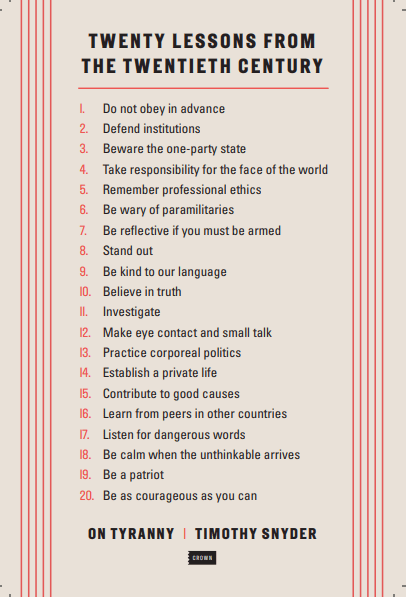
In this book, Snyder draws some uncomfortable lessons from history which have a very current application. He is under no illusions about the problems, but offers some thoughtful hope for facing what needs to be confronted. Snyder is a man who has committed his life to understanding the context of why we tend to war, how to spot the signs and what to do about it. Here are his twenty lessons.


What are the Twenty Lessons?2026-04-10T18:01:22+01:00
Go to Top