Was this the biggest moment of the year?

Dominic Thomas
Post written: March 2026  •  Post published: May 2026
4 min read

Was this the biggest moment of the year?

We are all aware that all is not well in our own nation. You are right, society does need to change, but possibly not for the reasons you think. This is a political piece, it may offend you, that is not my intention.

As yet another person is murdered by ICE, and the Trump Government lie about it, attempting to justify extreme violence towards an ordinary person like you and me, calling the individual a domestic terrorist (again) as part of their plan to remove opposition or dissenting voices through intimidation, arrest and execution.

It is the total lack of remorse, accountability or integrity that is displayed. These people are who they show themselves to be, as much as some wish to pretend otherwise, they are fascists and they won’t stop grabbing power and wealth until they are ended and it won’t be by “democratic means”.

Here in the UK, thankfully we don’t have anything like the same level of weapons or guns, but remember the Reform leader and his candidates invariably support Trump or Putin in their authoritarian approach. They don’t condemn heinous crimes by them, in fact they want their own version, they want to copy it and they push false narratives about anyone not white. If anything, their push for Brexit and independence has made us more vulnerable and isolated.

I understand why poor people might feel unheard, disrespected, ignored and don’t seem to have many prospects in life, want change – but they are being lied to, that this has anything to do with skin colour or religion or people fleeing war, starvation and persecution. How things appear often isn’t how they actually are. It is the structure of society and the truly wealthy and multinational companies not contributing a fair share to the social pot. The marches and the flags are attempts to be seen, but are also designed to intimidate and threaten. This is deeply wrong and racist and not what Britain is. Our flag should be something to gather around in celebration of what we are today, not stolen by white nationalists trying to tell us what we are not. Epsom take note.

Those who are ‘well off’ (our clients) have money and financial security, with connections and a sense of place in society. Many of you pay a lot in tax, some of which I would agree is desperately unfair. However, as noted in Spotlight, tax rates are actually lower than they were 40 years ago. Our top rate of tax is 45%.

None of us like to see our money wasted, yes it is easy to spend other people’s money, yes you are not thanked properly, yes we have to acknowledge that you need to look after your own, the tax system isn’t good, it’s far from simple and far from perfect, I know that very well, but it’s that which needs to change, not simply to cut away from those who need our support so that we can have a thriving and just society.

We need entrepreneurs who create jobs and wealth and are encouraged to do so, but this should not be at the expense of people. Nobody needs a billion, nobody. Those who feel hard done by that make a lot of noise in the media really should reassess their good fortune. We also need artists, poets, carers, thinkers, therapists, medics, engineers, designers and community leaders to inspire us to better. We need proper investigative journalists to bring corruption to light and the law to act justly. We need each other – wasn’t that the learned message from the pandemic?

You know that London isn’t a war zone, that actually it’s a thriving city, in fact you prosper as it does. The only shame I feel about London is the fact that we have homeless people. They need help. We are told that we pay tax to support lazy people, yet it’s these people (people like me and you) who can largely select our hours of work for a good income. Yet the irony is that these beliefs and arguments are very reductive lazy thinking.  Granted, we may have worked hard, but we had opportunities, tools, sufficient encouragement, health and even the setbacks were things we could overcome, we don’t work 2 or 3 jobs with vile employers just to be able to feed ourselves. We have not lost any rights or advantages other than those reduced by Brexit.

Racism isn’t always deliberate or obvious, it’s born through the gradual acceptance and accumulation of bad data. We all have unconscious biases and fears. It is the continual work of character formation that helps understand ourselves and change. Often we need confronting about what we presume. It doesn’t help when we are fed easy answers to difficult problems, (who doesn’t want easy solutions!) by people who have no intention of understanding, but merely regurgitating their own badly formed opinions.

Racists eventually hate any minority in any form because they are afraid of difference. Just because Reform has some women and some non-whites in view, does not mean that they want this, as ever, it’s a means to an end (power) and if once established, you will see the same regressive policies as in the US…(yes Donald Trump does the window dressing with plastic women, he’s a salesman) which at best is a gradual removal of economic and social independence, dismantling democracy, but ends with no jobs for women, increasingly reducing their freedoms (no say, no vote, no personal property) and of course removal of anyone who isn’t on board with the white replacement nonsense. This is deceitfully packaged at true patriotism, or traditional values or even ‘Christian’. This is what far right is. Any male with a mother, sister, aunt, wife, daughter, niece or female friend should think very carefully.

There will inevitably come a point where I won’t be able to see the good in those whose default position is to defend the indefensible racist garbage, where people are viewed as non-people.

These are dreadful individuals, vile – yes that’s Trump, Farage, Musk, Theil, Fox and those that platform them and their inner circle. They don’t care about society and certainly don’t care about you and me.

There is a heap of evidence about all this, it is deeply concerning and pretending that it’s not the same here is naive – look at the way American democracy is being rapidly destroyed, listen to Mark Carney. As he said in Davos:

“We know the old order is not coming back. We shouldn’t mourn it. Nostalgia is not a strategy, but we believe that from the fracture, we can build something bigger, better, stronger, more just. This is the task of the middle powers, the countries that have the most to lose from a world of fortresses and most to gain from genuine cooperation.”

Of course, Trump attempted to chastise Carney in his own ‘speech’, but as ever, he can barely string a few words together coherently. As Greenpeace say, if you are not part of the solution, you are part of the problem. Hating is never a solution and we have a diverse group of clients who we like and serve.

Carney video: https://youtu.be/JnE2HTfDivQ?si=dz7qygn4Dfmims0W

Was this the biggest moment of the year?2026-05-03T22:04:07+01:00

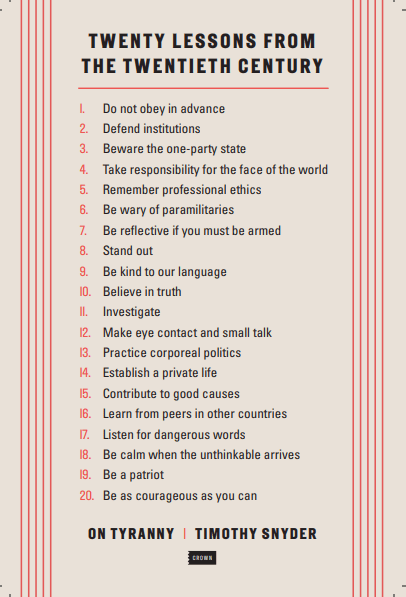
What are the Twenty Lessons?

Dominic Thomas
April 2026  •  3 min read

What are the Twenty Lessons?

Most marketing people will advocate using a number as a way to increase engagement – seven ways to improve your marketing, five things you need to know about… and so on, as humans we seem to love a list, preferably a short one that’s a prime number. Timothy Snyder’s book On Tyranny has the subtitle “Twenty Lessons from the Twentieth Century” which caught my eye as worth my attention.

There is no denying that we live in challenging times, where truth has become harder to reach and there are so many powerful vested interests determined to treat us like mushrooms, kept in the dark and fed on…

Truth is a big deal in financial planning. It’s the partner of trust, without both – any advice provided needs some considerable investigation. My sector is not known for its transparency, trust or grasp of truth. We have powerful regulation which attempts to ensure that we are. Yet, over the last two decades in particular, I can attest to the fact that many of the advisers I meet are decent people, who are keen to share best practice, have a degree of vulnerability about their need to improve knowledge and admit that they don’t know everything. Most of those I meet, I believe to be trustworthy and genuinely want to help both advisers and clients to make money and investing better understood.

There is even a software package called “Truth” that aims to reveal the truth of your ambitions for your financial decisions.

Sadly, not all are truthful, many will claim to provide financial planning, but are really selling investments, building the engine before even knowing what is required. It’s not easy to tell from a website or indeed when you meet them. There are still a few who are only interested in extracting your wealth for their own benefit and they are occasionally caught.

Aside from the charlatans, who I can do little about, other than pay my regulatory fees which cover their failings and deal with the consequences of mistrust, my main concern is a lack of thinking. Not about products and tax legislation, or indeed sensible solutions, but the eagerness to embrace anything that appears to save time. It is easy not to think, to simply accept narratives of large, powerful players or persona’s and what they say from their platform.

It seems to me that good financial planning is all about helping uncover your values and helping you to achieve and maintain your lifestyle. The one you really want, not the one that vacuous individuals display for you to envy and strive for. All choices come with a consequence and there is a price for every decision – who you love, where you work, live, what you eat, how you exercise, what you read and so on. To pretend that political decisions have no bearing on these things is to fail to appreciate the fragility of the freedoms you currently enjoy, which are certainly under siege. The belief that taxes are always bad, that there are those who don’t deserve help, that we are all ‘self-made’ and need a heavy shot of ‘resilience’, is to miss the point and purpose of what it is to live as a human in a thriving, peaceful community, To be critical is not the same as to criticise.

We can all point to problems, but the real skill is to address root causes, invariably this is envy and greed. Something that is on constant display in our scrolling. Add in a dose of fear and mistrust, a sprinkling of inflammatory words and the rabbit hole opens up to swallow, perhaps consume.

In the context of a ‘good life’, we need a good society and a functioning democracy; something that it seems many advisers forget as they chastise yet another Chancellor whilst failing to pause to consider the source of their information. None of us get it right all the time, but an attitude of thoughtful reflection about vested interests is one that I encourage.

In this book, Snyder draws some uncomfortable lessons from history which have a very current application. He is under no illusions about the problems, but offers some thoughtful hope for facing what needs to be confronted. Snyder is a man who has committed his life to understanding the context of why we tend to war, how to spot the signs and what to do about it. Here are his twenty lessons.


What are the Twenty Lessons?2026-04-10T18:01:22+01:00

Have You Found Reasons to be Cheerful?

Dominic Thomas
April 2026  •  3 min read

Have You Found Reasons to be Cheerful?

It was a wet, cold March evening as I parked up in Hammersmith and walked across the bridge to the Apollo. A now familiar route that I enjoy with my wife since the closure of the bridge in 2019. This evening we were to see David Byrne in concert, an evening of songs that in truth, we weren’t that familiar with. A missing older brother meant that our first exposure to Talking Heads was the whacky, off-piste videos from their 1985 album Little Creatures and tunes that quickly became ear-worms like And She Was and Road to Nowhere, which introduced us to earlier songs Once in A Lifetime (1981) and Burning Down The House (1983).

The oddity of David Byrne amused me at the time, but I wasn’t in a place to be intrigued enough by his messages at the time; fun tunes but little else. As I’ve aged, read more and become more engaged with difference as a way of making sense of the world, Byrne has come to be a rather engaging subversive optimist, someone who points to the absurd and causes us to think again.

Optimism is needed by all investors, there is little point in investing in future growth if you don’t really believe in much of a future and at the moment, that sense of optimism is being severely challenged by the lunatics and sycophants in the White House. Our once reliable, thoughtful, intelligent allies have reverted to the very worst of failing school bullies. The Trump administration and the couldn’t-care-less way in which they brutally treat people and the planet is deeply depressing. I wake most days hoping for news of his arrest or end, and within the week he has managed to dig even deeper into the depths of depravity.

So I seek out stories of hope, taking minor actions (reading, discussing, writing and protesting) to counteract the mainstream narratives. To make a stand for decency and our sole inhabitable planet. Some days it is harder to do than others. When I meet with clients, the sentiments expressed are of the same exasperation. I have come to rediscover people like Byrne who provide some respite and relief and of course a genuine sense that most people are actually decent, not complicit in a march towards fascism, but struggling to cope with the overwhelming amount of chaos and stupidity on display not simply in the US, but here in the UK and around the world.

Byrne also gives me hope as he turns 74 in May and whilst having some breaks from public attention, has been relentless in his creativity. Byrne took inspiration from Ian Dury (yes the hit me with your rhythm stick, Dury) title Reasons to Be Cheerful (1979) and founded an organisation of the same name which provides stories from around the world that most people would find hopeful. He attempts to counteract the mainstream narratives of division and hatred, building a sense of togetherness and an appreciation for the beauty of life and our planet. So whilst the media and the US regime probably makes many of us feel both despair and disbelief, there are, thankfully many billions of us who have reasons to be cheerful. As you may have read or heard me say, I encourage clients to “tune out the noise” by which I mean – try not to listen to the news which leans towards pessimism and strife and gets you living in a state of permanent anxiety about the future and your portfolio. We never hear news like “billions wiped ON to the market this week”. Of course we all need to be informed, but I think careful selection of our choice of media is important, and sadly the traditional forms appear to be considerably compromised under any substantive inspection. Indeed, we have witnessed the Trump administration threaten, cancel and mock journalists, actual news stations, comedians and frankly anyone who challenges their lies.

So you may find it helpful to have a look at Byrne’s organisation and perhaps put some music on and dance. He danced and performed on the very large Hammersmith stage for a solid two hours – no small feat for a man of 73.

Have You Found Reasons to be Cheerful?2026-04-02T10:07:35+01:00

What profits?

Dominic Thomas
March 2026  •  3 min read

What profits?

I wonder if you have seen the recent BBC series Small Prophets written and directed by MacKenzie Crook. To be honest, I’m usually very wary of “written and directed by” – often it’s not a good combination, but here Crook has built upon the charming Detectorists (2014-2022) to deliver another feel good, amusing and poignant comedy that will leave a smile on your face.

This is a tale of the extraordinary in the very ordinary, an exploration of grief and hope, with a dash of wry wit and some daft divine magic. I won’t spoil the plot as it’s a series with a probable follow up.

In essence Michael Sleep (Pearce Quigley) is living with the knowledge that the love of his life, Clea, has disappeared. Most presume she took her own life with her car being found on the Severn bridge. He is waiting for her return as he goes about his mundane, ordinary life as a member of staff at the local DIY superstore. He visits his father Brian (Michael Palin) each day who is now living in a local care home. Apples don’t fall far from the tree, both are curious and have sharp minds, though Brian’s is now failing him.

Brian has the ludicrous certainty that he can grow truth-saying spirits (Homunculi) in a jar of rainwater, who have to speak truth. This, Brian asserts, will lay to rest the question of Clea’s mortality. The fantastical is set against the backdrop of the plainly defiant ordinariness of a fairly bland life. Yet we quickly witness many moments of magic in the ordinary and are reminded of our humanity and ability to connect and relate to one another with grace, patience and goodwill.

The contrasting lives and experiences are set against one another, the minimalist nosy neighbour who can barely tolerate Michael’s chaotic overgrown garden. The ‘brother-in-law’ who has lost everything as an adult, yet can find his childhood being restored. The lost treasure within our clutter. The hopes of superstore staff who dream of careers whilst serving others intent on their own DIY, most being oblivious to all that is in front of them (bucket scene) and missing the mystery and magic within the ordinary.

So what? It is so easy for us to forget the basics of life, to connect and be connected, to pause, to think and to thank. The talent and skill of genuinely caring. To be curious and to allow our curiosity to explore the mundane to the mystical. It reminds me of what I sometimes hear from clients “we have a fairly ordinary modest lifestyle” as though I may judge your life choices or maybe perhaps you aren’t sure if you are quite rich or ambitious enough.

The point of great financial planning is to live on your terms, not those of others. Whilst it may not be mathematically ‘best’ to repay your mortgage, the sense of liberation felt by doing so is priceless for many. To be able to live and give generously, on your own terms, without strings attached and to be able to see your legacy taking shape during your lifetime. These are things that are ordinary yet deeply fulfilling and are the true profits of a rich life.

The short 6-episode series, which I watched on the BBC iPlayer was a great way to end an evening, that may otherwise have been punctuated by a stream of “nothing good” on social media. I agree with those who gave it the high score of 8.5/10 on IMDB. Here is the trailer.

What profits?2026-03-27T15:01:26+00:00

What is Trust?

Dominic Thomas
March 2026  •  3 min read

What is Trust?

At the heart of every good relationship is trust; when it is broken, the relationship will struggle. Sometimes it is possible to repair it, often it is not. A recent event I attended in London for financial planners offered up a talk by Rachel Botsman, author of What’s Mine Is Yours: The Rise of Collaborative Consumption (2010) a provocative title if ever there was, and more recently Who Can You Trust (2017) and more recently still How to Trust and be Trusted (2025).  I have not yet read her books. She is a celebrated podcaster, lecturer at Oxford University and with a Fine Arts Degree, an artist. Significantly she is a “global authority on trust” though quite what this is based on is unclear to me.

Anyway, she provided an interesting talk, some challenges and posed the argument that managing risk is not the same as managing trust and many financial advisers think they are doing one, whilst actually doing the other.

She described these issues as two lenses – risk being about certainty, control, compliance and protection, whilst the lens of trust being uncertainty, confidence, empowerment and possibility. She made some really insightful points about what advisers might do to help our clients reduce or understand risk, whilst also improving trust. In essence, this came down to capability (competence and reliability) fused with character (integrity and empathy).

There were some good lessons that I shall think on and attempt to shape for your benefit. As ever, I tend to be circumspect about what anyone on a stage or platform tells an audience. I was perplexed when she posed a couple of questions. Firstly, she put up three logos – Tesla, Meta and ChatGPT and asked the conference hall delegates to applaud for which they thought was the most trustworthy of the three.

Then she put the images of the CEOs of the same companies (Musk, Zuckerberg and Altman – three white men) and asked us to boo for the one we felt least trustworthy.

I can only speak for myself, but none of these men strike me as remotely trustworthy. They are all billionaires and have well documented histories of breaches of trust and legality, seemingly appearing to be above the law. It may not surprise you that I booed rather loudly for Elon Musk, when Botsman returned to ask people why they had made their selection. As you can imagine, I had a few very choice words to say on the topic. There were a few tuts from my 400 peers (quite a lot of them are Tesla ‘owners’) and she simply said “I was hoping not to get political”.

Whether you agree with my opinion of him or not, I don’t think I brought the politics into the room, it was already quite deliberately there. Maybe I misunderstood the assignment (it wouldn’t be the first time). Anyway, I could have said – well I don’t like him because he bought Twitter and made it a mouthpiece for extremism. That he won’t disable or remove the ability of his AI Grok to turn pictures of you and yours into pornography. I could mention his funding of far-right political parties around the world and here in the UK, or his many misogynistic statements, or replacement theory, his involvement with Trump and short-sighted arrogance with his childish ‘slash and burn’ DOGE antics. He appears to use his own children as human shields and manages to persuade women to have more with him, treating them like transactions. There are questions about his technological involvement in elections and despite his vast wealth, he uses it simply to fund excess and rocket tests rather than solving real problems here on earth. He complains about immigrants, despite being essentially a white South African that never opposed apartheid and is now in permanent exile. No I don’t like him and his interference, lies and utterly inappropriate commentary about “the state of Britain”. Yes I did see him do a Nazi salute and refuse to pretend it didn’t happen. It seems that the biggest ‘sin’ these days is naming things (like racism) as they are rather than actually being so.

So, ok – maybe I did bring the politics to the forefront, but I didn’t bring them into the presentation.

But this is about trust and integrity right? I think the ability to challenge narratives with the aim of shining a light on truth wherever it leads and however exposing it may be, are part of having integrity.

Rachel offers up a number of tests that we can try out exposing how our search for familiarity may offer up inaccurate trust signals, but that these are foundational in our early development. We look for familiarity in others to help us trust, backgrounds and appearance (even looking similar to ourselves) all play a part in this and form an unhelpful confirmation and desirability bias that facilitates trust, without any ‘real’ information. This also goes to the heart of AI and the trust being placed in systems that regurgitate familiar, not necessarily truthful answers.

Interesting though. I wonder what you think?  I’m genuinely curious.

Anyway, I will be adding to Rachel’s coffers at some point to read her work in more detail, it’s certainly interesting and relevant for the moment and she is an engaging communicator.

Ref: https://www.rachelbotsman.com/

https://www.sbs.ox.ac.uk/about-us/people/rachel-botsman

What is Trust?2026-03-06T11:09:26+00:00

The integrity of a sandwich

Dominic Thomas
Nov 2023  •  3 min read

The integrity of a sandwich

We all remember the credit crunch and the general ill-feeling towards bankers, perhaps you missed the story of the credit munch? Whilst the Credit Crunch lasted, well…truthfully the long term ramifications are still with us, but it really ‘started’ (became apparent) in 2007. The credit munch took place in July 2022 and lasted about a year.

A financial crime analyst with Citibank was on a business trip to Amsterdam. It appears that Mr Fekete forgot (see what I did there?) to declare that his partner joined him on the trip. They put a very modest sandwich lunch on business expenses, claiming £86.70 of the £100 daily allowance.

Mr Fekete’s managing supervisor queried his submission and wondered whether Mr Fekete had indeed really consumed two sandwiches and coffees. Here I must claim that my own personal battle with a good sandwich does not immediately conclude that such an appetite is implausible; but merely a little excessive… mea culpa! Anyhow, Mr Fekete didn’t confess that it wasn’t simply him and that he had in fact shared lunch with his partner. He was dismissed for breaking company policy of claiming expenses for his partner as though his own. In essence, Citibank concluded that he was dishonest.

A series of emails providing some “optimistic circumstantial rationale” for his forgetfulness was not accepted by a judge, as Mr Fekete took his employer to an employment tribunal for unfair dismissal. It seems that the judge agreed with Citibank that the employee should have owned up when challenged and then been given the opportunity to correct his error of judgement.

The judge said “I am satisfied that even if the expense claim had been filed under a misunderstanding, there was an obligation upon the claimant to own up and rectify the position at the first opportunity. I accept that the respondent requires a commitment to honesty from its employees.”

So, it seems that Citibank are holding their employees accountable and expect honesty from them. Perhaps this is a sea-change at the Bank and within the sector. After all, it was only last year that Citigroup were fined £12.5m for failing to properly implement market abuse regulation (which was a discount of 30% for admitting failure). In the context of all the ills of Banking, I  suspect you will agree that this all seems rather trivial in comparison to a Credit Crunch, LIBOR fixing and so on. However it does speak to a culture of integrity and when your employed job is upholding it, it is hard to fathom why on earth Fekete didn’t simply own up.

I’m reminded of Richard III shouting “A horse, a horse! my kingdom for a horse!”. How little it takes to lose everything. That was some meal deal.

The integrity of a sandwich2023-12-04T12:15:11+00:00

Pension Exit Charges

Pension Exit Charges

I wonder if I can be honest with you about pension exit charges? I freely admit that I probably spend too much time concerning myself with what others within my industry think. I spend a lot of time improving my knowledge and this involves reading both technical papers and opinion. Yet I find myself increasingly perplexed by the comments on industry media outlets.

THIS IS A LONG ITEM, BUT PLEASE STICK WITH ME…

Like it or not, the financial services industry regularly gets berated for being nothing short of self-serving. Often different or indeed competing elements of the spectrum that make up the financial services get lumped together, frankly this is our collective fault for not clearly defining or explaining the differences, invariably made harder by really rather poor regulatory clarity.

However I was utterly exasperated with my peers on yet another comment section within the “trade press”. This concerned the issue of exit penalties on pensions. At the time Mr Cameron, the Prime Minister was expected to outline his frustration with pension companies that apply high exit fees… for the sake of simplicity, let’s call them what they really are – transfer penalties.

Old World not New Model Advisers

The comments appeared in a publication that I respect by Citywire – New Model Adviser, the article written by a very thorough journalist, Will Robbins. The publication aims to high-light good or best practice and aims to help improve the advice sector and thus help achieve better results for the investing public. So one would hope that the readers and their comments are towards the front forward-thinking end of the adviser population.

The King is dead, long live the King

On the topic of exit penalties it seemed to me that commentators reverted to their historic stances as salesmen, not advisers, preferring to defend high penalties rather than lead a revolution to have them scrapped or at least capped.

Investors are being ripped off

Yes it is true that pensions set up were contracts and that contract law is therefore under the microscope…. but there are times to simply admit that enough is enough.  I have seen some horrendous penalties (the difference between the actual value and the transfer value of a pension)… some taking well above 30% of the fund. That is simply not good enough. OK there was a contract, but neither “adviser” nor investor could have anticipated these penalties which have become increasingly pertinent as investors and advisers seek better, more efficient and cost-effective solutions. Something that I regularly do to great effect for our clients.

Analogies have flaws but…

However suggestions that imposing a cap were largely greeted with derision. I was under the impression that it is the advisers job to represent the client, not the pension company and if engaged by them, to seek the most suitable solutions. I would like to think that it is in the collective interest to allow someone to move their money elsewhere with minimal fuss and cost so that it can grow better (hopefully) – and yes it cannot be guaranteed…. at least it cannot be guaranteed in a way that your life is not guaranteed by the protection that the airbags in your 2015 car should deploy if you have an accident, as opposed to your 1986 car that doesn’t have any of the current safety features. Yes you may be maimed or even die in the accident, but which do you think is likely to provide a better journey?

Aren’t we meant to put you, the client first?

In an industry steeped in scandal and mistrust this ought to be an opportunity for pension companies and advisers to put clients interests first. I find this even more frustrating as in reality it is all to do with commission and the lie that advice is free. Old style policies are those that typically paid high levels of commission, which the pension company advanced to the adviser as payment for arranging the pension with them. Of course it didn’t help that some pension companies offered more commission for using them as opposed to others, thus bringing into question the independence of the advice and adviser. If you went to a Tied Agent or Bank, you didn’t even get any option to compare costs…. which was the job of the IFA at the time.

Thinking that is so last century…

This has been going on for years, yet alternative approaches have also been available for those willing to face some truths. In 1999, 16 years ago I formed Solomons, removing commission, charging 1% on any investment or pension product – no matter who… a level playing field. 16 years ago! The regulator eventually caught up and banned commission on investments from 2013 called RDR so since then all advisers have had to charge fees properly.

Vive la revolution

Why does this vex me so? well as someone still in their 40’s I expect and plan to remain advising clients for many years to come, so I’d like to see things improve. I would like to see the standard of advice improve and the number of scandals and complaints decrease… not least because invariably the way compensation works is that those left working within the sector pay the compensation levy, even if they had nothing to do with it. This summer I had yet another regulatory invoice for this levy, an increase of 64% on last year…there comes a point when I and many (thankfully) like me, simply cannot absorb all these costs without jeopardising our own sustainability.

If you are fed up with your pension or not even sure what its worth, please check out my free guide, which  will help you regain control of your pension planning. There ought to be a box below to download this, if not just email me.

Dominic Thomas
Solomons IFA

You can read more articles about Pensions, Wealth Management, Retirement, Investments, Financial Planning and Estate Planning on my blog which gets updated every week. If you would like to talk to me about your personal wealth planning and how we can make you stay wealthier for longer then please get in touch by calling 08000 736 273 or email [email protected]

Pension Exit Charges2023-12-01T12:20:04+00:00
Go to Top