Geopolitics and Market Volatility

Matt Loadwick
Feb 2025  •  3 min read

Geopolitics and Market Volatility

The stability, or otherwise, and volatility of global stock markets can be affected by a number of factors, which can be both economic and political in nature. In terms of economic factors, both UK and US economies are currently experiencing well-documented inflation, the result of rising costs of goods and services. This leads to increased borrowing costs, and to market uncertainty, as investors get spooked by high costs, and have a tendency to wait for prices to drop before investing.

In the UK, a glimmer of light appeared when the rate of inflation dropped by 0.1% in December compared to November, easing the pressure on Chancellor Rachel Reeves, and going some way to improve market confidence as the odds increase of the Bank of England reducing interest rates early this year. That said, it does feel like the current news cycle in the UK will provide reasons to be cheerful one day, followed by reasons to despair on the following, fuelling further volatility as markets react.

Global stock markets are also influenced by geopolitical events, where often the unpredictability surrounding such events can lead to increased volatility. As an example, the Russian invasion of Ukraine resulted in firms that had strong ties to Russia experiencing a significant fall in share prices.

It is also worth pointing out that politics and economics clearly do not exist in a vacuum, with both influencing each other symbiotically – as politicians drive their economic agenda, markets respond accordingly depending on the success (or otherwise) of their policies …

As the 47th President of the United States was sworn in for the second time earlier in January, the world is braced for increasing geopolitical uncertainty with a Trump administration once again at the helm. Indeed, they have taken little time to give us a taste of what is to come over the next four years, creating headlines through divisive policies, such as the proposed mass deportations of illegal immigrants, withdrawal from the Paris climate agreement (compounded by plans to increase drilling for oil to promote as a key US export), pardoning the circa 1,500 Trump supporters who were charged over the 2021 US Capitol riots, and far-fetched rumours (we hope) of an interest in invading Greenland.

Such examples certainly give the impression that this administration may cause something of ‘a bumpy ride’ for markets in the coming years, particularly in the context of ongoing conflicts in the Middle-East and Ukraine. This is reflected in research undertaken by Scottish Widows, which suggests that geopolitics and volatility are likely to be among the top concerns for advisers in 2025.

If at some point you were to watch the value of your investments take a temporary drop, it is only human nature to feel a sense of nervousness. In the face of this expected volatility, we at Solomon’s are here as ever to encourage calm, and to ensure that our clients do not lose sight of the importance of planning for the long term.

Geopolitics and Market Volatility2025-02-10T10:02:08+00:00

The Rule of 72

Dominic Thomas
Dec 2024  •  2 min read

The Rule of 72

In the finance world we sometimes use the rule of 72, in truth it’s mainly for examination questions. The purpose of the rule is to establish how long it would take to double your money given a set investment return.

Those with a keen sense of maths will appreciate that returns are very rarely fixed, so the formula has limitations for real-life application.

So let’s take an example of a cash deposit paying 3% a year

72/3 = 24 (years)

An investment with a return of 9% a year would take  8 years (72/9 = 8).

As we enter 2025, those of you holding cash of £100,000 would need to wait until 2049 to see this become £200,000. For those investing and achieving 9% a year, your £100,000 becomes £200,000 in 2033 and £400,000 by 2041 and £800,000 by 2049.

Now for those of you working within financial services, or if you work for the FCA, I am not suggesting investments are 9% a year, this is merely designed to demonstrate the point of the maths and yes I am ignoring inflation. In this theoretical world with predictable results of compounding annual returns we might observe the values over time as shown below. The orange line being a 3% annual return and 9% being the blue line.

So whilst theoretical, there are obvious inferences. Investments offering low returns are often deemed as having less risk… but less risk of what? In the same way that higher returns are considered higher risk. For most people building wealth over time, holding too much in ‘low risk’ / low growth investments will have a detrimental effect over time.

So the questions you need to consider are the timeframe for your goals and how much you need to allocate towards growth (genuine growth assets).

The Rule of 722025-01-21T15:53:23+00:00

A Widow’s Ruin?

Dominic Thomas
Sept 2024  •  4 min read

A Widow’s Ruin?

The summer often produces plenty of occasions to open a bottle of bubbly as we celebrate various events or are simply enjoying ourselves. Perhaps this summer you have celebrated something, maybe a wedding, an anniversary, a big birthday or one of your family graduating. Champagne is invariably linked with celebration.

Living in the Surrey Hills, a short walk from Denbies, I have come to appreciate some of the English attempts to create Champagne – though of course we cannot call it such as it’s from Surrey not the Champagne region. I’m informed that the geology of the Champagne region of France is shared with Dorking (probably not news to the geologists amongst you). Anyway, perhaps you have your favourite – English, French, Spanish or Italian.

When it comes to naming things properly, I was intrigued by the story of Veuve Cliquot  (in French meaning Widow Cliquot) which has now made the transition from a 2009 book by Mazzeo to a musical and now to film and is being retold at selected cinemas, so may be one to catch at home for most people.

The story is of the woman behind this now historic and luxurious brand. Business owners will relate to some of the struggles that she faced and conquered, not least of which were the weather, Napoleonic wars and general misogyny of the day.  Women will relate, frankly because things have not moved on anything like as much as they should!

Quite how much is fact or fiction isn’t really that important; the messages of the film are there to be taken. Tenacity, optimism, acknowledgement of an inability to control the things you cannot, acceptance of the reality of things; stoic fortitude ushers in change by remaining true to principles and high standards. This is all beginning to sound a lot like the qualities that investors need to attain isn’t it.

I did not know the story and I was unaware of the meaning of ‘veuve’ – my O’ Level French has never been tested beyond very enjoyable trips to France.  Whilst I am a regular consumer of wine, I wouldn’t regard myself as an expert; but I have come to enjoy Champagne over the years!

What I find generally inspiring are the stories behind many well-known companies. The original ‘Founder Story’ has been an often neglected element of most marketing, including our own.  As Solomon’s celebrated our silver anniversary this summer, I was reminded that perhaps this is a little more than simply reminiscing. Of course there are many Founders and characters that are entirely unpleasant, which is often a subjective opinion, but sometimes … well not so much. Today, we are in a highly inter-connected world and we are all aware of particular billionaires or multimillionaires who are lacking any of the attributes that demonstrate much humanity.

I will never meet Barbe-Nicole Ponsardin who died in 1866 and I am highly unlikely to meet Mr Musk; but I have formed an opinion about both, based on the values that I hold. Yet this is perhaps the heart of the complexity of ethical, socially responsible or ESG investing. The world is complex, people are many things. To some, holding shares in an alcoholic beverage company is unethical, yet holding shares in Twitter (or whatever he wants to call it) invariably will not be screened out of portfolios.  The focus is based on the product rather than those behind them.

How we use or minds, tools, resources, time and money are our unique choices and important to each of us being true to ourselves – however many selves we might each be, have or become. I can tell you that I shall be favouring (revealing my biases) the widow’s Champagne. A young woman who was widowed at 27, took on an embryonic vineyard, battled social norms and obstacles, fought for her own financial independence, eventually turning it into a legacy of quality, used in moments of joy and celebration. Now, that’s something that I think is worthwhile.

Here is a trailer for the new film produced by and starring Hayley Bennett, along with Tom Sturridge, Sam Riley and Ben Miles:

A Widow’s Ruin?2024-09-23T12:32:17+01:00

Abu Dhabi D-I-Y

Dominic Thomas
Sept 2024  •  4 min read

Abu Dhabi D-I-Y

Those who read the financial press may have observed that Bristol-based DIY investment platform Hargreaves Lansdown, which has made the founders incredibly wealthy, has agreed sale to a private equity group. It will give shareholders cash up front and if the buyers are to be believed (careful Dominic), the investment will be long-term (meaning longer than the typical three to five years that a private equity group would normally wait before scuttling the ship). At an eye-watering £5.4bn, there will be plenty to go around for the brokers of the deal.

A shareholder in HL will be offered £11.40 for each share which was described by the Board as “fair and reasonable” (the share price reached a peak of £24.19 in May 2019 and had shrunk back to 2013 levels by April 2024 to £7.18.

Managers at HL will of course now be looking over their shoulders, particularly if they haven’t secured shares in the company themselves. HL is the largest DIY investing platform in the UK, but still three times the price of our favoured platform. Technically it is a DIY service with all risk residing with the investor (unlike an adviser relationship). Meanwhile HL’s own latest data suggest that revenue is up 4% but operating costs have increased rather more (by 14%) and profits are down. They hold over £155bn on their platform, with growth largely coming from market returns (remember this is investor selected funds).

I am sure that the consortium of CVC, Nordic Capital and Platinum Ivy will help many people to invest for their futures, I simply remain unconvinced that this will generally benefit the staff or ‘clients’.  Certainly technology is expensive, check that again for regulated technology as AI becomes ever more embedded into trading structures and report generation.

Competition that will likely focus on speed and cost reduction is the logical path ahead and one that HL will need in order to persuade its DIY investors to stay on board. This is probably the crucial aspect that platforms tend to forget. Those who are motivated by low price will always seek a lower price. Those that do not see or understand the value of advice will not pay for it, but may inadvertently pay rather more in the end.

Personally I quite like HL, they enable a lot of people to start investing. They are expensive, often having somewhat questionable ‘relationships’ with some investment companies who are then proffered as “Best Buys”; but nevertheless offer a nice, slick DIY service. The staff I have met all seem perfectly decent. Whether the culture changes and cost-cutting becomes particularly deep remains to be seen. Private Equity firms generally look for a lucrative return for owners not customers.

In summary, if you really want to spend your time fretting about Sharpe ratios, alpha, beta, OCF and the right asset allocation, you can continue to do so. Alternatively, we can do all that and take responsibility for a sum that I can assure you doesn’t even buy me a trip to Abu Dhabi, though perhaps Bristol. Of course I’m simply envious that I didn’t think of it 40 years ago!

Abu Dhabi D-I-Y2024-08-30T15:05:10+01:00

Your loss is your gain

Daniel Liddicott
July 2024  •  3 min read

Your loss is your gain

You may recall from my recent piece in Spotlight that capital gains tax exemptions have fallen yet again for the 2024/25 tax year. As a reminder, you can now realise gains of up to £3,000 before having to pay capital gains tax (CGT). This allowance was £6,000 last tax year and £12,500 the tax year before that. The reduced £3,000 capital gains exemption affects those of you with General Investment Accounts (GIAs) in particular, as these are not sheltered from CGT, unlike your ISAs and pensions.

It is now more likely than ever that moving funds from your GIAs into your ISAs and/or pensions may result in the need to pay some CGT, at 10% or 20% dependent upon whether you are a basic, higher or additional rate taxpayer. It is important to understand that you only “realise” a gain if investments in your GIA are sold, which is the case if the funds are being withdrawn or moved into an ISA, for example.

The reason for carrying out this strategy year upon year has been to gradually move funds out of the less tax-efficient GIAs into the tax-efficient ISAs and pensions, which are sheltered from paying tax on any future capital gains.

A key factor that we can use to help you to reduce or, in some cases, completely remove the need for you to pay CGT on gains within your GIAs is to register any losses made in previous tax years. You can actually register losses made in any of the previous four tax years, to be used to offset against any gains that you make in future. And you can carry these valuable losses forward indefinitely until used. Example incoming:

You can now “realise” gains of up to £7,000 without any CGT payable.

Unfortunately, these losses are not automatically registered with HMRC. You can do this either in your tax return for 2024/25 if you usually submit these, or you can write to HMRC instead. We are putting together a guide and letter template that you can use to send to HMRC to register losses to make the process as easy as possible.

We are currently looking back through the previous few tax years to determine who has made losses that can be registered and used moving forwards – if this is you, you should expect to hear from us in the next few months.

Whilst, generally speaking, falling valuations of your investments is a negative experience, we can help you to make the most of these. Your past loss can become your future gain.

Your loss is your gain2025-01-28T10:03:08+00:00

Are you taking too much?

Dominic Thomas
June 2024  •  3 min read

Are you taking too much out of your pensions and investments?

It would seem that many people are. According to research conducted by NFU Mutual, over half of people accessing their pensions for the first time cleaned the entire pension pot out. If that is even half-true, it’s a concern.

A dig into some of the data suggests that 739,535 pensions were accessed for the first time in 2022/23 up from 420,727 the year before. The research found that over 75% of people taking their pensions were not advised, so will have no recourse. Many will likely have paid emergency tax and failed to reclaim it if they had been over-taxed.

It seems that on one hand the former Chancellor Mr Osborne (I cannot now remember how many we have had since) would be pleased that people are using their own money to fund their lifestyle. However, this sort of data, when viewed in conjunction with the regulator’s concern about ‘retirement income’ and a heavy, detailed questionnaire that seeks ‘big data’ rather than the nuance of real life, leaves me concerned. Osborne made pensions rather like a bank account.  Prior to his changes, there were limits on how much people could access, which whilst often seemingly at odds with reality, at least was a sense check. Today you can blow your life savings as quickly as you can say Ferrari.

The problem is that this might lead to a return to restrictions, in a world where pensions are already ludicrously complex. I hope not, but certainly some reimagining of what a pension pot could and should do for us all is required.

Here at Solomon’s, we plan income withdrawals very carefully for our clients. Many people are lucky enough to have decent old-style final salary pensions (NHS, Teachers, Local Government and old large companies) which provide a good base income.  For all its problems, the State Pension begins at an individually specific time and often there is a gap in the need for income between retirement and the State Pension starting. Of course, some will need and want more and so we plan with all the options in mind on an individual basis.

We model scenarios, attempting to build a plan that has a very high chance of success, which in plain English simply means ‘not running out of money’. However, we don’t know how long you will live and what the future holds (we are neither magicians nor fortune tellers). We use historic data and run multiple scenarios. We stress-test the plan and just as importantly review progress and make adjustments. There are no absolute certainties, but we do our best to ensure that your plan is set up to pay minimal fees and taxes, so that your money has the best chance of lasting as long as you do.

If you know someone who could use our help with this, please send them along. We specialise in working with people approaching retirement and those in it, who have two key questions – will I have enough? And will I run out? (which are much the same).

There are limitless things to spend money on, but not having enough to turn the heating on is a problem no-one should ever have.

Are you taking too much?2025-01-28T10:03:18+00:00

Probate delays

Dominic Thomas
May 2024  •  2 min read

Probate Delays

I suspect you are familiar with the Probate process. In essence, this is accounting to HMRC the value of someone’s estate upon death. The process is often tedious and full of unhelpful jargon and bureaucratic forms. In order for beneficiaries to inherit, probate needs to be agreed or more accurately granted.

Those of you who have experienced the process at any point will have a sense of the time that it takes and the scale of the task. Often the task is delegated to a solicitor and this can be both liberating and beneficial; but not necessarily any faster.

Aware of the growing number of delays, a Freedom of Information request revealed that the number of cases taking over a year has increased by 65% according to the Ministry of Justice. Some have been as long as 23 months, some even longer. It is generally agreed that the process should take around four months.

Death is a stressful time for the survivors; and handling an estate can be very time-consuming (close to a full-time job in some instances). There are things that can be done to reduce the impact, such as placing life assurance policies into Trust. There is a degree to which we can each even ‘plan’ for our own deaths, but of course this is not something that most do; many people have not prepared their finances nor kept their affairs in good order.

We help our clients make this arduous and stressful task a little easier for their loved ones when the time comes – and rest assured they will be grateful to you for it.

Probate delays2025-01-21T16:32:38+00:00

ISAs are being ”Simplified”

Dominic Thomas
April 2024  •  5 min read

ISAs are being ”Simplified”

I don’t like sounding (or being) cynical (there’s a but coming isn’t there!) … but – when a Government or HMRC use the word “simplification” they seem to merely describe their own thought process and nothing else. The intention is usually good, the real-world working, well … not so much.

There are some rule changes, announced by the Chancellor in the Autumn statement, that are designed to simplify the scheme and encourage more people to invest tax-free, allowing for a more ‘balanced’ investment portfolio. There are too many ISAs being used as cash deposit accounts by ‘nervous’ investors. Our clients tend not to fall into this trap, but of course millions of people do. Inflation is best beaten over time by investment into assets that grow (holdings in companies listed on the world stock markets). Cash is simply giving banks your money so that they can invest it for their benefit.

Here are the six reforms from HMRC:

The Government announced a package of ISA reforms and will make these changes to ISAs from 6 April 2024:

  1. Increase the age for opening Cash ISAs from 16 to 18 and over. This is consistent with the age requirement already in place for opening Stocks and Shares, Innovative Finance and Lifetime ISAs.
  2. Allow subscriptions to multiple ISAs of the same type, with the exception of Lifetime ISA, within the tax year, removing the limit on subscribing to one ISA of each type per year. All subscriptions must remain within the overall ISA limit of £20,000.
  3. Remove the requirement for an investor to make a fresh ISA application where an existing ISA account has received no subscription in the previous tax year.
  4. Allow Long-Term Asset Funds to be permitted investments in an Innovative Finance ISA, which does not require access to funds within 30 days.
  5. Allow open-ended property funds with extended notice periods to be permitted investments in an Innovative Finance ISA.
  6. Allow partial transfers of current year ISA subscriptions between ISA managers.

The government also plans to hold discussions with industry on allowing certain fractions of shares to become permitted ISA investments.

Most of this will not impact you, everything we do here at Solomon’s is flexible and one of the benefits of regular reviews is that we can assess and check ongoing suitability of the financial products we have arranged for you and the portfolio being used.

If you have any questions at all, please get in touch. If you need a review sooner than normal or feel one may be overdue, please drop us a line.

ISAs are being ”Simplified”2025-01-23T10:50:33+00:00

Mixed messages of mortgage market

Dominic Thomas
March 2024  •  6 min read

Mixed message of mortgage market

I wonder if I’m exaggerating if I suggest that property is such a UK obsession that it is the political dividing point between the ‘haves’ and the ‘have nots’. Think about it – what policies are designed to protect and inflate the value of property and which are there to house people (irrespective of your political beliefs or persuasion)? The value of mortgage borrowing in the UK is now £1,657.6bn 1.1% lower than last year.

Anyway, the current Government is keen to reassure us that the UK is not really in a recession and talking about one merely leads us into one through negative talk. We know that the Chancellor considered offering guarantees to banks if they issued 99% mortgages, but this never made it into the final list of ideas, probably because most of us thought it was daft.

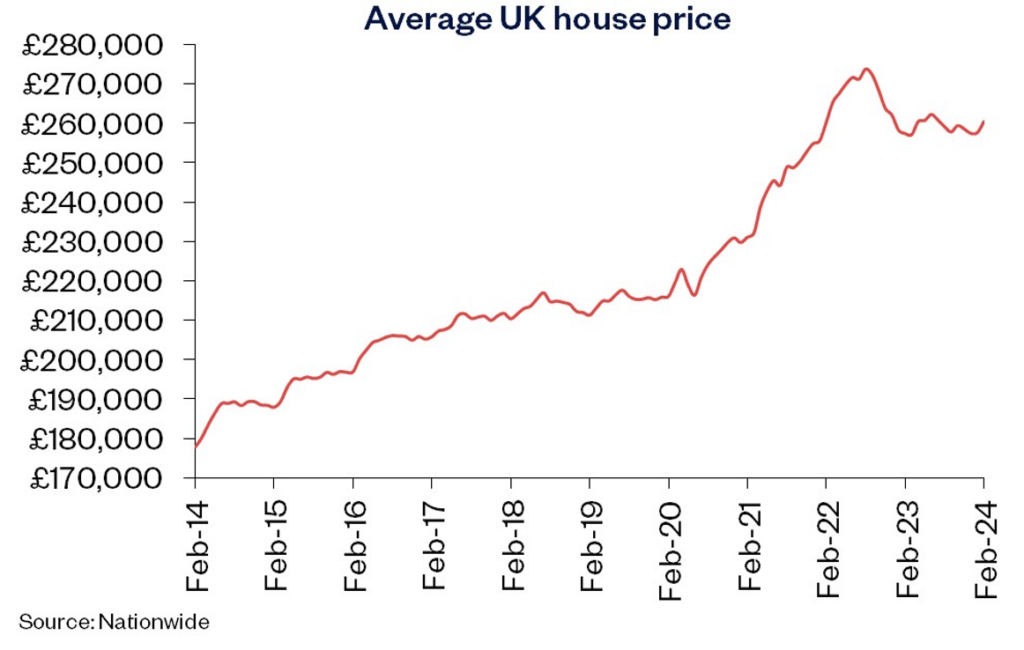
Meanwhile the UKs largest Building Society Nationwide (who have recently bought Virgin Money for £2.9bn) report that property prices have been rising, up 0.7% in February 2024. The average house price is now £260,420 up 1.2% over 12 months. This is in contrast to the figure that the Land Registry produce of £284,691 for December 2023.

As our office is currently based in SW20, the average price of all property in the area was £555,262 but for a detached house £1,604,983, or a semi at £884,485, a terraced house at £611,401 and a flat or maisonette at £390,792. You can search your location using the UK House Price Index here

On the other hand, reports from the Bank of England also show that mortgages in arrears (missed payments) now stands at around 13.2% of mortgages.

Comparing the last two quarters of 2023 (Q3 and Q4) isn’t really ‘fair’ as we all know that most house buying and selling is done in the summer months (Q3) not over the Michaelmas term. So in that context, the Bank reports that new mortgage commitments is down 21.2% comparing Q4 in 2023 with 2022. The value of advances is down 33.8%. In Q4 2022 £81.6bn of loans were agreed, a year later it is £54bn.

The number of First Time Buyers continues to decline, from 351,000 in 2019 to 287,000 in 2023. Affordability is the key phrase in lending these days and rising rates have evidently placed pressure on borrowers, stretching their mortgage over greater lengths to make the monthly repayments more ‘affordable’. I imagine most of us are familiar with a 25-year mortgage, but 1 in 5 (20%) first time buyers takes on a 35 year mortgage, double the number a year earlier.

“It was the same in our day”… no it was not.

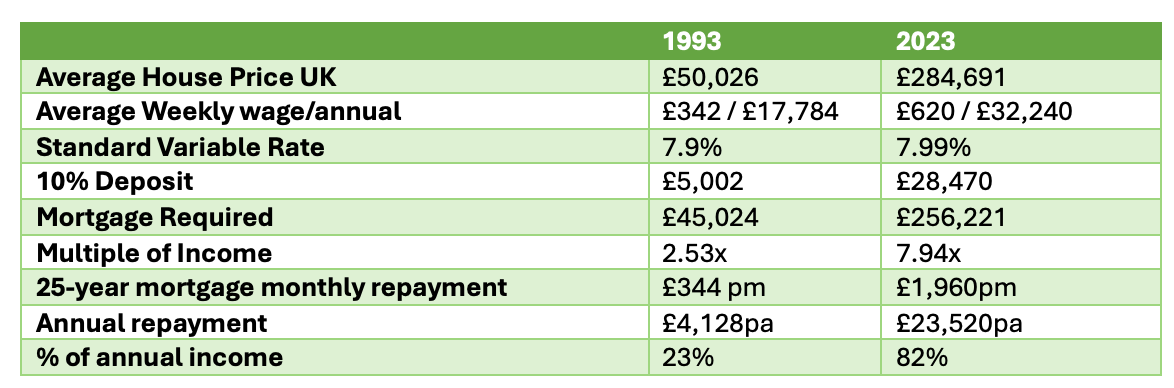
You will likely have heard or thought that everyone struggles at first with a mortgage and their finances. That’s true, but it’s worse for young people these days, much worse. Admittedly everyone is different, there are enormous regional variances, but if we go with averages for the UK, here are some facts that may convince you that buying a coffee and avocado on toast really isn’t the issue. The system is broken and it is deliberately set up to favour property owners here in the UK. Most law is based around the notion of property ownership.

As is evident from the above, clearly it is not possible for someone wanting the average mortgage with the average income to afford the monthly repayments on a 25 year loan, so lenders have responded by offering longer durations. This does not address the problem, it merely keeps the system going and keeps young people in debt until they are definitely not young! Of course better mortgage rates can be found (true in both periods) and of course property prices differ as noted in my local example of an average flat in Merton being more expensive than the average UK home.

If you factor in other costs that young people have which you and I did not have in 1993, it would include student loans and auto-enrolment pensions. The latter being a very good thing, the former being a State-wide fleecing (my opinion).

Yet, I suspect that you and I are likely to presume that these same young people will be happy to do all those jobs that keep civilized life ticking along, from emptying the bins, caring for the elderly and unwell to policing our streets and running the country. I imagine that they may not be quite so enthusiastic to keep doing the work and the paying of taxes to support it.

Remortgages, which you would think should be increasing as people shop around for better rates are actually in decline from 849,000 in 2021 to 538,000 in 2023. The table below makes me wonder why on earth people are not remortgaging. I do hope that it isn’t a sense of fear. To provide a reminder let’s consider mortgages and houses in December 1993. The average property price was £54,026 (Land Registry) and the standard variable mortgage rate was about 7.9%. The average salary in 1993 was £17,784  in December 2023 it was £32,240.

Perhaps your energy costs are starting to subside, if you have a mortgage or pay rent, I am sure you will have been aware of the increases in your monthly costs, at least if you have had to renegotiate terms. Variable rates are considerably higher than they were a few years ago. There is a fair chance your mortgage is with Lloyds, Nationwide, NatWest, Santander or Barclays who account for 64% of the entire mortgage market. The top nine lenders in 2022 (out of 79) affirm Pareto’s law of having 80% of the market from 20% of the players (or less).

Anyway, in terms of your financial planning, we don’t arrange mortgages, but advise you speak to Martin and his team at London Money (see our professional contacts page). You may be concerned about your children or grandchildren getting onto the property ladder or perhaps downsizing to release equity at some point. Please ensure that you keep us up to date with any changes in your thinking about how you intend to use property in relation to your planning.

Reference: Bank of England: Mortgage and Lender Administrators Statistics 2023 Q4 (LINK HERE)

Reference: UK Finance: Household Finance Review, latest data Q4 2023 (LINK HERE)

Reference: UK Land Registry: UK House Price Index (LINK HERE)

Mixed messages of mortgage market2025-01-28T10:04:23+00:00

The cautious investor

Dominic Thomas
Feb 2024  •  2 min read

The cautious investor

Rising interest rates that offer ‘certainty’ often appear a good solution for investors in an uncertain world. The thing about uncertainty of course is that it’s always present. You can remain holding cash in deposit accounts for years, trying to avoid market falls in the belief you are being prudent; sensible with your money. The uncomfortable truth is that we won’t know if you were right until many years down the road.

What we can do is look back at history and observe how missing out on returns impacted the valuation of portfolios, even if it was simply for a week or a month, the impact of sitting this one out can have (and has had) a substantial impact on portfolios. Second truth bomb – I have no idea when this might happen again. I don’t have a crystal ball to be able to predict such things.

I came across this neat little video by Dimensional (an excellent Investment Management firm with the unusual evidence-based approach whilst clutching a bunch of Nobel prize winners for their work in finance and economics). The data considers January 1997 until the end of 2021.

The key for investors, as it is in many aspects of life, is one of patience.

The cautious investor2024-02-23T09:27:47+00:00
Go to Top