

Dominic Thomas
Post written: Oct 2026 • Updated: Oct 2026
3 min read
Selling Your Business? Expect more tax
Politicians often claim to recognise the importance of entrepreneurs and business owners, who create the conditions for employment and jobs, thereby creating tax revenue for the Government (corporation tax, VAT, national insurance and income taxes) as well as moving people into work and potentially off benefits.
Unfortunately Mr Healy, the current Chancellor in his October 2026 Budget decided to take another bite out of business owners. When an owner sells their business they invariably do so for a reasonable lump sum, it’s not income and many business owners will often describe their business as their pension. So it becomes a lump that they then use to live off, with applicable taxes. When this ‘capital event’ occurs it triggers capital gains tax.
On 6 April 2008 the Labour Chancellor Alistair Darling introduced Entrepreneurs Relief, which enabled a business owner a lower rate (10%) of capital gains tax on the first £10m of the sale price of their business. It was a lifetime allowance, so not used again and again. He also standardised the flat rate of CGT of 18% for everyone at the same time. So in short there was a tax saving of 8%.
On 6 April 2010 a higher rate of CGT was introduced by Alistair Darling (28%). From 6 April 2016 the CGT rates were reduced from 18% and 28% to 10% and 20% by George Osborne. Invariably, the higher rate will apply to business owners selling a business.
Entrepreneurs Relief was quietly replaced by Boris Johnson’s Chancellor Rishi Sunak from 6 April 2020 with (only a bureaucrat could make up such a term) Business Asset Disposal Relief (BADR). This relief slashed the allowance from £10m to £1m. Today Mr Healy and a Labour Government reduced the allowance to £500,000 for any business sold after 6 April 2027, which means that there will be rather more tax paid.
I have a great deal of support for a complete overhaul of the tax system and everyone paying their ‘fair share’, however the small business owner selling their business for £2m or so and then the Government taking 28% of it doesn’t really seem like an incentivising solution. Don’t forget that once the money lands it will have to be spent (economic activity) or saved (taxed) to generate income (taxed). All that really happens is that it encourages business owners to seek a higher sale price and probably vote for someone else. If you have run a business prior to sale for say 30 years, it’s a bit like eight of them were working for HMRC.
What Healy has done is introduce a new allowance, The Founders Relief, which has a £10m allowance at 10% tax. To qualify, your turnover needs to be £10m and the business run for five years. If you think about it, on the whole, a business sale is often to a much larger company, who buy up smaller ones to obtain market size and scale, perhaps buying key clients in the process. Often those brilliant ideas, often funded within an EIS, VCT, or SEIS are bought by the likes of Google or Meta. In short, it merely compounds the concentration of wealth and its production in the hands of larger businesses.
It is said that “everyone has their price” but I don’t believe that, for good reason. I have met with many business owners who want to ensure their business and reputation continues, serving their clients well, requiring a “cultural fit” as part of the sale process. Understandably, because they have likely poured heart and soul into establishing and running it at significant personal cost. Not everyone, I am sure, but certainly a significant proportion.
Political policy reveals intentions and understanding (or lack of). Over the last two decades, right up to the present day, it was only Labour Chancellor Alistair Darling that made any actual policy to support businesses. Everyone else has simply made it harder. Healy has not addressed the big issues of our time, the climate crisis and gross wealth inequality. Other than removing the overly complex proposal to change Cash ISA rules, he has merely papered over the cracks, without addressing any of the systemic problems, which will, sadly make them rather worse.
Your estate will almost certainly pay rather more inheritance tax from April 2027, your tax allowances remain frozen. The tax loopholes are largely addressed purely by digitalisation and ever greater surveillance of your life, whilst the most wealthy (billionaires) can still evade UK taxes, with offshore Trusts, crypto currency and can fund political agendas with the intention of extracting wealth from the UK.
It’s worth noting that the £10m allowance in 2008 would today be £17,011,706 if it had tracked inflation until September 2026. The personal allowance in 2008/09 was £6,035 and rose under the LibDem/Conservative Government to £10,600 prior to Brexit. It has been frozen at £12,570 since 2021/22 and if inflation linked would be £14,888. So the odd ‘gift’ of £100 really doesn’t change anything.
UK income tax personal allowance by tax year, 2008/09 to 2026/27
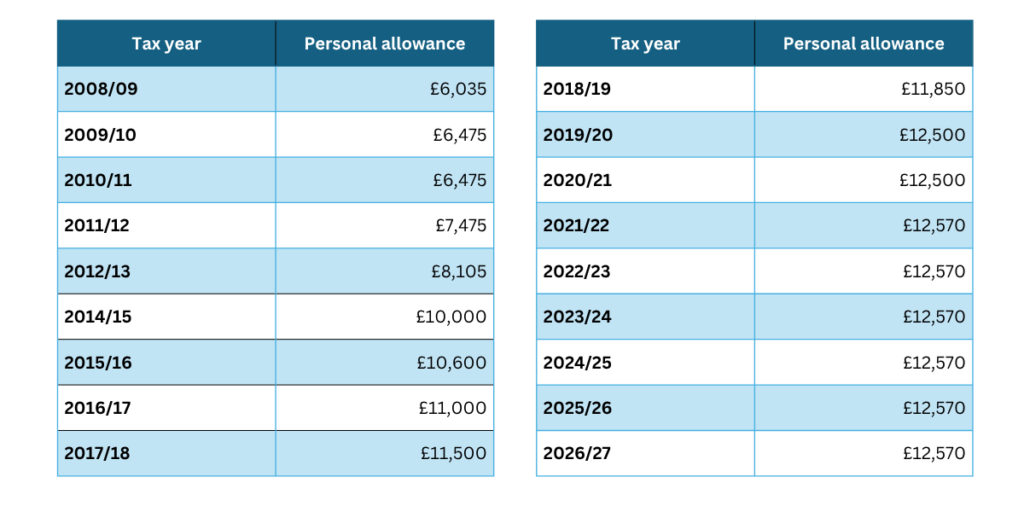
(Source: https://www.gov.uk/government/statistics/income-tax-personal-allowances-and-reliefs)
As a reminder, the personal allowance is expected to remain frozen until 2030/2031. It is the income you can earn without any tax being applied. It is available to everyone, unless you earn over £100,000 when it is reduced by £1 for every £2 of income. So someone earning £125,140 will not have any personal allowance and this slice of income (£100,000 – £125,140) has a mathematical tax rate of 60%. It was introduced by Alistair Darling from 06/04/2010 to help with the credit crisis. It hasn’t been removed. Had the £100,000 threshold tracked inflation, today it would start at £161,195.
Of course, you may disagree – I often change my own mind and opinions in light of evidence, or see a different perspective. Healy began his Budget with a nod to the Bond market, acknowledging his additional interest payments of £14bn this year alone, so everything said afterwards wouldn’t rock the markets. Economics is meant to serve society not the other way around. When your costs increase due to inflation, but your tax allowances do not, you pay even more.
References:
Institute of Fiscal Studies: https://ifs.org.uk/articles/unfreezing-personal-allowance