
Business Owners and EIS

Business Owners and EIS

This item is aimed at business owners and how an EIS might be of use.

Many business owners are growing increasingly frustrated about the tax associated with extracting profit from their companies. Often referred to as “double taxation”, a company owner must first face corporation tax on profits made by their business and again when they decide to pay themselves a dividend/salary. It can at times, feel like you are working for HMRC.

An Enterprise Investment Scheme (EIS) can be used to extract profit from a business tax efficiently. EIS was introduced by the UK Government in 1994 in order to induce investment into UK smaller companies. In order to make investing in smaller companies more attractive, compensating the additional risks, there are a number of tax reliefs available through EIS investments (providing you hold your investment for at least three years).

Income Tax Relief CGT deferral IHT relief
Reduction in income tax liabilities amounting to 30% of the total investment Facility to defer paying CGT on all, or part, of a chargeable gain by investing the gain into EIS qualifying shares EIS companies qualify for Business Property Relief (BPR)
Relief can be applied to the current or previous tax year Investors can defer CGT by using EIS up to 12 months before crystallising gains or up to 36 months afterwards As long as shares have been held for 2 of the last 5 years and are held at time of death and remain BPR qualifying, the value of the EIS investment will count as part of your estate but will have a nil value for IHT purposes
The maximum amount of income tax that can be claimed is £300,000 for the current tax year and £300,000 for the previous tax year
Relief cannot exceed the amount which reduces an investor’s income tax liability to nil

Business Owner – Double Tax

Mr Williams, normally a higher rate tax payer, owns a small business. He pays himself a £10,600 salary per year in order to stay within his personal allowance; no income tax is paid on this amount. In addition to this salary he pays himself a dividend each year which attracts an income tax liability. However, he is still frustrated with the amount of tax paid on the dividends.

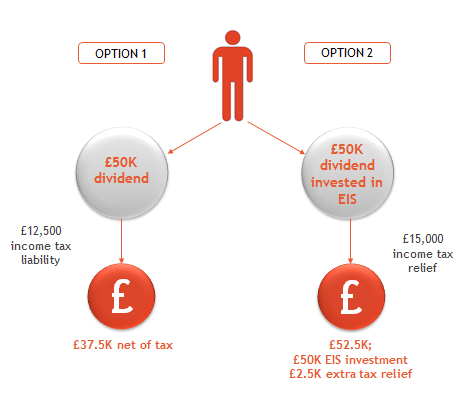
If Mr Williams pays himself a £50,000 dividend, he will owe 25% (£12,500) in income tax on this (once we take the tax credits into account). This will leave him with £37,500 of net funds in his account after paying the tax.

If Mr Williams invested £50,000 into an EIS, he will be entitled to 30% income tax relief (£15,000). This tax rebate can be used to wipe out the £12,500 due on the dividend. It also leaves him with an extra £2,500 of income tax relief to set against other income tax he has paid across the current and/or previous tax year.

He is left with a £50,000 EIS investment, which he can liquidate once he has held the investment for three years. Providing the EIS investment has, at least, preserved its value Mr Williams has saved £15,000 in tax as a result of this investment.

Any growth within his EIS investment is tax free, as per the EIS rules.

My example, implies that Mr Williams has adequate resources elsewhere, so that he can invest £50,000 rather than it being needed for income. The word or note of caution, is that an EIS is obviously an investment and at the higher end of the risk spectrum (though running your own business obviously carries risk). Whilst investing in smaller companies often involves higher levels of risk and worse levels of liquidity, many investment companies offer EIS investments that target capital preservation. These investments involve companies with long-term, index-linked and stable cash flows.

Want to know more? – get in touch.

Dominic Thomas
Solomons IFA

You can read more articles about Pensions, Wealth Management, Retirement, Investments, Financial Planning and Estate Planning on my blog which gets updated every week. If you would like to talk to me about your personal wealth planning and how we can make you stay wealthier for longer then please get in touch by calling 08000 736 273 or email [email protected]

Business Owners and EIS2025-01-27T16:09:47+00:00

Auto Enrolment – the rising tide

Auto Enrolment – the rising tide

Auto enrolment pretty much effects everyone that isn’t yet retired. In a nutshell, having faffed around with pensions for the last 30 years the Government are now forcing employers to offer pensions to their staff. Employers will be required to contribute 3% of salary… employees 5%.

It’s true that this is not a compulsory pension. Employees can opt out. Employers cannot. There are hefty daily fines for those that fail to meet the deadline to implement their new, qualifying staff pension. Everyone has to comply…. not doing so isn’t an option.

All the UKs biggest businesses have now set up their auto enrolment pensions (also called workplace pensions…. helpful eh?). Just pause to think what an administrative nightmare this is… staff coming and going on a daily basis, all needing to comply else suffer fines. What a headache… thankfully technology will reduce the headache, but action still needs to be taken.

Now small and medium-sized firms are gradually reaching their “staging date” (start date) and there will be a massive number of them. Few realise that there are implications for contracts of employment and of course operating costs. However the biggest issue is technology as all staff need to have a working email address… presumably a work email address is easiest to monitor and demonstrate that information has been sent by the employer.

Pain Relief

Most financial advisers and Accountants aren’t getting too involved in auto enrolment. Frankly because the work can be expensive and small firms don’t want that. So we have found a solution – a bit of really good IT. Its called AE in a Box. It isn’t a pension. It’s a project management tool that ensures that you are compliant with the rules, makes it easy to set up a scheme and communicate with your staff.

If you are an employer (even if you run a Limited company with only one other Director or member of staff) you have to comply. So check out the very easy to use tool. It is a monthly license subscription (and you will need the ongoing support) as even those that opt out of your pension, will need to be opted back in every 3 years… the Government hope that inertia will ensure more people join pensions and thus build up their own resources, rather than relying solely on the State Pension… which is already over-stretched.

Are you an Employee?

Do your boss a favour, point them to our tool and earn some brownie points. I promise you that auto enrolment is a headache and leaving it until thousands of employers are trying to do the same thing at the same time will end in tears…. and fines. As an employer myself, I really value people who bring me solutions not problems.

Are you an Accountant?

The tool enables Accountants to assist in the process, providing and checking data. This will make your life much easier on so many levels when dealing with your small firm clients.

Click this link to get more information, its low-cost with a single sign up fee. The monthly fee isn’t taken until 6 months before your scheduled staging date. But whatever you do, now is the time to take action.

Dominic Thomas
Solomons IFA

You can read more articles about Pensions, Wealth Management, Retirement, Investments, Financial Planning and Estate Planning on my blog which gets updated every week. If you would like to talk to me about your personal wealth planning and how we can make you stay wealthier for longer then please get in touch by calling 08000 736 273 or email [email protected]

Auto Enrolment – the rising tide2025-01-27T17:03:19+00:00

Office Envy? 24 of the best offices

Office envy? 24 of the best offices

I came across this and thought that those of you that work in an office might be interested. It was put together by an insurance company (Unum) who specialise in protection and staff benefits.  I loathe dull offices and have always wondered why, given that so many people have to spend so many hours in them, so few are designed with any sense of creativity.


Dominic Thomas
Solomons IFA

You can read more articles about Pensions, Wealth Management, Retirement, Investments, Financial Planning and Estate Planning on my blog which gets updated every week. If you would like to talk to me about your personal wealth planning and how we can make you stay wealthier for longer then please get in touch by calling 08000 736 273 or email [email protected]

Office Envy? 24 of the best offices2023-12-01T12:20:02+00:00

Is your website useful?

Is your website useful?

Sometimes when you land on a web page, it is hard to navigate or recognise what is important. That’s why many website owners focus their minds on web design – making sure that people are attracted to their website and can use it with ease.

However, the design is not the only issue that makes people have a good experience with a website. Indeed, there are several “user experience” issues that affect us subconsciously when we land on a web page. One of these, for instance, is the amount of material. When there is little information on a web page, we tend to have a reduced sense of trust with the information the page does carry.

Human beings “weigh by the pound” and when we see a web page that has loads of information, we trust it more. That is part of our experience of a web page. As users we want to trust what we are faced with, so subconsciously we assess the volume of information and it if is large, we rate our experience of that page as more positive.

There are plenty of other issues relating to our user experience of web pages that operate at a subconscious level. Now, though, researchers in technology user experience have provided a clue as to what makes us like some web pages more than others.

Tips for business owners - Graham Jones, the internet psychologist with tips for business owners with an online offering

Warning: It has nothing to do with design..!

The researchers from Tampere University in Finland found in their study that the most influential aspect of user experience was whether or not the technology was useful to the individual. It appears that usefulness overrides other considerations. It suggests that we persist with any minor niggles of using the technology, as long as we find it useful.

Facebook, for instance, is notorious for its technological issues. You can’t design things the way you want. You can’t really control groups and pages with any real degree of flexibility. Nor can you make changes to certain things because of the way Facebook works. Yet in spite of its technological issues (and there are plenty of them) more than a billion people are happy to use the site most days of the week because they find it extremely useful. The significant degree to which we find Facebook useful overcomes the technological issues.

So when people visit your website are they faced with technological issues, such as poor navigation, or are the met with wonderful, prize-winning design? Either way there could be a “user experience” issue for you.

If your navigation is naff, then people will have a negative experience. Equally, though, if your design is fantastic, but your site is of little use to people, then that too is a user experience issue. Their experience of your website is negative.

If you want more visitors, more business and more profits, you need to ensure your website is of practical use to people.

Graham Jones

http://www.grahamjones.co.uk/

You can read more articles about Pensions, Wealth Management, Retirement, Investments, Financial Planning and Estate Planning on my blog which gets updated every week. If you would like to talk to me about your personal wealth planning and how we can make you stay wealthier for longer then please get in touch by calling 08000 736 273 or email [email protected]

Is your website useful?2023-12-01T12:20:05+00:00

How Was Your Last Quarter?

Solomons-financial-advisor-wimbledon-blogger

How Was Your Last Quarter?JOBSposter

You may have seen the news that the Apple corporation have just posted the largest profits for Q4 in history. Apple is an enormous company, worth around $640 billion. At the end of 2013 Apple had a market capitalisation value (the value of the company based on the price of issued shares) of £302 billion…which at the time was about 2.2% of the total US market (£13,304 billion)… or to put it another way 14.6% of the UK market (then worth £2,057 billion)…. to give this some context the market capitalisation of Greece was £20 billion…. so back in 2013 Apple was worth 15 times more than Greece.

The results of Apple for the last quarter of 2014 saw profit of £11.8 billion. That’s profit. So one has to ask, what does Apple do that others don’t either as corporations or nations?…. and hence the obsession that many have with Steve Jobs. Much of the profit was due to the sales of the iphone – all 74.5million of them sold in the last quarter!… good to feel unique eh?

Many businesses will look at Apple with considerable envy, the more thoughtful will reflect on what they do to create such loyal customers…. perhaps a few lessons for the politicians too.

Dominic Thomas

How Was Your Last Quarter?2025-01-23T13:50:17+00:00
Go to Top