
Tracker/Index funds

Sam Harris
May 2025  •  2 min read

Tracker/Index funds

You may have heard the terms ‘Tracker’ and ‘Index’ thrown around when we talk about investments or your portfolio, but what do these terms mean and what are the key features?

Simply put, a tracker portfolio aims to mimic the performance of global markets. This is typically done through index funds. An index in the context of stock markets is essentially just a list of companies. Though, there are often certain criteria a company must satisfy in order to be included, such as market capitalisation (the value of the company).

I’m sure you’re already familiar with well-known indices such as the FTSE 100, which is an index made up of the 100 largest British publicly traded companies. Or even the S&P 500 which is comprised of the 500 largest American companies. These funds ‘track’ the UK stock market and the American stock markets respectively.

Index tracking funds come with the added benefit of generally being less expensive than most alternatives. This is due to the passive nature of this type of investment, these funds are simply trying to replicate an index so most of the hard work has already been done by another organisation. For example, Vanguard might offer an equity fund which tracks the FTSE 100 index, however the index itself is calculated and maintained by FTSE Russell.

The Tracker portfolios we use at Solomon’s are prime examples of utilising index funds to ensure investments are well diversified. Meaning, that the markets which are performing well help mitigate losses from markets which are struggling. Conversely, this could also be seen as underperforming markets eating into the gains of strong markets. Though ultimately, diversification is a strategy used to reduce risk, rather than to increase returns. The aim is not to beat the global markets, but rather to match them.

Tracker/Index funds2025-05-27T10:47:03+01:00

Sanctions, sanity and sanctuary

Dominic Thomas
April 2025  •  5 min read

Sanctions, sanity and sanctuary

You are old enough to know that the world is fairly mad. Nations are often run by fairly despicable people, sometimes elected into power, sometimes they simply take it. At some point in life (for some this might be their entire lifetime) an opinion is formed about ‘others’ who are used as the excuse for many ills and failures. The truth is a victim of agenda and despite the cold epitaphs of November Remembrance services, nothing is really learned other than to repackage misery.

We take it as a sad reflection of “man’s inhumanity to man” that some people don’t and won’t get on, invariably due to holding a different opinion about religion or politics or both. In a capitalist world, withholding money and trade (or making it harder for both) is a way of attempting to coerce a required behaviour. This may have worked in the 1980s with sanctions imposed against South Africa; whether it has worked elsewhere is debatable. Yet it remains a rather obvious tool.

Idealists (which I am prone to myself at times) may well argue that the power of withholding custom or money from some companies may help nudge them towards better behaviour. Trying is arguably better than doing nothing.

In the investment world, screening out companies (or even countries) is not without its challenges. One man’s freedom fighter is another man’s terrorist. Perspective and narrative are up for grabs and twisted to suit.

The war in Palestine, which is horrendous, poses challenges. For some to criticise Israeli politics is to be antisemitic, which is, in my opinion, utterly daft. Anyone who has paid attention to history, knows the misery and horrors inflicted upon Jews for centuries, particularly in the last World War with the holocaust. It is more than understandable that Jewish people would wish to defend themselves. However, any reasonable person, would not consider the atrocities in Gaza anything remotely reasonable but rather more ironically fascistic.

When Government fails to address a problem, individuals are left to find ways that they might express their concern, and investors reduce or completely withdraw from particular sectors or countries. We are all investors; most people simply don’t know how things really work. If you have a final salary pension (lucky you!) then you may not be aware that money doesn’t simply appear, it is the consequence of investment in property, debt and shares in companies. You do not get to select the investment and given the size of the scheme and pressure on it to provide a guaranteed income for your lifetime and your spouse’s, there isn’t really that much invested into shares due to the need for predictable income and an inflation linked one at that.

Some protest groups have taken to highlighting “investment into Israel” or ammunitions and defence companies that supply Israel (amongst many others). They call for a ban on such holdings as an attempt to influence the behaviour of the companies and Governments concerned. I have sympathy with the sentiment, but as a member of such a scheme you don’t get to choose how and what the pension is invested in and it is enormous. The Local Government Pension for England and Wales for example stood at £354,047,000,000 (£354billion) at the end of 2023. This is a scheme where more is paid out (in pensions) than paid in (contributions by employed members). Roughly 51% of the LGPS is invested in shares. Interesting (for me) the investment costs for 22/23 were £1,726,500,000 which is about 0.4876% of the portfolio (so your portfolio – if arranged by us – gets lower investment costs than the massive pension schemes).

In 2022/23 there were 6.49million members of the LGPS, up from the previous year by 0.1million. Active members (people employed and contributing) amounted to 2.09m (32%); deferred members (former employees not yet taking their pension) 2.39m (37%) and 2.0m people (31%) drawing a pension. To say getting this balance right is difficult would be an understatement.

So, to exclusion … well one article I saw claimed that “81 local government pension funds have known complicit investments” and that £12,214,286,216 was the sum involved. Don’t forget that the value will fluctuate wildly each day (they are shares). These include Amazon and Google, I’m going to guess that you use these services so would be deemed complicit too. If I may infer that roughly half of the LGPS is invested in shares (£180bn or so) then the focus (£12.2bn) is on about 6% of the shares held (by value) – or 3% of the total value of the LGPS.

I’m not going to pretend that this is an easy problem and telling the Board of LGPS to divest itself of £12bn into other shares is either a wise, good or bad thing. Will it make any difference? Is 3% of something an issue that normally causes you distress and guilt? How much of your tax is spent on things you don’t agree with or approve of? Do you write to your MP about it?

£12bn is a lot of money, it should be enough to make most of us stop and think, but when presented as 3% – does that alter your perspective?

Sadly, the world is a chaotic, messy and often nasty place. My privileges of living here in the UK (amongst many others) are not lost on me. I don’t have the answers for the crisis, which is both decades and centuries long. Flexing an economic muscle has its appeal, but quite how much this particular issue is of significance I am afraid that I’m unable to say.

Members of final salary (Defined Benefit) pensions are not able to select funds, but of course are able to lobby the Board about their concerns. For those of you with an investment-based pension, we can discuss screening policy at any time.

If you are seeking a personal opinion, then I would say that lobbying is a good approach to the problem, but it isn’t an easy or straightforward process. Arguably, UK Government (or broader) sanctions might have more of an impact.  Demonstrated by the fact that Mr Musk’s remarks and gestures have not gone unnoticed and have resulted in a dramatic change in Tesla’s valuation.

References:

Sanctions, sanity and sanctuary2025-04-08T11:14:04+01:00

Market turbulence

Dominic Thomas
March 2025  •  3 min read

Market turbulence

If you have followed the news, you will appreciate that global stock markets have been falling sharply over recent weeks. This is in response to the wave of changes and abandonment of normal policy by the new, rather insane US Government.

Your portfolio will have fallen. It will recover, the question is really how much worse will things get and how long before they recover. To which the answer is, “I don’t know” and nobody knows.

I would remind you that we have seen significant falls in market values every year (on average -15% every year at some point), it’s simply that some years you and the media pay more attention.

You can view your portfolio in our secure portal or on the platform portal that we are using for you, typically Fundment, Nucleus, Parmenion or Transact.  However I would caution against doing so regularly as this will merely increase your anxiety, which isn’t good for your health or your financial plan.

Many of us realised that Trump was not someone to be trusted, based on his actions over many years, but despite his very odd decades-long special relationship with Putin, it seems that there are still swathes of Americans who are unable to discern this (even if it smacked them around the face with a kipper). Denial and distortion of facts and reality are in evident supply, unlike truth and justice.

In terms of helpful and reassuring information and our approach to evidence-based investing, JP Morgan produce data about the worst declines in valuation during each calendar year.  Admittedly, this is the FTSE All-Share not the global market, but the principles are exactly the same. It’s a chart that you would have seen before in our client magazine Spotlight.

The chart shows the grey bars as the final return for the calendar year since 1986. It shows that of the 39 completed years, 27 (70%) were positive, 12 (30%) were negative. That means that roughly one year in four is negative. The red dots indicate the worst or deepest decline in each of those years. Every year has a ‘crash’. The average drop is 15% and the median (the middle value when all lined up in order) drop is 12%.

This knowledge hopefully provides some comfort about the reality of ‘drops’ each year, but the message is really – don’t panic, stay in your seat. Admittedly you could say “sell it, get me out” but this will actually realise a loss (make it real rather than notional) and it is unlikely that you will re-invest at a point that is any more favourable, if you do that’s probably luck rather than skill.

We have built your financial plan making allowance for these scenarios. Investments do not grow in straight neat lines; they are erratic.  The greater the proportion you hold in equities (shares), the more volatile, but also the greater the reward over time. Your plan is designed for your entire lifetime and beyond.

As of now (March 17th 2025), the global equity market is down -3.75% since the start of 2025. Global Bonds are up +0.85% and a 50/50 portfolio is down -1.73%. The numbers in pounds will look considerably worse than this, they always do because you relate to pounds in terms of your income and spending rather than your capital, but it is healthier to consider it in percentage terms. The chart below shows the Year to Date (YTD) figures for Timeline Tracker 100 (green) 50 (yellow) 0 (red).

Looking at a longer term perspective helps provide some context.

None of us like to see portfolios hit heavily, it is unnerving. As I have said, this is currently down to the politics of the US Government, with proposed tariffs and appointing billionaires to act as parodies of Bond villains providing ‘advice’ to the White House. Personally, I hope that he is removed from office as soon as possible, but it is also clear that the Vice President is perhaps even worse, possessing very little understanding of how the world works.

Generally in life we tend to assume that wisdom is correlated with age. At the age of 78 I find no evidence that Trump possesses any. Mr Vance at age 40 certainly hasn’t acquired any yet.

Market turbulence2025-03-20T16:51:04+00:00

WONDERVISION

TODAY’S BLOG

WONDERVISION

Its not a typo, I am well aware that the latest Marvel series is WandaVision, which far from being about superpower, is all about the very real human feelings of grief and loss. So no, today I am not talking about that.

This morning (too late?) ok, so tomorrow morning when you wake up, I’d like you to think about how many companies have been involved in your morning routine. Let’s face it, morning routines have been fairly routine for months now, so this may require very little effort as many of us are on autopilot.

RISE AND OBSERVE

To the matter at hand. I am going to assume that you are waking in your bed, with a pillow in your own room. Can you remember where you bought these from? Or who made them? How about your bedside table, lamp, clock, book (and pen?) what about your nightwear, sheets, carpet? How much “stuff” can you observe that you have bought before you have even put a foot into your slippers or directly onto the floor? A surprising number already I imagine. Where is your smartphone at this point? Do you have lots of applications running?

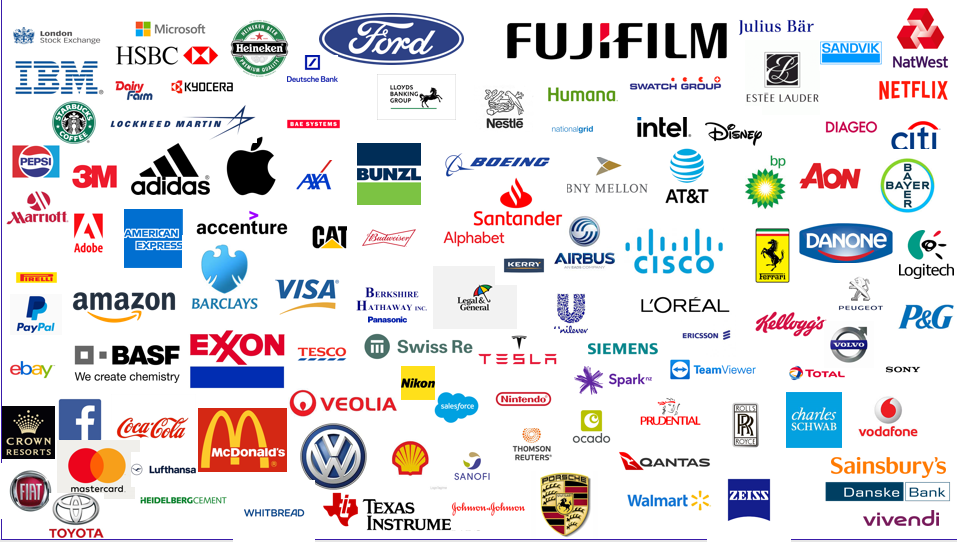
The image below is one that I have been using recently, but it is very flawed, there are about 100 companies shown here, there are about 1600-1800 in the global equity part of your portfolio. So that’s about 5% of the list. Note the size and position of each logo means absolutely NOTHING.
SOLOMONS IFA - INVESTING 1800

X-RAY VISION

Now for the superpower, imagine that you have x-ray vision. You can see all the components of all the objects around you, the springs and stuffing in your bed, the wires and plumbing, the bricks, plaster, cement, the metal window locks, the PVC, glass, the screws, nuts and bolts. How about all those automatic things that are also supporting this modest existence of yours? The utility company, your broadband provider, your insurance policies, water supplier, your bank accounts and so on. A vast number right? So many you probably gave up or did not attempt to count.

Most of those products and services are provided by companies found listed on the world stock markets. They are also in your portfolio, no matter how big or small it may be. They are there. This is investing. Deploying your money to back businesses that we all use, many of which we do not even realise. Even with the huge rise in technology where you will be using software on hardware that perhaps you are so familiar with it does not even register until its replaced, upgraded or fails…much like (exactly like) all the things you have just observed.

You own a part of all of this. A small part, but your money is backing those companies to improve what they do. We all know that the future will be different, and some businesses will need to adapt to the changes or fail, but new ones will emerge for things that none of us can imagine clearly (if you can, please get backing (money) to make it).

This is what your investments do.

Should you wish to see the mini-series WandaVision about Wanda and Vision, it can be found on the Disney channel, another holding in your portfolio.

Dominic Thomas
Solomons IFA

You can read more articles about Pensions, Wealth Management, Retirement, Investments, Financial Planning and Estate Planning on my blog which gets updated every week. If you would like to talk to me about your personal wealth planning and how we can make you stay wealthier for longer then please get in touch by calling 08000 736 273 or email info@solomonsifa.co.uk

GET IN TOUCH

Solomon’s Independent Financial Advisers
The Old Mill Cobham Park Road, COBHAM Surrey, KT11 3NE

Email – info@solomonsifa.co.uk 
Call – 020 8542 8084

7 QUESTIONS, NO WAFFLE

Are we a good fit for you?

GET IN TOUCH

Solomon’s Independent Financial Advisers
The Old Mill Cobham Park Road, COBHAM Surrey, KT11 3NE

Email – info@solomonsifa.co.uk    Call – 020 8542 8084

7 QUESTIONS, NO WAFFLE

Are we a good fit for you?

WONDERVISION2023-12-01T12:13:09+00:00

2015 has been a bad year…. for investors too

2015 has been a bad year… for investors too

It has not been a good year for investors, frankly it has not been a good year for lots of people – we are all aware of the disasters and atrocities that have occurred around the world. So as you review your investments which have not performed as anyone would have hoped, a sense of perspective is probably wise.

The problem with stock market or traditional investing is that we see good years a bad years. 2015 has been a bad year, with the FTSE100 opening the year at 6,556 rising to a high in April of 7,103 (up 8.3%) but currently lagging at around 6,050 (down 7.7% over the year to date).

It is natural to feel annoyed and fed up, particularly as it is easy to get the impression that somewhere, somehow others are doing better. The truth is perhaps rather different. A fall of 7.7% is what the market provided via the FTSE100 (the UKs 100 largest companies). To have a smaller fall (or even a gain) you would have had to take more investment risk (essentially attempting to beat the market return based on belief, information or frankly luck). The market return is literally the market average return. This assumes that you were invested at the start of the year. If you invested towards the end of April your “loss” would be worse.

Realisation about Loss

However what is a loss? In essence a loss is only realised when you sell your investment for less than the price you paid for it, which might happen due to changing circumstances, but should not happen within a financial plan.

Part of my role is to help clients minimise their mistakes. One would be to sell at the bottom – to panic and “get out” once markets have fallen (this would be called “realising a loss” – ie making it real). It is tempting to do so, but unwise unless your circumstances have genuinely changed.

Risk and Diversification

However all portfolios are diversified across a range of assets, so you aren’t purely in the FTSE100. Portfolios have a global nature and hold cash, commodities and Bonds. The mix (asset allocation) is the important tool we use to devise a suitable portfolio for you, given your ability to cope with investment risk and also have a context (your financial plan) for your money. This is what we call diversification of risk, but might be better understood as “not holding all your eggs in one basket”.

Yes, the year has been poor for investors, but do not be tempted to seek higher returns, and yes even cash with its dreadful returns was a better option in hindsight. The returns will “feel” and appear worse as statements at 5th April would have exposed the comparative high point in the year. However in the long-term investing rewards those that stick with the plan. There is ample and readily available evidence for this.

Noisy “genuises”

Be mindful that most people will never (or very rarely) talk about their investment losses, but invariably shout from the rooftops about their investment successes. The truth is rather different and much better hidden. This applies to private investors and professionals alike.

Tomorrow I will highlight another mistake that you can avoid and frankly, one that you need to encourage anyone you know to read the piece.

Dominic Thomas
Solomons IFA

You can read more articles about Pensions, Wealth Management, Retirement, Investments, Financial Planning and Estate Planning on my blog which gets updated every week. If you would like to talk to me about your personal wealth planning and how we can make you stay wealthier for longer then please get in touch by calling 08000 736 273 or email info@solomonsifa.co.uk

2015 has been a bad year…. for investors too2025-01-27T16:38:38+00:00
Go to Top